
Fixed mortgage rates surge across all four major banks, how many years should investors refix for?
Last Thursday, the 21, ANZ suddenly raised all its fixed mortgage rates sharply, by 45 basis points, with its one-year rate rising from 2.79% p.a. to 3.24% p.a. Early the following morning, Friday the 22, the other three major banks also raised their fixed mortgage rates across all terms,
Last Friday, the much-anticipated public seminar on medium-density housing planning policy, organised by the New Zealand Chinese Building Industry Association (NZCBIA), went ahead as scheduled. The webinar examined, discussed and interpreted the Housing Supply Bill, new housing construction legislation jointly proposed the previous week by the Labour Government and the National Party.
Last Thursday, the 21, ANZ suddenly raised all its fixed mortgage rates sharply, by 45 basis points, with its one-year rate rising from 2.79% p.a. to 3.24% p.a. Early the following morning, Friday the 22, the other three major banks also raised their fixed mortgage rates across all terms. Taking one-year rates as an example, ASB raised its rate by 26 basis points, from 2.99% p.a. to 3.25% p.a.; BNZ raised its rate by 25 basis points, from 2.99% p.a. to 3.24%; and Westpac raised its rate by 20 basis points, from 2.99% p.a. to 3.19% p.a. Many mortgage brokers exclaimed that New Zealand mortgage rates had well and truly left the “2.0 era” behind! See the chart below for the specific exchange rates.
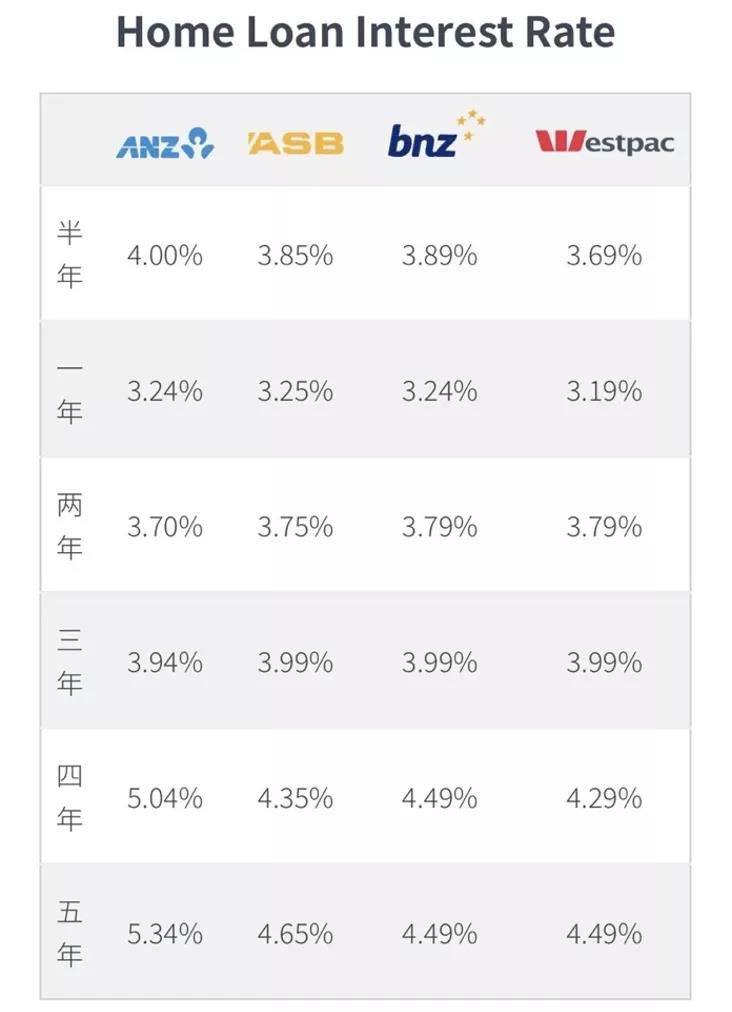
10: major banks’ updated fixed mortgage rates as at the 22 (source: online)
Is the pace of these increases making many investors uneasy? Remember, these major banks had raised their fixed mortgage rates only a week earlier! The news set social media alight. Commenters said: “The Reserve Bank of New Zealand only raised the Official Cash Rate (OCR) on 6 October, and these major banks already cannot hold back? They have raised mortgage rates several times in a row!” “Previously, it took more than a year for one-year rates to fall from around 4% p.a. to around 2% p.a., but now they have risen from 2.14% p.a. to 3.24% p.a. in just four months!” “How are we supposed to get by with mortgage rates rising like this? House prices, CPI, vegetable prices — what living cost is not going up?!”
Will mortgage rates rise or fall? Earlier this year, there was no clear answer, but the situation has now changed. Economists predict that rate rises will continue into next year. They believe the Reserve Bank’s ultimate aim is to bring the OCR to between 1.5% and 2% within 12 months, and perhaps higher in 2023. This means homeowners need to hurry to refix their mortgage rates! A quiet tip from YIJU: check when your current fixed term expires. You can lock in a new rate up to two months in advance!
That raises another question. When homeowners choose a fixed rate for a new mortgage or refix an existing one, should they choose the lowest one-year rate, or fix for two, three or even more years? Making the right — or wrong — decision could mean paying thousands of New Zealand dollars less — or more — on a mortgage. As it happens, someone did these calculations a few months ago, when interest rates were at their lowest:
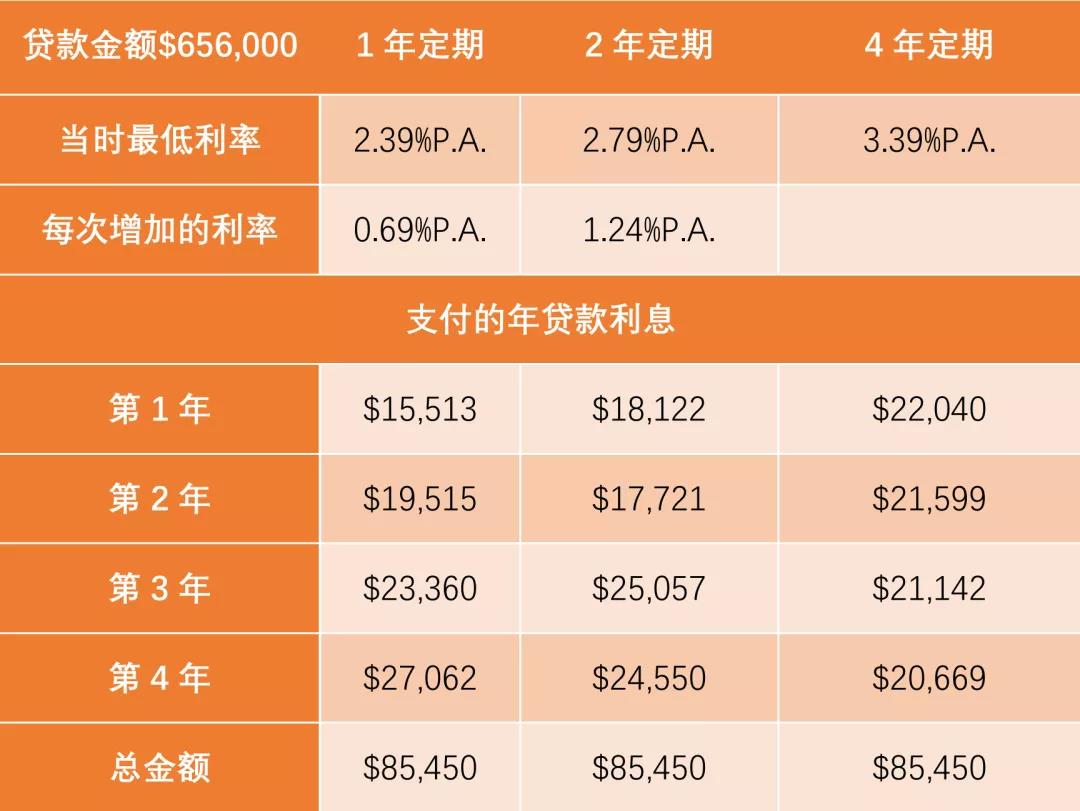
1, 2 and 4-year fixed mortgage rate comparison
Note: The loan amount above is based on 80% of the national median house price of NZ$820,000 in REINZ’s June 2021 residential property statistics report. The current lowest 1-year, 2-year and 4-year fixed rates are based on owner-occupier loans available at 80% LVR in Canstar’s database. Interest costs assume that the 1-year and 2-year loans are refixed at a new rate at the end of each term, with rates increasing as shown and a total loan term of 30 years. Data source: Newsroom Pro. Source: www.canstar.co.nz
According to Canstar’s data, for a New Zealand home at the median price — NZ$820,000 in June, according to the Real Estate Institute — with an 80% LVR loan over 30 years, fixing for four years rather than one would mean paying approximately NZ$6500 more in interest over the first 12 months (NZ$22040 minus NZ$15513).
But notice how these figures reverse as interest rates rise.
If our homeowners’ mortgage rate rises by 0.69% each year for 4 years, in year 4 they will pay approximately NZ$6,400 more than homeowners who fixed for 4 years (NZ$27,062 minus NZ$20,669).
This is what Canstar calls the “break-even point”: the annual rate increase at which homeowners pay the same amount of interest over four years, whether they fix once or refix four times.
For a two-year fixed term, the increase would be 1.24% each time. Of course, these assumptions produce results under particular conditions. In theory, however, if mortgage rates rise by less than 0.69% annually, our homeowners would be better off fixing each year; if the increase is greater, they would be better off choosing a four-year fixed mortgage.
Canstar NZ general manager Jose George said that, given this analysis, mortgage holders could make a decision based on where they thought interest rates were heading.
Next, let us look at what New Zealand’s economists have to say:
Kiwibank chief economic adviser Jarrod Kerr said choosing a fixed mortgage rate was not an enjoyable decision. “Earlier this year, mortgage rates were low, but there were indications that the Official Cash Rate would rise, so I locked in longer-term rates in month 4/May.” Kerr describes himself as an economic data nerd. He usually splits his mortgage into portions fixed for different terms ranging from one to five years, but earlier this year he shifted more of his borrowing into longer fixed terms. “I like playing the ‘interest rate game’. I fixed part of my mortgage for 5 years at 2.99% p.a., and another portion for 5 years at 3.11% p.a. That means if rates really do rise further, at least I know some of it is fixed.”
Canstar general manager Jose George said that, overall, people might be financially better off choosing shorter terms despite the potential for interest rate rises. “Delta’s arrival has created an extremely unstable environment, and there is no magic solution for borrowers. The Reserve Bank is still signalling rate rises, but in an overleveraged society where people have stretched themselves through mortgage borrowing, a 500% increase in the benchmark OCR, from 0.25% to 1.5%, could be disastrous.” On the other hand, “Some people may prefer the stability of longer-term mortgage rates, knowing what their repayments will be in a world where instability has become normal. Others will feel comfortable with short-term fixed rates, hoping to see a financial return.”
Indeed, some people prefer fixing for the long term, while others choose lower short-term rates in the hope of a short-term financial benefit. Whether you choose a long or short fixed term, YIJU reminds you that securing the lowest mortgage rate on the market is always the key! Today, YIJU checked ICBC New Zealand’s official website and found that its latest fixed mortgage rates offer a substantial advantage over those of other major banks. The rates are as follows:
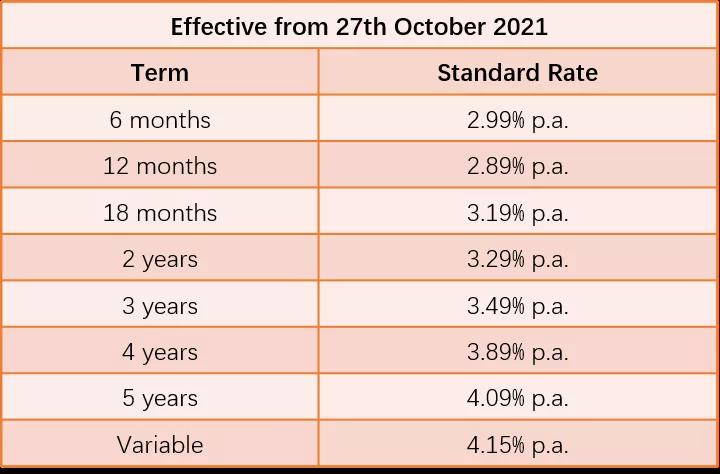
YIJU New Zealand reminds readers that special conditions may apply when applying for the financial products or services above. If interested, please contact ICBC New Zealand:
Phone: 09 3747266
Email: operation@nz.icbc.com.cn
Disclaimer: The views above are personal opinions and are provided for reference only. Neither YIJU New Zealand nor ICBC New Zealand accepts any liability.