
The big discussion: With external pressures mounting, will New Zealand house prices really plunge?!
Since New Zealand's renewed outbreak in August, it has felt as though every week brings major news pulling the property market in different directions. One moment, favourable government policies suggest prices will be pushed higher; the next, banks introduce tighter lending rules to cool the market. Leading economists have also stepped forward to warn investors of a house-price crash: ‘For investors who have borrowed heavily or do not understand property risks, there will be a day of reckoning!’

Well! It has been one act after another. This Wednesday, the Reserve Bank of New Zealand finally stepped into the spotlight too, releasing its latest Financial Stability Report. It said the unprecedented challenges of the pandemic continued to affect many businesses, leaving considerable uncertainty ahead, while rising house prices and climate change added further risks to financial market stability. It particularly emphasised its concerns about ‘unsustainable’ house prices, saying:
{ad}
Recent further increases in house prices have taken them beyond sustainable levels. The factors that could cause prices to fall are multiplying, and any correction could be substantial. Recent buyers have borrowed heavily relative to their incomes and are vulnerable to rising mortgage interest rates or falling house prices. Given the risk of higher interest rates and the economic outlook, the Reserve Bank also expects banks to be more cautious about approving mortgages for highly indebted borrowers.
So whose words should we investors believe? Before answering that, YIJU will examine the current relationship between supply and demand in the property market to see whether New Zealand really has a housing shortage.
The latest analysis of housing supply and demand by interest.co.nz shows that, for at least the past three years, the number of new homes consented has exceeded demand arising from population growth. It also suggests that in some densely populated areas, particularly Auckland, the housing shortage that existed more than three years ago may now be history.
Methodology:
The analysis uses Stats NZ's latest census data, including population changes across all territorial authority areas arising from natural increase (births exceeding deaths), internal migration (people moving between New Zealand regions) and external migration (people moving into or out of the country long term). It then uses household occupancy rates for each area from the 2018 Census to calculate how many new homes are needed to accommodate the additional population. Those figures are compared with the number of new dwelling building consents issued in each area.
Comparison of housing supply and demand across New Zealand over the past three years
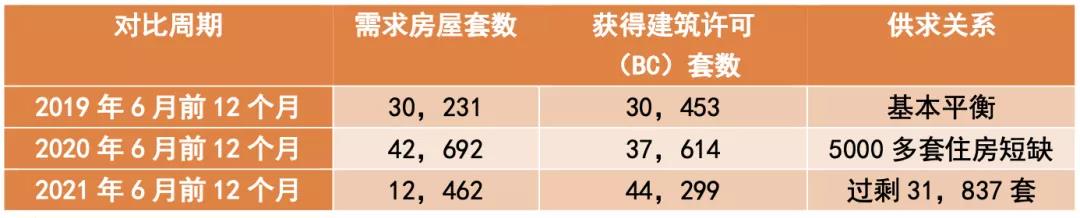
Data source: interest.co.nz (also for the tables below)
In the 12 months to June 2021, border closures sharply reduced overseas migration, while new dwelling building consents (BCs) continued to grow at record levels, taking new housing supply well above population-driven demand. However, although building consents are an important indicator of construction activity, not every consented project is ultimately built, and completion times can vary considerably.
Comparison of housing supply and demand by New Zealand region over the past three years
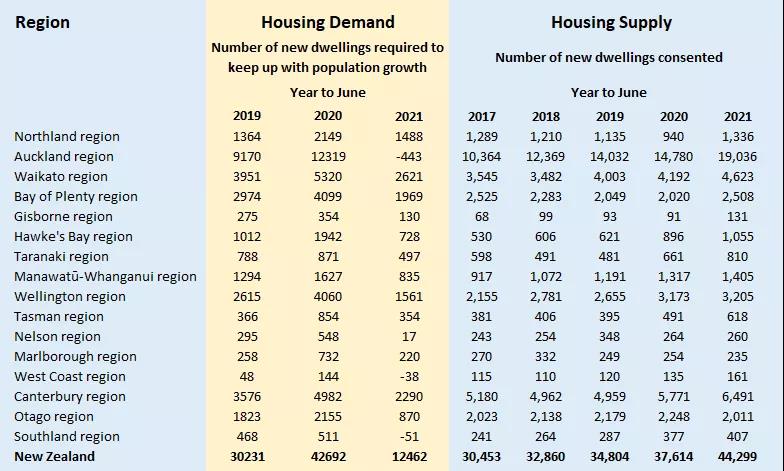
Has Auckland always faced an undersupply of new housing? As the city benefiting most from New Zealand's population growth, Auckland has long experienced rapid migration-driven growth, placing sustained pressure on housing supply. However, in the 12 months to June this year, the previously reasonable balance between supply and demand changed fundamentally. A sharp fall in migration into Auckland saw the region's population decline for the first time on record, while the excess of housing supply over demand surged to nearly 19,500 homes.
An oversupply of new homes could ease pressure on the rental market, increase vacancy rates and put downward pressure on rents. Combined with higher mortgage interest rates, this would inevitably put downward pressure on property prices. Canterbury and Otago are experiencing the same issue.
Some regions, however, have demand exceeding supply. This is most evident in upper North Island regions such as Northland, Waikato, Bay of Plenty, Gisborne and Hawke's Bay. In particular, new housing supply in Bay of Plenty has fallen well below the demand generated by its population growth.
The following table shows average annual demand for new housing over the three years from 2018 to June 2020, broken down by New Zealand region and Auckland local board area. It compares this with the average annual number of new dwelling building consents (BCs) issued in the same areas over the same period. Areas where demand exceeds supply are highlighted in pink, and those where supply exceeds demand in green.
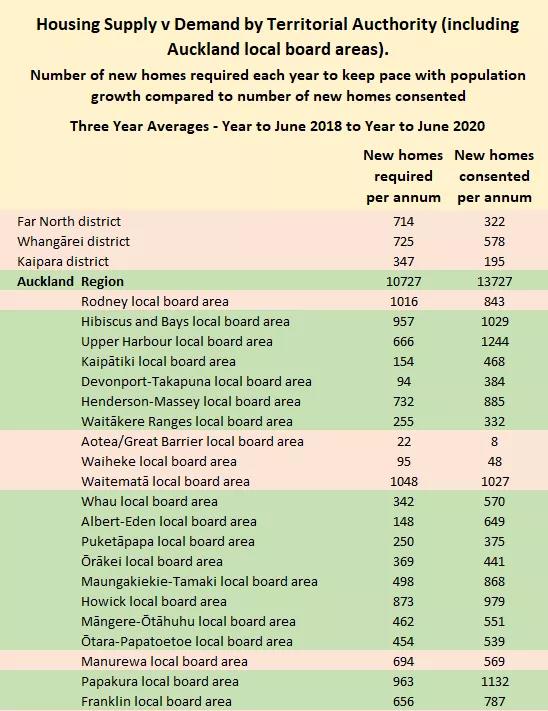
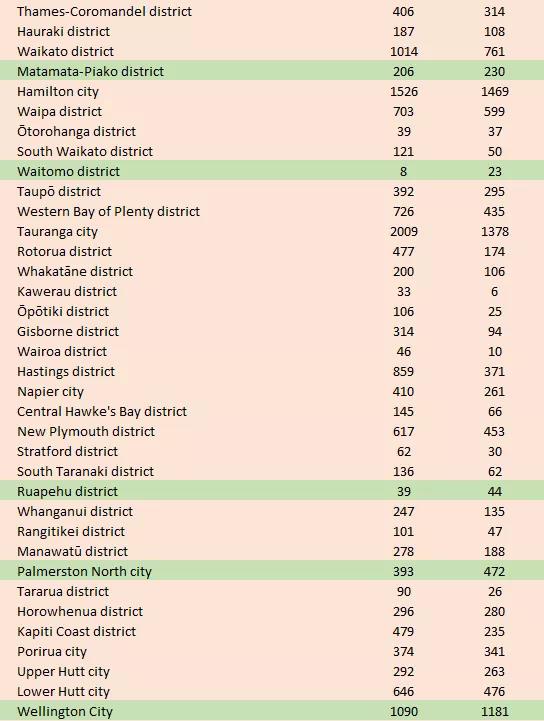
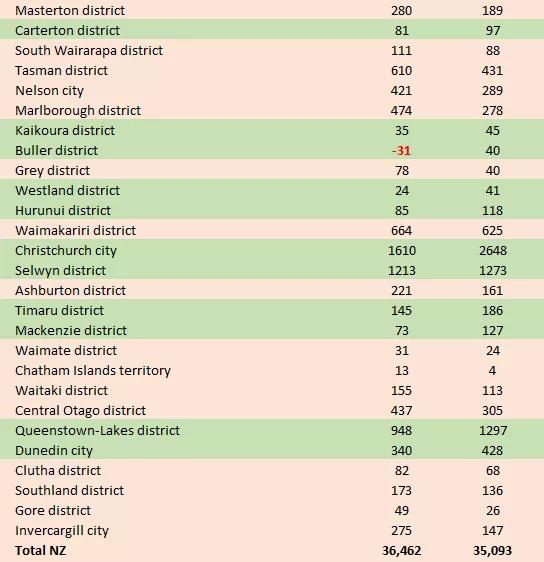
The data show that in some areas, such as Auckland, new housing supply is broadly balanced with demand from population growth, while other areas need more new homes. They also show that the suspension of overseas migration as part of the pandemic response has given the housing market some breathing space, helping to rebalance supply and demand.
Conclusion
There is currently no sign that the housing market is experiencing a clear oversupply. Rather, it is in a relatively delicate balance. If migration returns to pre-pandemic levels, that balance could easily tip back into shortage. Looking ahead, the market's direction therefore depends heavily on how quickly and extensively the Government reopens the border to migrants over the coming years. Returning to the question at the start, ‘Will house prices plunge?’ What goes up can come down. The question is no longer really whether prices will fall, but whether buyers can withstand a fall. Existing owner-occupiers have accumulated substantial equity through successive rounds of price growth, while investors have significantly reduced the proportion of high-risk loan applications following the Reserve Bank's tighter LVR restrictions. Sense Partners economist Rosie Collins says: ‘After house prices rose by more than 30% last year, the risk of a correction is high. But do we still believe these forecasts? If we begin to free-fall towards disaster, new fiscal policies will provide a proven antidote. Just look at how the wage subsidy has protected against business failures and unemployment so far.’