
Major announcement: Kiwibank halts low-deposit lending, including for first-home buyers! What these signals reveal about the housing market in 2022...
In just over a month, the Southern Hemisphere will enter 2022. New Zealand's housing market has remained unexpectedly strong this year despite increasingly stringent government controls. In October, nationwide house prices broke through the million-dollar mark for the first time. As prices continue to surge, year-end restrictions are also intensifying.

With the property market remaining hot, New Zealand's major banks will continue responding to the Reserve Bank of New Zealand's call to tighten LVR restrictions. The Reserve Bank recently said: 'This move aims to maintain financial market stability and reduce high-risk mortgage lending.' Notably, new residential construction will be exempt from these restrictions.
{ad}
1
Kiwibank takes the lead in announcing a suspension of low-deposit lending
Yesterday, Kiwibank announced that complying with the Reserve Bank's new rules would require a difficult decision: it will stop accepting pre-approval applications from buyers with deposits below 20%, including first-home buyers. A bank spokesperson said: 'We deeply sympathise with the difficulties facing first-home buyers, but the bank is also acting to maintain stability in the current financial market.'
Put simply, the bank will no longer provide loans to home buyers with deposits below 20%. Across the housing market, New Zealand's mainstream banks are steadily implementing the Reserve Bank's latest round of year-end controls. High loan-to-value ratio lending will face increasingly stringent restrictions.
A Kiwibank representative said: 'We will diligently implement and comply with the Reserve Bank's new rules. We are no longer accepting pre-approval applications with a loan-to-value ratio (LVR) above 80% that do not qualify for the regulator's exemptions. However, we will process lending as usual for property-specific offers or auction purchases accepted before Friday evening, 12 November.'
'In other words, if your sale and purchase agreement arrived after 5h in the afternoon last Friday (12 November), we will be unable to process loan pre-approval for a deposit below 20%. Loans already pre-approved but not tied to a specific property will be handled under the new LVR rules. We will provide a list of affected customers as soon as possible to confirm whether their applications will be cancelled.'
In fact, as early as September this year, Reserve Bank of New Zealand Deputy Governor and General Manager of Financial Stability Geoff Bascand had announced:'From 1 November 2021, major banks will limit the total amount of lending with loan-to-value ratios above 80%, including lending to first-home buyers.'
Back in 2013, when the Reserve Bank of New Zealand first introduced high-LVR restrictions, ASB took measures similar to Kiwibank's to manage lending risk. Other mainstream New Zealand banks are also understood to be tightening their LVR requirements, with more detailed implementation rules to follow.
2
High-LVR restrictions will have a major impact on first-home buyers
Reserve Bank Deputy Governor Geoff Bascand said last week: 'Conditions in the lending market have improved, and we have observed rapid growth in high-risk investor borrowing. We will consult on restoring pre-pandemic restrictions to limit the amount of high-risk lending banks can provide.' This clearly shows the Reserve Bank's firm determination to stabilise financial markets and curb highly leveraged borrowing.
In the past, LVR restrictions targeted only investors, but this latest announcement will directly affect large numbers of first-home buyers.
An agent in Auckland's property market told us:'This time, banks are targeting more than investors; more first-home buyers will also be affected. Those whose budgets allow for a deposit below 20% face the greatest impact and will have to abandon their home-buying plans because of the new rules. Some of my clients had already submitted their documents to the bank, only to be turned down in the end.'
'With the tighter LVR restrictions announced by the Reserve Bank taking effect on 1 November, and given current property market activity, we are considering a further range of measures to ensure we remain within regulatory limits,' a BNZ spokesperson said.
An ASB representative said: 'We are actively managing our home-loan pipeline, to comply with the new LVR restrictions introduced on 1 November. We will continue lending to ASB customers with deposits below 20% who meet our lending criteria. However, to ensure we can continue supporting our own customers, we are not currently accepting applications from customers of other banks.'
3
Interest rates pass five per cent as five mainstream banks announce further rises
The hotter the housing market, the stronger the controls. As Kiwibank announced yesterday that it would stop accepting pre-approval applications from buyers with deposits below 20%, New Zealand's five mainstream banks have each announced further interest rate rises this week. Looking at banks' rate rises this year, from 2.49 per cent at the start of the year to above 5 per cent by year-end, the increases have come with considerable urgency. This shows how keen the Government and Reserve Bank are for the housing market to return to normal.
Next Wednesday, the Reserve Bank will announce another OCR change. This wave of year-end controls will also directly affect next year's housing market.
The latest increases show that ANZ has raised its 4-year and 5-year mortgage rates the most, taking them to 5.24 per cent and 5.54 per cent respectively. It also currently has the highest rates. ASB has raised rates almost across the board, with the largest increase applying to its 3-year rate: a rise of 30 basis points to a peak of 4.69 per cent, currently the highest three-year rate among New Zealand's five mainstream banks. (For details, see the table below showing banks' interest rate changes on 15 November.)
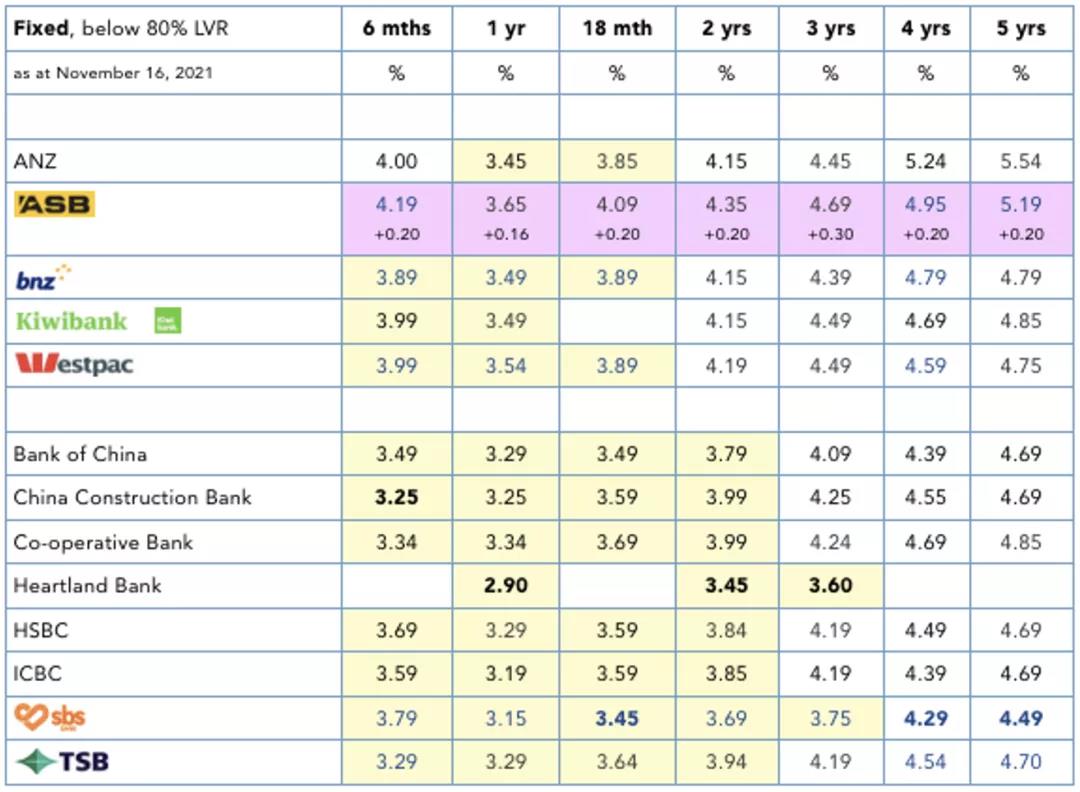
As housing market controls intensify towards year-end, each bank has deployed its own strongest measures to respond to the booming property market.
Last month, on 28 October, BNZ also officially announced the introduction of a DTI policy. This major announcement is undoubtedly a signpost for housing policy this year and even next year. Overall, New Zealand's controls appear to be becoming increasingly stringent, raising the question of whether next year's housing market will remain as 'unstoppable' as this year's. In the author's view, a return to normal market conditions has become the prevailing trend.