
Reserve Bank announces another OCR increase, and this is only the beginning…
This afternoon, the Reserve Bank of New Zealand (NZRB) officially announced an increase in the official cash rate of 0.25% to 0.75%. This is the second 0.25% increase, following last month’s rise. The Monetary Policy Committee noted that “further removal of monetary policy stimulus is expected over time, given the medium-term outlook for inflation and employment”. Within minutes of the announcement, the New Zealand dollar began falling in foreign exchange trading. By 2:05 pm, it had fallen to 69.30 US cents, below the 69.50 US cents recorded before the 2h announcement.

Many believed that, since the NZRB’s previous OCR increase, the major banks’ almost weekly fixed mortgage rate rises had already largely priced in today’s 0.25% increase. Unexpectedly, immediately after the Reserve Bank announcement, ASB moved to raise its Variable home loan rate from 4.45% to 4.6%, and its Orbit rate from 4.55% to 4.7%. Its special new-build lending rate, Back My Build, will also rise from 2.04% to 2.29%. The new floating rates will apply to new loans from 1 December and existing loans from 8 December.
{ad}
With the pandemic repeatedly resurging, people are no longer confident that it will soon end, and lockdown measures continue. Amid the pandemic’s impact, the possibility that a deep recession in the global real economy could trigger another global financial crisis is also a challenge facing the world’s economies.
US economist Robin Brooks said: “The spread of Delta is slowing economic reopening and has led us to lower our global growth forecast, cutting this year’s expected growth from 6.2% to 5.7%. This could complicate central banks’ plans to withdraw crisis support by slowing asset purchases or raising interest rates.”
Low interest rates offer only a temporary remedy for markets
Since mid-2020, the New Zealand Government has introduced extensive monetary support to address the pandemic’s economic impact. From February, the OCR fell by 75 basis points to 0.25%; monetary easing expanded to an eventual liquidity injection of $100,000,000,000; and major banks opened the lending taps, with mortgage rates falling to record lows. The ultimate result of this rescue effort was a 30% surge in New Zealand house prices last year, while low interest rates globally laid the groundwork for financial bubbles.
Reserve Bank Deputy Governor Geoff Bascand recently said,
“Extremely low interest rates are problematic. We see speculative risks associated with low rates. We have observed rapid growth in high-risk investor borrowing and will limit the amount of high-risk lending banks can undertake.”
Recent information from the Reserve Bank indicates that the monetary policy cycle has turned.
As early as August this year, industry observers expected the Reserve Bank of New Zealand to withdraw support early, with rate increases beginning in August. Surprisingly, its August announcement left the OCR unchanged at 0.25. With major banks’ rates now exceeding 5 per cent and increases proceeding urgently and firmly, a Reserve Bank OCR rise in November may already be a foregone conclusion.
This year’s second rate rise could take the 0CR to 1%
Amid rising inflation and record house prices, the OCR rose for the first time in seven years on 6 October, increasing by 25 basis points to 0.50%. Before the Reserve Bank of New Zealand’s monetary review meeting today, many economists predicted that “the OCR will rise another 50 basis points to 1%”. In hindsight, this 25-basis-point increase is understandable.
ANZ NZ economists said last Friday: “We expect the Reserve Bank’s second rate increase this year to be 25 basis points, taking the OCR to 0.75%. Mortgage rates are currently rising at their fastest pace in 15 years. A 25-basis-point increase will help lock in that tightening without putting excessive pressure on the economy.”
Since the pandemic began, the Reserve Bank has adjusted monetary conditions on a 3-month cycle. On 8 May 2019, it lowered the OCR (official cash rate) from 1.75% to 1.50%. This was the first adjustment since November 2016, before which the rate had remained at 1.75%.
Let us look at the table of OCR changes over the past two years:
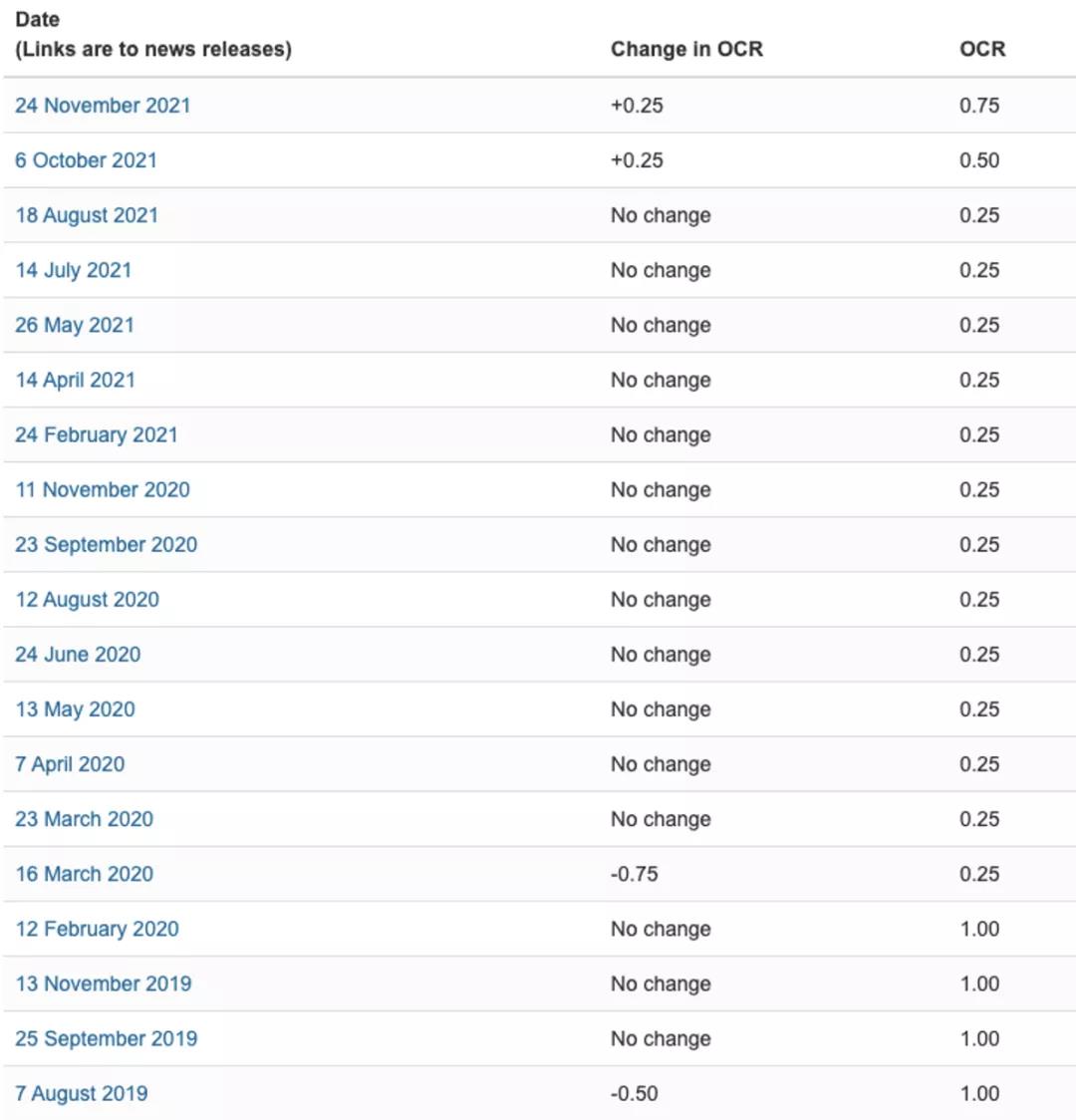
Data source: Reserve Bank of New Zealand official website
The Reserve Bank of New Zealand has consistently used the OCR in setting monetary policy, with inflation as its main reference point. Inflation is measured using the Consumers Price Index (CPI). The table above shows that 16 March 2020 was an exceptionally rare day in New Zealand’s lending history: the Reserve Bank announced it would lower the 0CR to 0.25%, the country’s lowest official cash rate since 1999.
With inflation pressures surging, the OCR could exceed 2 per cent early next year
Stats NZ data shows New Zealand’s third-quarter inflation rate reached 4.9%, its highest level in a decade and well above the Reserve Bank of New Zealand’s 4.1% forecast. Industry observers expect high inflation to persist much longer than the Bank previously anticipated.
ASB senior economist Mike Jones said: “We expect regular rate increases in the first half of next year, taking the OCR to at least 2%.” In fact, since the second half of this year, major banks have been competing to raise rates, with mortgage rates climbing sharply. The market is already tightening monetary conditions on the Reserve Bank’s behalf. Looking at OCR movements over the past two years, from its pre-pandemic level of 1.5% to a record low of 0.25%, a hawkish rebound towards normal levels is understandable.
Industry observers believe the Reserve Bank’s projections for future rate increases may signal that the OCR will reach a higher level than previously expected, perhaps around 2.5%, and sooner than 2024, as forecast in August. Industry analysis points to further rate increases as the Bank seeks to keep inflation within its 1–3% target range.
Will lending restrictions and higher interest rates bring house prices down?
After the property market boom last year and this year, what will the housing market look like in 2021? According to Reserve Bank forecasts, New Zealand house prices could begin falling as early as 2022, with a conservative estimate of a decline of around 5% by 2024.
Reserve Bank Governor Arian Orr said: “Given current policy measures, there is a substantial risk of house prices falling next year, but it is difficult to predict precisely how far. New Zealand house prices are already correcting, and market signals indicate that this sustained upward trend will be difficult to maintain.”
With property values inflated by inflation, some property investors already face high debt risks. One real estate agent said: “Mortgagee sales are already beginning to appear as interest rate increases take effect. However, the impact of the government’s latest measures on next year’s housing market remains unclear. New Zealand introduced an immigration amnesty this year, and 160,000 prospective new residents are waiting to secure residency and buy homes. They will also provide strong demand in next year’s housing market.”
New Zealand’s largest real estate agency, Barfoot & Thompson, says that with mortgage rates continuing to rise and Labour and National agreeing to allow greater housing density, house price growth will eventually return to normal, acceptable levels over the medium term. Mortgage rates have been at unprecedented lows over recent years. In 2008, floating rates were around 11%, before falling below 7% over 12 months. Rates continued trending down from then, bottoming out near 4%.
That downward trend has now ended, with floating rates at most major commercial banks about to exceed 5%. Rising rates will not immediately undermine current market prices. Borrowers can still fix their rates for 5 years at levels comparable to floating rates, allowing them to lock in mortgage costs at today’s levels.