
Lixing’s property picks: MDRS bill passes reading 3, this type of property in the Bays is set to attract greater demand!
New Zealand’s Parliament recently formally passed the Resource Management (Enabling Housing Supply and Other Matters) Amendment Bill at its third reading.
The bill was initially proposed jointly by Labour and National, and subsequently gained support from the Green Party and Māori Party. The final version emerged after nearly 2 months of research and discussion involving central government, multiple political parties and city councils across New Zealand. Details of the amendments can be found at this link: https://www.legislation.govt.nz/bill/government/2021/0083/latest/whole.html The bill’s passage signals more intensive land development, with more homes built on limited land. So which kinds of properties will offer greater development potential and attract more market demand?
{ad}
According to data in an article published yesterday on YIJU New Zealand’s official WeChat account (click to read the 14 December article), waterfront suburbs recorded the strongest house price growth within Auckland City during the more than four months of lockdown in this outbreak. Herne Bay prices rose by nearly NZ$300,000, taking the average house price to $4,036,000. Today’s featured location in Lixing’s property picks is also in the Bays: Mission Bay. Data shows that its average house price rose by as much as $158,000 over the past few months, reaching $2,510,000. For investors, property investment returns in the area will be substantial.
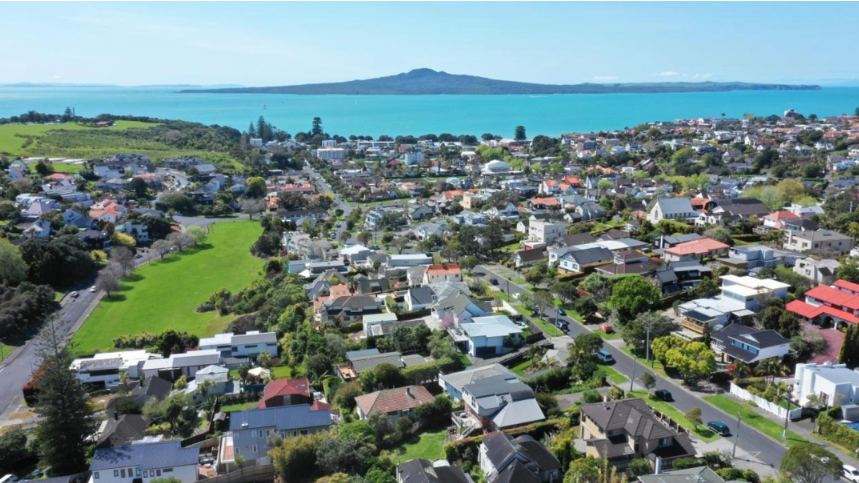
Mission Bay is around a 5 to 10 minute drive east of central Auckland. Facing Auckland Harbour and connected to the city centre by a coastal road, it sits between hills and sea, with particularly beautiful scenery in its north-facing areas. With its long, level beach, people enjoying the waves, and outdoor cafés along the road offering uninterrupted harbour views, it is one of Auckland’s finest residential areas. Water activities include swimming, sailing, kayaking and yachting, making it an important holiday leisure destination for locals and overseas visitors. Sitting on the beach or the park’s soft, carpet-like grass, you can look across to the symmetrical cone of Rangitoto Island. Formed by its last eruption 650 years ago, it is the volcanic island closest to Auckland. The streets are lined with restaurants serving international cuisine, as well as hotels. These include Mediterranean restaurants Mecca and Aga Restaurant, continental restaurant Capri Cafe & Bar, Indian restaurant Jewel Of India, and Italian restaurant Mamma Mia Restaurant Pizzeria. Its exceptional location keeps Mission Bay lively on holidays and weekdays alike, and many visitors choose to stay here. After dusk, you can sit on a restaurant’s outdoor terrace and enjoy the picturesque evening scenery—you may never want to leave...
Today’s featured listing is at 242 and 242B Kepa Road, Mission Bay, directly across from Eastridge Shopping Centre. Its excellent location offers convenient access to Auckland’s eastern bays beaches and the neighbouring suburbs of Orakei, St Heliers, Kohimarama and Meadowbank. This 809 square metre site combines two adjoining lots and is zoned Terrace Housing and Apartment Building Zone (THAB), something relatively uncommon in such an upmarket neighbourhood.
For this article, we have once again invited experienced Auckland investor Liang Lixing to give an in-depth assessment of the property for sale.
Q: Mr Liang, how would you assess this property’s strengths and weaknesses?
Lixing: Certainly!
Strengths: It has a good location, a stone’s throw from the shopping centre and close to Mission Bay’s waterfront and nearby beaches. The top floor of the existing building offers uninterrupted views over Mission Bay. The property is on a main road served by buses to the CBD, with well-established surrounding infrastructure, including decile ten school zones for Kohi School, St Thomas and Selwyn College. This means any development built here would appeal to a large buyer market, including first-home buyers and investment property purchasers.
Weaknesses: The site is not particularly suitable for projects requiring a large development area, such as sizeable apartment or multi-townhouse developments. It may be necessary to buy neighbouring land to create a larger development site. Existing rental income is insufficient to cover the mortgage, so the buyer would need a substantial upfront deposit.
Q: We often think high-return property investments can only be found in lower-priced areas, while established upmarket neighbourhoods offer limited capital growth. Are property projects in expensive neighbourhoods still worth investing in?
Lixing: Didn’t we mention at the start that the suburbs with the biggest gains over the past 4 months were Auckland’s well-known Bays suburbs? Herne Bay’s average house price has already exceeded NZ$4,000,000, yet prices there still rose by nearly NZ$300,000 over the past few months! This demonstrates that good areas retain growth potential however expensive they become, and can rise even faster. When a family considers buying a home to live in, the first priority is a good location—what we always call “Location! Location! Location!” Location directly affects a home’s value. This listing has an excellent position, plenty of school choices, and convenient transport and shopping between Mission Bay and the CBD. A popular location often gives you a better opportunity to achieve a higher sale price once development is complete.
Q: If you became this property’s next owner, what investment plans would you make?
Lixing: I would hold it as a land bank and wait, potentially until neighbours sell adjoining properties, allowing me to assemble a larger site for high-density housing. Of course, obtaining resource consent and building consent requires lengthy planning, so I would rent out the two existing properties to generate some income towards the loan payments. Alternatively, I could wait for a better time to sell. I believe the return would also be substantial.
Q: YIJU’s exclusive report, published in month 12, on day 6, covered “Neighbours use legal action to halt the 44 Ventnor Rd townhouse project” (click to read) and analysed the case. Could the similarly upmarket suburb of Mission Bay face the same problem?
Lixing: I have noticed that most homes in Mission Bay were built between 1960 and 1969. There are quite a few historic buildings, outstanding natural surroundings and cultural features, and it is also a very well-known tourist destination. Development and renovation projects in an older neighbourhood like this certainly carry considerable risk. However, provided we follow the council’s relevant design rules and pay particular attention to Mission Bay’s neighbourhood character, residential amenity and building intensity during planning and design, I believe securing neighbours’ agreement, council resource consent and building consent, and ultimately completing the project need not be an “Impossible Mission”.