
Do more property listings signal brighter days for first-home buyers?
The latest Real Estate Institute of New Zealand (REINZ) figures show that Auckland property sales slumped last month, falling from a high of 4013 in March 2021 to 2367, a year-on-year decline of 41%.

The latest Real Estate Institute of New Zealand (REINZ) figures show that Auckland property sales slumped last month, falling from a high of 4013 in March 2021 to 2367, a year-on-year decline of 41%. The nationwide picture was equally discouraging: residential sales fell from 10151 in March 2021 to 6752 last month, down 33.5% year on year. Although nationwide home sales in March this year increased 17.7% compared with February, seasonally adjusted sales fell 5.2% between February and March. Apart from Tasman and Marlborough, where sales rose 15.7% and 8% respectively, every region recorded a decline of varying severity.
{ad}
Commenting on the market’s performance, REINZ chief executive Jen Baird said March sales were weaker than expected. Upward pressure on prices had eased, while the number of properties available and the average time each property spent on the market were both increasing. She said:
Buyers have more time and more choice, which is particularly good news for first-home buyers. There has been much discussion recently about falling house prices, but the market people are seeing is part of a full property cycle. Most people will not sell unless they have to, which will cushion the economic downturn. She believes investors remain very active in the market and has seen no sign of capital flowing out.
Changing property sales methods
Last month, fewer than 20% of properties sold at auction, compared with 34% a year earlier. This signals a decisive move away from auctions towards sales requiring longer marketing periods. The shift is particularly pronounced in Auckland, where the proportion sold at auction fell from 51.5% in March last year to 29.4% this year. Baird believes auctions remain the best way to sell property because they attract buyers quickly within a set timeframe. Clearance rates have fallen because buyers need longer to secure finance, while homeowners are no longer taking the risk of buying their next home before selling their existing one, as they did last year.
Changes in the number of properties listed for sale
The key change since the end of last year is a substantial increase in properties available for sale. Nationwide, the total has reached 25,659, up 32% on a year earlier. Although Auckland’s new listings in March numbered 10736, down 10% on the previous month, this figure has returned to levels seen during the market trough between March and April 2019. Harcourts Cooper & Co managing director Martin Cooper said listings in his North Shore area had reached a record high, with 1600 properties to choose from, compared with just 1000 this time last year. He considers 1400 listings the ideal level for the market.
Taken together, these developments suggest the market is increasingly heading towards oversupply, perhaps signalling a quieter winter than usual. At the same time, the market is becoming more favourable for buyers, particularly first-home buyers. Conditional offers can give them enough time to arrange finance and negotiate prices with vendors, while growing listing numbers provide more choice. Of course, another crucial factor is whether they can secure the best available fixed mortgage rate.
Rising interest rates facing first-home buyers
When it comes to mortgage rates, many first-home buyers probably feel as heavy-hearted as we do. After the Reserve Bank of New Zealand announced a substantial 50-basis-point increase last Wednesday, the major local banks charged ahead with another wave of rate rises. ANZ led the way, generally raising fixed mortgage rates by 35 to 40 basis points, taking its one-year rate to 4.55%. Its two-year fixed rate also pushed the market for that term to a new high, breaking through 5% to a startling 5.25%. Its three-year rate rose to 5.55%, while four- and five-year rates climbed well above 6%, reaching 6.35% and 6.45% respectively. ASB followed, and just yesterday BNZ and Westpac also announced substantial fixed-rate increases, with some terms matching ANZ’s rates from a week earlier. All four major New Zealand banks have now significantly increased their fixed mortgage rates in response to the Reserve Bank’s 50-basis-point rise on 13 April.
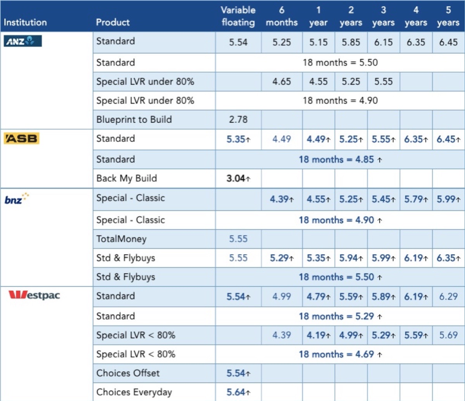
As at 4/21: interest rates at the four major banks (source: interest.co.nz)
OCR and fixed mortgage rates: when will the rises end?
Commenting recently on increases in the OCR and interest rates, ASB economists said short-term fixed mortgage rates still had “a considerable way to go” this year. “As the Reserve Bank of New Zealand continues to raise the OCR, interest rates in 2022 will rise more than in previous years.” Their latest forecasts put mortgage rates higher and rising faster than previously expected. In ASB’s recent Economic Weekly, chief economist Nick Tuffley said mortgage rates were already rising aggressively, outpacing increases in the official cash rate. In March 2021, banks’ average one-year fixed rate was 2.3% and the five-year rate was 3%. Currently, taking ASB as an example, the one-year rate is 4.49% and the five-year rate is 6.45%,
“Our forecasts reflect our expectation that the Reserve Bank of New Zealand’s strategy of rapidly raising the OCR to respond to inflation will see mortgage rates peak higher and sooner than we previously forecast, in 2022/2023, before easing to 5–6% over the longer term. ASB economists now expect another 50-basis-point OCR increase in May, followed by successive 25-basis-point rises to a peak OCR of 3.25% in early 2023, with cuts beginning in mid-2024.”
With so much uncertainty in the mortgage market, YIJU urgently contacted several experienced licensed mortgage advisers at Goldsmith Mortgages, a specialist lending company well regarded in New Zealand’s financial sector, to provide first-home buyers with first-hand market information and mortgage assistance.
Q: With listings surging, what preparations should first-home buyers make if they find a property they love?
The Goldsmith Mortgages advisory team: Buying a home is a major decision, particularly for first-home buyers, and may affect the whole family’s finances for a long time. We believe buyers should consult thoroughly with a bank or qualified lending institution before committing to a purchase. First, a mortgage broker or financial adviser will tailor a lending plan and calculate the amount available to borrow, giving clients a clearer understanding of their purchasing power. Second, the broker will arrange for the bank to assess the intended property to ensure it meets the bank’s security requirements. Third, they will help calculate borrowing costs so clients can prepare for future repayments.
Q: How should borrowers choose a suitable fixed mortgage term?
The Goldsmith Mortgages advisory team: Loan terms and structures vary between clients, so there is no single answer. Options include interest-only repayments or principal-and-interest repayments. Some clients expect cash to become available in the near future. They can choose to repay part of the principal and fix for a short term, avoiding penalties when mortgage rates fluctuate. An experienced mortgage broker will offer different recommendations according to each client’s circumstances.
Q: How can buyers find an excellent mortgage broker who can truly help them?
The Goldsmith Mortgages advisory team: Mortgage brokers should know the lending policies of major banks and lending institutions thoroughly and be able to help clients obtain the best rates as quickly as possible. Experience is therefore extremely valuable and important in our industry. Every broker in our team, for example, has years of experience dealing with New Zealand’s major banks and lending institutions. Their familiarity with different institutions’ lending strategies and the latest industry information saves borrowers time and makes securing a loan easier. Each of our skilled brokers also maintains good professional relationships with banks and financial institutions. Banks assess both clients’ borrowing capacity and brokers’ professionalism. If a broker is insufficiently professional, banks will scrutinise their clients more closely, making approval harder and increasing the risk of rejection. Alongside professionalism, care and patience with clients matter most. New lending policies have made procedures more complicated, and every borrower’s circumstances differ. This highlights how each of our brokers uses expertise and patience to give clients the best possible mortgage experience. Whether you are a first-home buyer or a property developer, we welcome you to contact us promptly with any lending questions.
Contact details

Phone: 09 555 1608
Email:admin@goldsmithmortgages.co.nz