
Falling prices and sales suggest a cooling housing market. Record building consents suggest a construction boom. Which best reflects the market today?
A range of property figures for April 2022 has recently been released. As the Reserve Bank of New Zealand's OCR and mortgage interest rates continue to rise, subtle changes appear to be quietly taking place in New Zealand's property market...

The latest April figures from Barfoot & Thompson, Auckland's largest real estate agency, show that just 615 homes sold in April, down 44% from 1107 in the same period last year. This was the agency's lowest sales volume for April since 2008, apart from April 2020, when New Zealand's Covid lockdown prevented transactions.
In contrast, the stock of listed properties continues to rise. At the end of April, the agency had 4845 homes available for sale, up 45% on the same period last year. This was its highest April stock level since 2011.
House sale prices have clearly begun to fall too. The agency's average sale price in April was NZ$1,212,376, down from NZ$1,234,572 in March. It was NZ$66,271 below the peak of NZ$1,278,647 in December 2021, while the median sale price in April was NZ$1,410,000, a drop of NZ$99,000 from the December peak of NZ$1,240,000. Barfoot & Thompson managing director Peter Thompson warned sellers against unrealistic price expectations if they wanted to secure a sale.
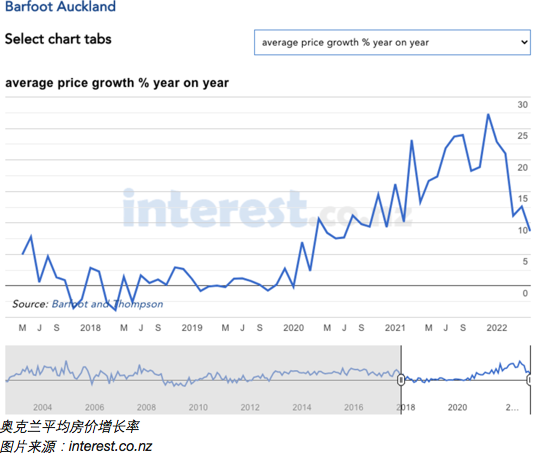
Changes in New Zealand's national housing market figures
New Zealand property data firm CoreLogic has also recently released its House Price Index. Over the three months to the end of April, New Zealand's average house price was down 0.8% compared with the three-month period to March. Among the main centres, house prices in Auckland, Tauranga, Wellington and Dunedin in April were respectively down 1.6%, 0.3%, 1.5% and 0.7% compared with March. Christchurch was the only main centre to record growth, with its average house price in April up 0.5% on March. The index shows that prices in many areas in April were below their levels three months earlier. These included parts of Auckland, particularly the North Shore; Hamilton; rural Waikato, down 10.1%; Hastings; Whanganui; Palmerston North; much of the Wellington region; and much of Dunedin. Full regional figures are shown in the table below.
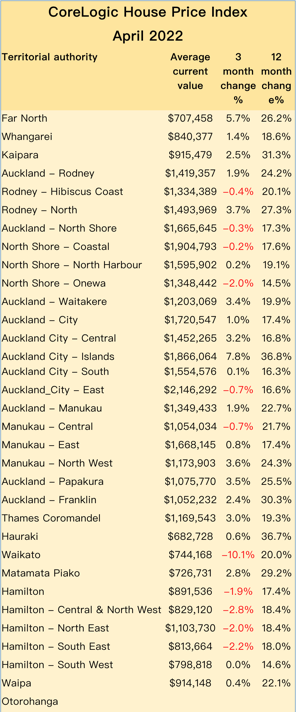
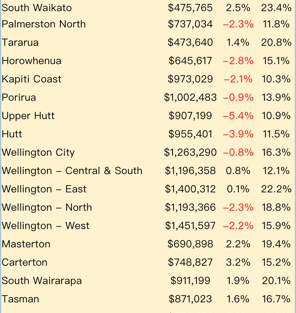
4 month CoreLogic House Price Index
Source: CoreLogic
Changes in construction market figures
Despite the subdued housing sales market, new home approvals show no signs of slowing. Stats NZ figures show that building consents were issued for a record 5303 new homes in March this year, up 26% on the same period last year and the highest level of the year. In the 12 months to the end of March, a record 50,858 new homes were consented, up 24% on the same period last year and also a new annual high. Another significant change was that, in the year to March, consents were issued for 25,475 multi-unit homes, including townhouses, apartments, units and retirement village units. This exceeded the 25,383 standalone houses approved over the same period and also set an annual record.
The figures show particularly strong growth in new home approvals across New Zealand's main centres. In March, approvals rose 43% in Auckland, 58% in the Wellington region, 35% in Canterbury and 31% in Otago. In the 12 months to March, NZ$2,469,000,000 of residential alteration work was approved, up 22% on the previous year. Meanwhile, the total value of all consented residential building work was NZ$22,157,000,000, up 28.9% on the preceding 12 months.
Five insights into the current property market from a leading economist
{ad}
Leading New Zealand economist Tony Alexander conducts 5 in-depth surveys of the country's property market each month, studying data such as sale prices to identify subtle market changes. He recently outlined 5 findings.
1
The availability of credit has improved somewhat. His monthly survey of mortgage advisers with mortgages.co.nz showed that, two weeks ago, 8% of advisers believed the major commercial banks were becoming more willing to lend. He sees this as a major turning point: in March, 12% believed banks were tightening their assessment of loan applications, compared with 61% in February and 83% in January. Bank rejection of mortgage applications peaked in December, when 93% of advisers said banks' willingness to lend was deteriorating. This also indirectly confirms that the forthcoming CCCFA changes announced by New Zealand's Minister of Commerce have already affected the market, and that credit tightening is easing.
2
Investors are still in no hurry to leave the market. Many have stepped back as buyers since tax rules changed at the end of March last year. However, Tony's latest survey of real estate agents with REINZ showed that 5% of agents nationwide were seeing fewer owners looking to sell, rather than more. His monthly survey of existing property investors with Crockers Property Management showed that, three weeks ago, just 20% were considering selling within the next 12 months. This was the lowest reading since the survey began in June last year, and down from 27% in January.
3
FOMO, buyers' fear of missing out, has disappeared and continues to fade. The REINZ survey showed that only 6% of agents could see buyers displaying fear of missing out, a substantial fall from 70% in October. Conversely, 65% of agents said buyers had a fear of overpaying, or FOOP, considerably higher than 19% in October.
4
Asked how investors' lives would change as interest rates rise, only 12% of agents said one of buyers' main concerns was losing their job or suffering a fall in income. Two years ago, that figure was 48%, indicating strong job security. Opportunities in the labour market also remain plentiful. This should help cushion the current pullback in household spending and encourage people to refocus on buying property. More importantly, however, it should discourage those worried about being unable to meet mortgage payments in the short term from selling too readily.
5
Despite perceptions that tax changes and rising interest rates have scared off all investors, the reality is different. In Tony's survey of real estate agents, 39% believed investors were motivated by the prospect of finding a bargain. That figure was just 17% in October.
Finally, economist Tony Alexander believes the national and Auckland property markets are undergoing a correction that may gradually fade by the middle of 2023. His surveys suggest the coming period of stability could even arrive before the end of this year.
Disclaimer: The views above do not represent YIJU's position. YIJU accepts no legal liability.