Breaking: A powerful brake on house prices has been scrapped. Is buying a home now easier?
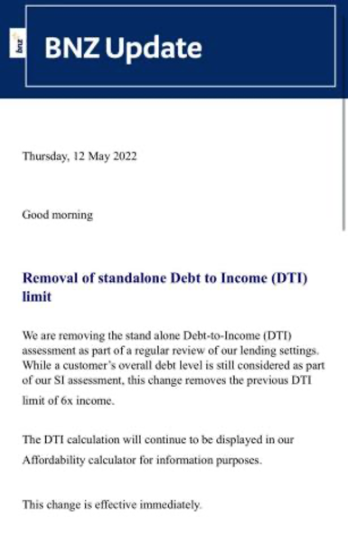
This morning, several mortgage brokerages received an official letter from BNZ advising that its debt-to-income (DTI) lending restrictions had been removed with immediate effect.

BNZ was in fact the first mainstream New Zealand bank to formally use DTI restrictions when assessing home loans, and the only one. On 28 October last year, BNZ announced that customers applying through mortgage brokers would be limited to borrowing 6 times their gross income, in addition to meeting existing serviceability assessments.
Explainer: What does introducing DTI mean?
The debt-to-income ratio, or DTI, is an important tool for gauging a borrower's ability to repay. As a way of limiting total borrowing, DTI determines a borrower's maximum loan amount based on their income.
Suppose an ordinary Auckland household earns NZ$100,000 a year. Based on Auckland's current average house price of NZ$1,550,000 in the OneRoof-Valocity April House Value Index, without DTI and using LVR rules alone, that household could borrow up to NZ$1,240,000 (80%), requiring a deposit of only NZ$310,000. Under DTI, however, the household's maximum bank home loan would be just NZ$600,000, meaning it would need to provide NZ$950,000 of its own money as a deposit.
DTI had long been talked about before BNZ officially announced it, but had yet to materialise. Some experts believed other banks would follow once BNZ took the lead in introducing DTI restrictions in New Zealand. In reality, by the time BNZ announced their removal today, no other bank had officially followed suit. It seems unlikely that any bank will introduce them in the near future.
DTI has long been seen as a powerful weapon for the New Zealand Government to control house prices. When the Reserve Bank of New Zealand first consulted on introducing it in 2017, it stressed that “DTI is the most effective tool if house prices surge again”. With credit currently tightening, what does BNZ's sudden removal of DTI restrictions mean for investors and first-home buyers respectively? And what impact will it have on New Zealand's property market as a whole?
YIJU New Zealand interviewed several senior mortgage managers with extensive experience in New Zealand lending to share their views with YIJU readers and help inform your future borrowing and home-buying decisions:

YIJU: What do you think prompted BNZ to scrap DTI?
Tim Liu:There must have been many considerations. My personal guess is that a major reason was that DTI had genuinely reduced BNZ's market share, because other banks were not using the policy to restrict loan applications.
Secondly, rising mortgage test rates and the new Credit Contracts and Consumer Finance Act (CCCFA) rules, particularly the assessment of customers' actual spending, had already made borrowing harder. Adding DTI restrictions had quite a significant impact on the overall market, particularly on owner-occupiers. The Government and the Reserve Bank of New Zealand have always wanted to help owner-occupiers while using certain measures to restrict some investment property buyers. However, during the policy's implementation, it became apparent that owner-occupiers and first-home buyers may also have been significantly affected.
Thirdly, the Reserve Bank of New Zealand has clearly stated that it will not require banks to enforce DTI before next year. Only BNZ had explicitly introduced the policy, with no other banks following. By scrapping DTI, BNZ may also want to signal to the public that its lending policy has eased. After all, BNZ also needs to compete for lending market share.
YIJU: DTI has been scrapped. Will borrowing become easier?
Frank Fu:Removing DTI will, to some extent, make borrowing relatively easier, particularly for first-home buyers, because its main purpose was to restrict some investment property buyers. However, test rates generally remain high, all above 7. Compared with last year, borrowers still face higher serviceability requirements, making borrowing considerably harder. Nevertheless, removing DTI is certainly good news for buyers with a strong ability to repay.
YIJU: With credit tightening overall, does removing DTI mean policy is easing?
Tim Liu:In a sense, removing DTI does mean bank lending has eased. Loan approvals are no longer subject to a blanket rule, and lenders have greater discretion to approve applications from strong borrowers. Looking at the overall situation, however, every bank's mortgage test rate is still rising, and requirements for calculating customers' expenses remain very strict. Although the Reserve Bank of New Zealand will make some adjustments to its position on the CCCFA in June, in the second half of the year, there are currently no clear signs of easing. In other words, adjusting DTI cannot be equated with an easing of lending policy.
YIJU: What impact will removing DTI have on first-home buyers and investors respectively?
Frank Fu:Removing DTI will certainly benefit some first-home buyers and investors by giving them more borrowing flexibility, provided their incomes remain stable. Many first-home buyers and investors may have strong repayment capacity but have been unable to borrow the amount they need because of DTI. Its removal will therefore help them secure larger loans. How much difference it will make remains uncertain, however, because the test rate has risen to 7.25% and expense assessment requirements remain stringent.
YIJU: What impact will removing DTI have on New Zealand's property market?
Steven Sun:Removing DTI will have some positive effects for customers previously constrained by debt-to-income limits. Those with strong repayment capacity may well return to the market to look at properties within their budgets and work out whether they can borrow more than before. This is a relatively positive signal for the lending and property markets as a whole, and for buyer sentiment. It may also indirectly help the market gradually recover: signalling easier credit will stimulate property market growth. After all, property is a pillar industry for the Government, and amid the pandemic's effects, expanding domestic demand and stimulating spending are needed to drive economic development.
YIJU: Do you think DTI will be implemented in New Zealand in the period ahead?
Steven Sun:I think so. DTI policies have been in place in the UK and the US for many years, with both countries stipulating that the debt-to-income ratio must not exceed 4.5. This is a widely used lending policy internationally. New Zealand's market is currently in a deep downturn, and the Reserve Bank of New Zealand has said it will not consider mandatory implementation before next year, perhaps because it does not want to deal people too heavy a blow. But DTI, the sword of Damocles hanging over the market, will fall one day. So make the most of your borrowing opportunities and enter the market promptly once you have pre-approval. In future, borrowing may become harder, or the amount available may be lower.
Lending policies have been changing rapidly recently. If you have any borrowing questions, please consult the senior mortgage managers at Huarong (Plaxo Mortgages)
. We will tailor the best solution for you.
Scan the QR code to add Huarong's assistant and begin your borrowing journey!