
A round-up of recent good news for the property and construction sectors!
The New Zealand Government announced major good news yesterday: from 11:59 pm on 31 July, New Zealand's border will fully reopen after more than two years of the pandemic. This means the following groups will pour into New Zealand.


The New Zealand Government announced major good news yesterday: from 11:59 pm on 31 July, New Zealand's border will fully reopen after more than two years of the pandemic. This means the following groups will pour into New Zealand:
- New Zealand citizens and resident visa holders, regardless of vaccination status
- Vaccinated Australian citizens and permanent residents
- Unvaccinated Australian citizens living in New Zealand
- Temporary work visa and student visa holders who meet visa requirements
- Up to 5000 international students granted exemptions
- Vaccinated visitors granted border exemptions
- Vaccinated working holiday visa holders
- Vaccinated visitors from visa-waiver countries
- Vaccinated visitors from non-visa-waiver countries who hold valid visitor visas
- Other vaccinated travellers who meet current border requirements
According to Westpac's latest research report, as New Zealand's border opens, net migration will eventually settle at around half its pre-pandemic level, while new home construction may remain elevated. A report by Westpac senior economist Satish Ranchhod says New Zealand's population grew by approximately 11% between 2015 and 2020, but its housing stock increased by only 7% over the same period. This left a shortfall of around 75,000 homes. He believes that although the housing shortage has been felt most acutely in Auckland, it has become increasingly widespread elsewhere, with every region recording strong growth in average net migrant arrivals over the past decade. However, the pandemic has fundamentally changed the situation over the past few years. Border closures have seen annual net migration fall from an average gain of around 60,000 people to a net loss of 7600, while the number of new homes being built has risen to record levels. For details, see YIJU's article of 9 May. The report estimates that during this period, the housing shortfall has fallen from 75,000 homes before the pandemic to around 45,000 now, a reduction of approximately 30,000 homes.
Ranchhod said: “Over the next 5 years, New Zealand needs to build around 130,000 new homes to address the existing shortage and keep pace with the needs of our growing population. That equates to 26,000 new homes a year. Although shortages of building materials and labour have affected the pace at which residential developments are completed, we still see a period of rapid homebuilding over the next few years.”
The report says net migration may remain negative in the short term as young New Zealanders whose travel plans were delayed begin heading overseas again. In the longer term, however, the full reopening of New Zealand's border will bring a sustained recovery in arrivals of new migrants, investors, international students and work visa holders, although numbers may remain well below their pre-pandemic peaks. The report estimates that net migrant inflows could settle at around 30,000 people a year, down from 50,000–60,000 annually before the pandemic. Higher levels of new home construction and lower net migration have had the greatest impact on Auckland. The report notes that Auckland's housing shortfall has fallen from 35,000 homes at the start of the pandemic to 15,000 now.
Ranchhod believes there is still some way to go before housing supply and demand reach a balance. As construction activity continues to strengthen, Auckland's housing underbuilding over the past decade is expected to be largely addressed by the end of next year. With new home construction increasing significantly nationwide, housing shortages outside Auckland should also be largely eliminated over the next four to five years.
Good news for construction workers
The New Zealand Government recently announced a further NZ$230,000,000 investment in the construction industry's Apprenticeship Boost programme. Rapid growth in New Zealand's property sector in recent years has reportedly created strong demand for skilled construction tradespeople nationwide. The apprenticeship programme will help around 38,000 apprentices across New Zealand.
Since August 2020, more than 43,000 apprentices have received support through Apprenticeship Boost. As part of Budget 2022, an additional NZ$230,000,000 will support 24,000 newly enrolled apprentices through the programme, while helping around 14,000 existing apprentices continue receiving employment support after the programme takes effect on 4 August 2022.
Figures show that more than 17,000 employers are currently registered for Apprenticeship Boost, with the New Zealand Government having paid more than NZ$346,500,000 so far to support employers, apprentices and the economy. Apprentice numbers have risen substantially since the programme began. By the end of February 2022, more than 56,000 apprentices were funded by the Tertiary Education Commission (TEC), compared with just 37,000 at the same time in 2020, an increase of 55% in two years.
The extension of Apprenticeship Boost means new employers can also join the initiative. Both new and existing participants will receive support for longer to take on more apprentices. Given the substantial growth in apprentice numbers since 2020, and to extend the initiative at a reasonable cost, the first-year subsidy will fall to NZ$500 a month from 5 August 2022. However, the second-year subsidy will remain at NZ$500 a month until the initiative ends in December 2023.
A friendly reminder:
For information about Apprenticeship Boost eligibility criteria and how employers can apply, visit the Work and Income website www.workandincome.govt.nz
Good news for borrowers
The good news does not end there. Yesterday, BNZ officially announced it was scrapping its DTI (debt-to-income ratio) rules. Does this mean borrowers will find it easier to get a loan from BNZ?
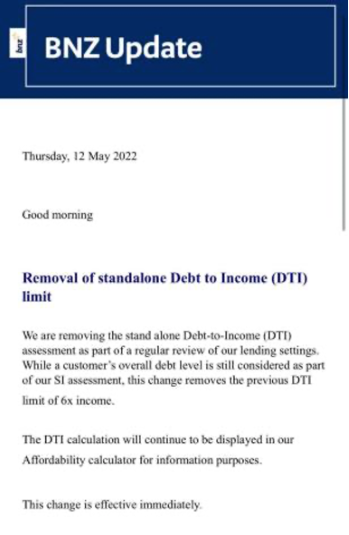
YIJU contacted several senior mortgage advisers at Goldsmith Mortgages for their exclusive analysis:
Q: What do you make of BNZ's recent decision to scrap DTI?
Goldsmith Mortgages team: We should not overlook the fact that, while scrapping DTI, BNZ has also followed other commercial banks in raising its mortgage stress-test rate, from 6.75% to 7.25%. With income unchanged, this reduces the amount customers can borrow. Put simply, the negative and positive effects on the market almost cancel each other out. BNZ's move is more about expanding its personal home loan business. Overall, however, it is still positive news for the mortgage market because it gives our clients more choices when applying for loans. We very much welcome moves like this from mainstream banks.
Q: What is the difference between applying directly to a bank and applying for a mortgage through an experienced adviser?
Goldsmith Mortgages team: As we explained in the previous answer, each bank has different lending rules and requirements. Although BNZ has scrapped DTI, it has increased its stress-test interest rate. Our professional advisers at Goldsmith Mortgages therefore provide clients with timely, accurate information based on their individual circumstances and the latest market developments. Matching them with a suitable loan package from a bank or financial institution is the most important part of the application process. Otherwise, if one bank or financial institution declines an application and the client then approaches another, this works against them. It wastes time and can also make borrowing more difficult!
Our team's strength is that our senior mortgage advisers know the interest rates and lending policies of different banks and lenders extremely well. This is particularly important in financial markets that change rapidly every day. We also have strong bargaining power, as each bank allows different margins above or below its base rate. Based on a client's financial credentials, we can make a strong case to secure the safest and most affordable loan options for them.
Contact details

Phone: 09 555 1608
Email:admin@goldsmithmortgages.co.nz
Disclaimer: The views above do not represent YIJU's position. Please call the Goldsmith Mortgages team for professional investment and financial advice.