
New Zealand's property “bargain list” is out! Can buyers really find bargains in these areas?
Yesterday, YIJU New Zealand's lead article covered the latest national house price index report. It sparked a wave of discussion, click to read the article.
Yesterday, YIJU New Zealand's lead article covered the latest national house price index report.(Click to read the article) It sparked a wave of online discussion about which New Zealand cities and suburbs had seen house prices fall, and which were still growing and offered potential to retain or increase their value. Some suggested that now might be the best time to enter the market: listings had surged, leaving buyers with plenty of homes to choose from without having to outbid others at auction. Buyers could take their time and negotiate a good price with owners.
But is that really the state of the property market? Figures recently released by Realestate.co.nz showed that 26,301 residential properties were available for sale nationwide on its website at the end of May, up 76.7% from the end of May last year. In many regions, the number of homes available had more than doubled in a year. Wellington recorded the largest increase, with stock levels up 188% compared with May last year, followed by the Central North Island, up 165%; Hawke's Bay, up 148%; Wairarapa, up 143%; Bay of Plenty, up 143%; Manawatū/Whanganui, up 142%; Nelson and Bays, up 116%; and Waikato, up 106%.
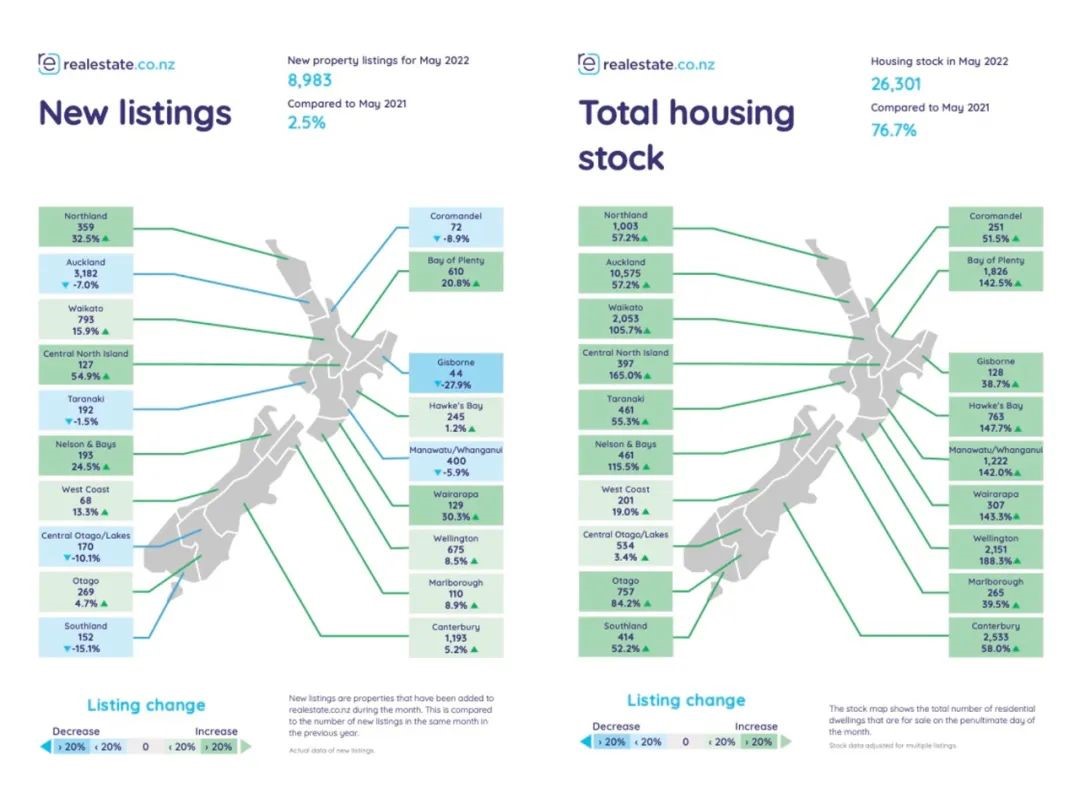
New listings nationwide in May rose by only 2.5% compared with May 2021. The first chart above shows new listings by region. This suggests that the increase in stock was almost entirely due to slower sales. According to the Real Estate Institute of New Zealand, 4860 residential properties sold in April this year, down 35% from April last year. There are signs that abundant stock and low sales volumes have begun to affect asking prices.
Across Realestate.co.nz's 18 sales regions, average asking prices in May were lower than in April. Waikato recorded the largest decline, with its average asking price in May down 15.5% from April, followed by Gisborne, down 9.2%; Hawke's Bay, down 5.9%; and Southland, down 5.8%. More stock and softer prices are clearly good news for prospective buyers. For sellers, the market has become more difficult. They need to pay particular attention to presenting their properties well and setting realistic prices to secure a sale as quickly as possible.
{ad}
So where might buyers find a bargain?
YIJU New Zealand's article on the national house price index report showed that central areas in some cities had experienced the largest house price declines over the past year.
According to the latest OneRoof-Valocity figures, average property values in Oriental Bay, Auckland CBD, Meremere and Newmarket are now between 1% and 2.9% lower than in June 2021. Owners in these 4 suburbs could be in negative equity, as average house prices in these areas have fallen by at least 3% over the past year. Prices in another 124 suburbs are now below their levels 6 months ago, and more areas could record losses in the coming months. Over the past 12 months, Auckland CBD's average house price fell by NZ$19,000 to NZ$637,000. In neighbouring Newmarket, the average fell by NZ$10,000 to NZ$1,006,000 over the same period. Meremere in Waikato recorded a decline of NZ$12,000 to NZ$496,000. In Oriental Bay, Wellington's most expensive suburb, the average fell from NZ$2,674,000 to NZ$2,657,000, a drop of nearly NZ$41,000. Two other suburbs also recorded annual declines, but unlike the four above, they had fewer than 20 property sales over the past 12 months. These were Wellington's Pipitea and Waikato's Hampton Downs, where prices fell by 4.9% and 2.3% respectively year on year.
Valocity senior research analyst Wayne Shum said city-centre house prices tended to fall first during a market slowdown, as had happened in Auckland CBD, Newmarket and Oriental Bay. Auckland CBD apartments had been popular rental choices for international students and Airbnb guests, but that demand had disappeared with the arrival of Covid-19.
Tommy's Real Estate sales director Nicki Cruickshank said the 1.5% decline in Oriental Bay's average sale price could reflect reduced demand for central-city properties. “We also have people returning from overseas buying these apartments, but demand has definitely fallen. Last year and the year before, quite a few people returned because of the pandemic. We have very few returning at present, so that could be another reason for the decline.” Pipitea's average house price fell from NZ$819,000 a year ago to NZ$779,000, which she attributed to investors and first-home buyers leaving the market because of stringent lending rules. “First-home buyers usually make up more than a quarter of our market. I estimate that has now fallen to around 10% at most, so our first-home buyer market has halved.” She believed the most sought-after properties in Wellington were currently three- to four-bedroom family homes in suburbs on the city's fringes, such as Island Bay, Hataitai, Khandallah and Karori, where people were either upsizing or downsizing.
LJ Hooker Huntly sales manager Sheryl Hamilton said markets everywhere were “flat”, and they were working hard to attract people to open homes. She said Meremere's reported price decline of 2.4% over 12 months was little different from falls elsewhere in Waikato. Early this year, two three-bedroom brick homes at a property in Hamilton's Meremere sold to Auckland investors for NZ$500,000 above market value, setting a local sale-price record. She did not think that price could be achieved now.
LJ Hooker Pokeno owner Fred Heikell said Meremere offered “huge potential value” compared with other parts of Auckland, which had drawn Auckland investors to buy there over the past two years. It was not a glamorous area, but its proximity to Hampton Downs offered some employment opportunities and attracted first-home buyers too. Although Hampton Downs had also recorded a decline over the past 12 months, its racecourse made its market entirely different from Meremere's.
Three other New Zealand suburbs—Forbury in Dunedin, Clutha in Otago and Grafton in Auckland—recorded growth of less than 2% over the past year and were below their average sale-price levels of a year earlier. Another 498 suburbs on the “bargain list” recorded zero or negative growth in the three months to the end of May. That represented more than half of the 984 suburbs nationwide with more than 20 recorded property sales over the past 12 months. About 330 suburbs had no recorded sales at all.
Over the past three months, Chatswood on Auckland's North Shore recorded the largest house price decline, with its average down 8.1%, or NZ$153,000, to NZ$1,725,000. Okura Bush in Auckland's Rodney district recorded the largest dollar loss, with its average plunging NZ$183,000 to NZ$3,035,000.
Hamilton Lake in Hamilton suffered the country's second-largest house price hit, falling NZ$80,000 to NZ$1,031,000. It was followed by Wellington's Roseneath, down NZ$69,000 to NZ$1,947,000, and Wanaka in Queenstown Lakes, down NZ$5400 to NZ$2,040,000. Otumoetai in Tauranga and Kennedys Bush in Christchurch also each fell NZ$32,000 to NZ$1,814,000.
With falling prices showing red across almost the entire New Zealand housing market, many say buyers can wait a little longer in case prices fall further. Others say prices cannot fall much, given land prices and construction costs, and that now is a good time to enter the market...