
Are more sellers missing their best chance to sell by refusing to accept today's property market realities?
The property market moves in cycles, with falls following rises. When most people blindly assume prices will keep rising, events may take a different turn.

The latest QV House Price Index shows that average house prices fell in almost every region nationwide in May compared with April this year. The index tracks average house prices across 16 main cities and districts, from Whangarei to Invercargill. It found that, apart from Queenstown Lakes, where prices continued to rise, average property prices in every other area were lower in May than in April.
Specifically, the nationwide average house price in May was NZ$1,030,221, down NZ$10,706 from April and NZ$33,544 from January. Compared with April, the largest decline in May was in Napier, at NZ$29,634, followed by Wellington at NZ$25,196 and Auckland at NZ$23,182. Looking further back, the largest decline since the start of this year was in Auckland, at NZ$71543, followed by Wellington at NZ$64849 and Palmerston North at NZ$46655. The table below shows house price trends in all New Zealand's main centres since the start of the year.
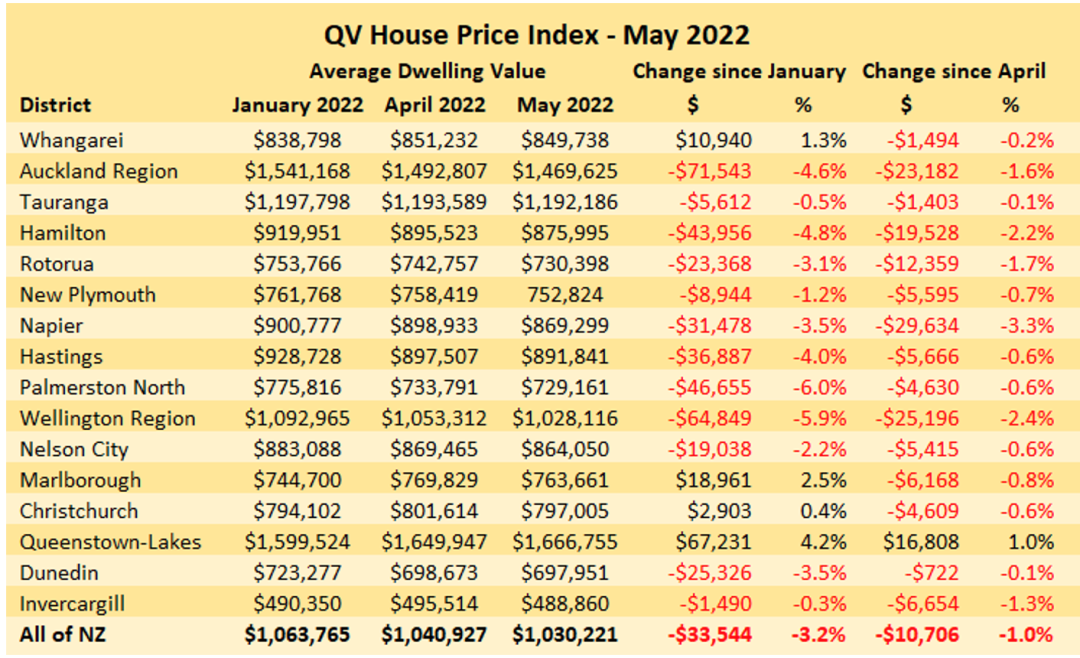
Source: Interest.co.nz
History has repeatedly shown that the property market moves in cycles, with falls following rises. When most people blindly assume prices will keep rising, events may take a different turn. As early as a year ago, prominent economist Tony Alexander noted in speeches and commentaries that, whether people were discussing the short, medium or long term, New Zealand was already nearing the end of the house price upswing that began in June 2020. Previous property booms in New Zealand occurred between 2012 and 2015, depending on the region, while the boom in 1992 produced an average annual nationwide property value gain of 7%.

Prominent economist Tony Alexander
Alexander believes tighter credit was the main factor behind the market's turn after Auckland house prices peaked in November and prices elsewhere peaked in February. Banks began reducing low-deposit lending in November, and stricter new lending rules took effect in December. Other factors affecting the market had already been at work: loan-to-value ratio rules (DTI) began to be reinstated in February 2021 and were strengthened in May. Tax rules affecting investors became stricter from the end of March. Banks' fixed mortgage rates also began rising steadily from the start of 2021 through to the end of last year.
{ad}
Alexander's monthly real estate agent survey, conducted with REINZ, shows that back in October last year, 70% of agents reported seeing buyers display FOMO — fear of missing out. That figure fell to 21% in January this year, to 7% in February, and to just 4% in the latest survey. By contrast, in October last year, 19% of agents said buyers were displaying FOOP — fear of overpaying. That proportion is now 73%.
Market turning points can be brutal. Surveys of real estate agencies explain why annual property sales have fallen from a peak of 100,000 in the middle of last year to 78,000, and are likely to drop below 65,000. This is not simply because buyers feel the market now favours them. Sellers have also shown considerable reluctance to accept that they missed the frenzied prices of late 2021. This attitude has cost many sellers dearly. In a falling market, the first offer is often the highest. Rejecting it can trap sellers in a vicious cycle of lowering their asking price, rejecting offers below that level, then lowering it again.
Alexander points out that the current property market slump may be more about sellers than buyers, with unemployment at a historic low and job security very high. When agents were asked in the latest survey what buyers were most concerned about, only 8% cited employment and income at the end of May, compared with 13% in October last year. Rising interest rates were buyers' biggest concern according to 83% of agents, followed by financing, cited by 74%. Only 7% said a shortage of listings was a problem, a substantial fall from 66% in October last year.
To explore these views, YIJU also spoke with two real estate agent friends who have remained active in Auckland's property market. Through these conversations, we hope to give readers an accurate picture of current market conditions.
Q: There was a report about a seller who reduced their asking price by 50,000 each week for several weeks without securing a sale. Do you feel market prices are falling rapidly?
Gavin Han:This does happen, but it is not common and does not represent the direction of the entire property market. Owners who are not in a hurry to sell are under little pressure and will sell only when the price is right. Some people urgently cutting prices may be developers under pressure from their own circumstances, needing funds quickly for other projects or investments.
Cindy Guo:It depends on the property's underlying value, location, condition and other factors. Good investment opportunities and properties have not changed greatly, but properties are certainly taking longer to sell. Prices depend more on how urgently owners need to sell. A weekly price reduction of 50,000 is likely an isolated case and does not reflect the broader market trend.
Q: As the market shifts from FOMO to FOOP, are more sellers missing their best chance to sell because they refuse to accept reality?
Gavin Han:Owners who bought long ago tend to have more reasonable price expectations and find market prices easier to accept. Those who bought recently paid higher prices, and their purchase price plus other expenses already sets a limit on what they can accept when selling. In a weak market, accepting the prevailing price is difficult. Properties now take longer to sell after listing, with 3–5 months quite common. Owners' price expectations often remain fixed at the time of listing — looking back to 2–March — while the market has already changed substantially. Without adjusting their expectations promptly, they can miss an opportunity to sell.
Cindy Guo:That does happen. However, if sellers are selling and buying in the same market, their sale price may look less attractive than during a booming market, but the investment they buy at the same time may also be cheaper. So although the price may appear lower than in a booming market, the overall difference may be small.
Q: Is now the time to pick up a bargain, or should people wait until prices bottom out and rebound before buying?
Gavin Han:Opportunities always favour those who are prepared. In property, you also need the financial capacity to seize them. Finding a “bargain” really means understanding the market well enough to act quickly and confidently when the right opportunity arises, and, above all, having the funds available. For owner-occupiers, the most important thing should be finding a home they love while their loan pre-approval remains valid, acting promptly and creating a stable, welcoming home for themselves and their family. If you feel confused about the current market, a conversation with me may help clarify things.
Cindy Guo:I mainly sell lifestyle properties, and that market is not very different from before. Unlike the residential market, there are few lifestyle properties available and few new listings. So if you find a lifestyle property you are happy with at the right price, it is worth buying.
The views above are personal opinions and are provided for reference only.