
Property data round-up from leading agencies, how is Auckland performing in a subdued housing market?
A total of 78 residential properties went to auction in the week from 25 June to 1 July, down from 100 the previous week.

Latest auction figures
The latest auction results released by Auckland's largest real estate agency, Barfoot & Thompson, show that 78 residential properties went to auction in the week from 25 June to 1 July, down from 100 the previous week. Of the 78 properties offered, 15 sold, giving an auction clearance rate of 19%. Although fewer properties went to auction last week, the clearance rate changed little from the previous week's 17%. Across Auckland, only three main areas had more than 10 properties go to auction: the North Shore (15), central Auckland (30) and south Auckland (13). Clearance rates in central Auckland and the North Shore were just 8% and 17%, respectively.
Changes in property listings and asking prices
Property website Realestate.co.nz recently reported that the number of properties listed for sale had almost doubled over the past year, from 13861 at the end of June last year to 26271 at the end of June this year. Although new listings increased by 89.5%, asking prices continued to fall.
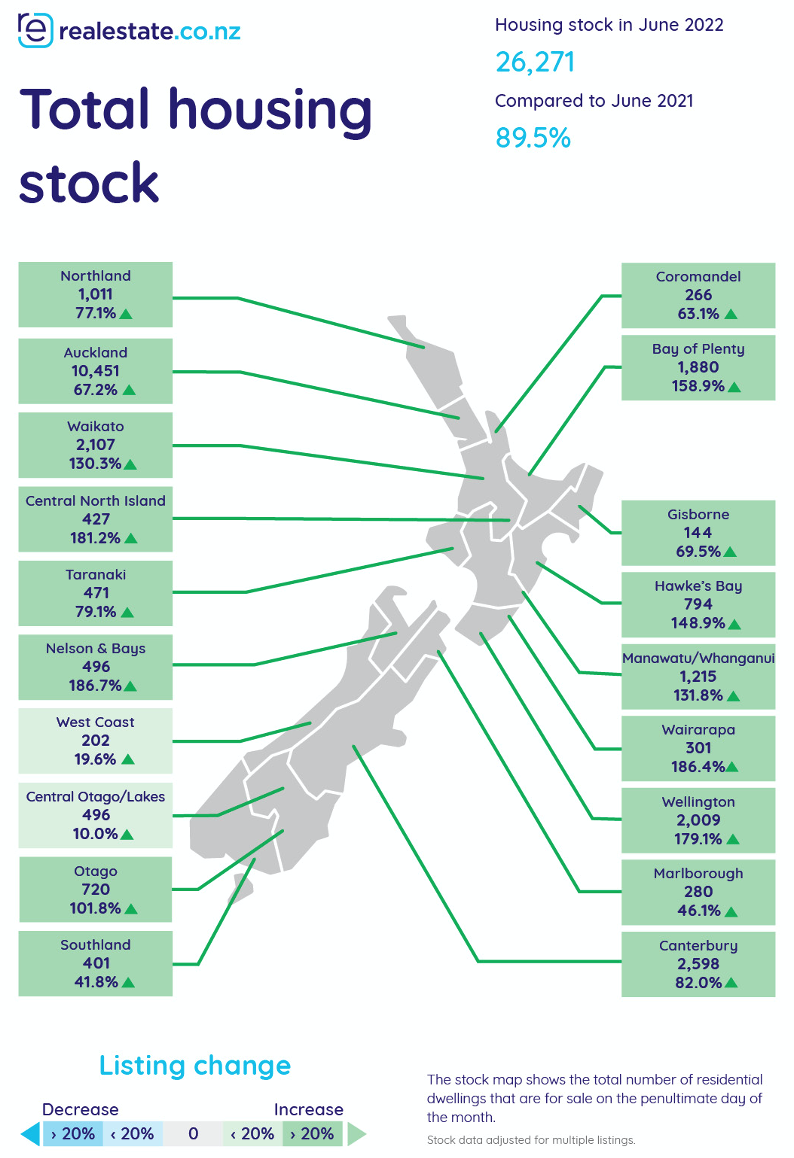
The chart above shows annual changes in the number of homes available for sale across New Zealand's regions. Over the past 12 months, available housing stock increased strongly nationwide. Wairarapa recorded the largest annual increase, at 186.4%, followed by Nelson & Bays at 186.7%, Central North Island at 181.2%, Wellington at 179.1% and Bay of Plenty at 158.9%. The smallest increases in stock were in Central Otago/Lakes, up 10.0%, Westport, up 19.6%, and Southland, up 41.8%.
The latest figures also show that sellers are lowering their price expectations as they recognise that buyers now have more choice. At the end of June, the national average asking price for properties listed on Realestate.co.nz was NZ$992,432, down NZ$972,553 (-7.2%) from this year's January peak of NZ$994,885. Average asking prices are now falling in all New Zealand's main urban areas, with Waikato, Bay of Plenty and Wellington having dropped out of the million-dollar club. Only Auckland, Coromandel and Central Otago/Lakes still have average asking prices above NZ$1,000,000, and prices in these areas are also falling. In Auckland, the average asking price fell from a peak of NZ$1,279,330 in January to NZ$1,167,121 at the end of June, a decline of NZ$112,209 (-8.8%). In Wellington, it fell from a peak of NZ$1,013,206 in January to NZ$934,657 in June, down NZ$78,549 (-7.8%). Auckland and Wellington have remained buyers' markets for three consecutive months, suggesting that slower sales in these regions may persist.
Property industry experts assess the housing market
In a recently published housing market assessment, James Wilson, head of valuations at property data company Valocity, said Auckland's housing downturn was now beyond doubt. Prices had fallen substantially from the market peak, with most areas recording declines of varying sizes. CoreLogic figures show that more than half (119) of Auckland's 206 suburbs recorded price falls of at least 1% over the past three months. Another 36 suburbs recorded declines of less than 1%. Of the 11 suburbs nationwide where prices fell by more than 5%, 5 were in Auckland: Pakuranga Heights, 6.7%; New Windsor, 6.3%; Waterview, 5.5%; Rosedale, 5.5%; and Avondale, 5.0%. CoreLogic chief property economist Kelvin Davidson said Auckland had been at the forefront of falling house prices and was experiencing a reasonably substantial decline. He said the region's high prices had stretched affordability, so the decline was unsurprising. Despite continuing price falls, only 23 Auckland suburbs had a median house price below NZ$1,000,000, and just one had a median below NZ$600,000: Auckland's central business district.
Some areas have undoubtedly been hit harder by the slowdown, including central Auckland. City Sales sales manager Scott Dunn said properties there were taking longer to sell and prices were falling, largely because of tighter finance and rising interest rates. Buyers were becoming more selective and less inclined to rush into decisions. Last year, fear of missing out motivated them; this year, they were happy to wait for the right property. He also said high-end apartments in central Auckland were still selling well. Although activity appeared slower, their sales volumes were now higher than during the traditionally busy peak months of month 3 and April, when Covid had affected activity. Over the next 12 to 18 months, Dunn expected more investors to try to sell properties to free up cash as interest rates continued to rise. More small apartments coming onto the market this year would put some downward pressure on prices.
{ad}
According to Real Estate Institute figures, the North Shore is another area where house prices have fallen year on year. Harcourts Cooper & Co managing director Martin Cooper said the market was adjusting from its boom-time highs. He said: "At last year's peak, there were 1000 listings, which was very low. The lack of choice created a fear of missing out and drove intense competition. Two months ago, listings surged to 1608, which was very high, but there are now 1379 listings, suggesting the market is in much better shape. People still want to buy, and motivated sellers can find buyers." He said the growth that had occurred was unsustainable. Auckland's market correction was not a crisis but part of the cycle, offering more opportunities for first-home buyers.
Auckland investor David Whitburn, a former president of the Auckland Property Investors' Association, said that although the outlook for Auckland's market appeared unpromising, some areas would perform better than others over the coming months. Suburbs near town centres, such as Takapuna, Manukau, Albany and Westgate, which are employment hubs with infrastructure, would perform more strongly. Inner western and eastern suburbs such as Ponsonby, Westmere, Kohimarama and St Heliers had traditionally held up better when the market softened.
Property Ventures real estate director Mark Honeybone believed there would be some hope at the end of the downturn, as suggested by a recent recovery in enquiries about new builds. He said Auckland's new-build market had been very quiet over the past six months because of tighter lending conditions and a lack of confidence. Over the past three weeks, however, he had seen some experienced investors return to the market. CCCFA lending rules might also be eased somewhat in July, potentially creating more opportunities. His instinct was that interest rates were close to their peak and Auckland house prices were close to their floor.
To explore recent developments in Auckland's property market, YIJU again contacted several experienced Auckland property sales consultants for an urgent discussion, aiming to give readers insight into the latest trends on the front line.
Q: The recently released property data is not particularly encouraging. As sales consultants on the front line, what are you seeing?
Gavin Han:The property market as a whole has been very subdued. Traditionally, though, winter is the quiet season, and with school holidays coming up over the next few weeks, families with children will put viewing and buying on hold. Buyers are hesitant and selective at viewings and do not want to rush into decisions. However, bank lending rates will also continue to rise. Buyers need to judge the timing and balance the possibility of finding a cheaper home against facing higher mortgage rates.
Crystal Chen:The main reasons are rising interest rates, tighter lending conditions, including the reinstatement of LVR restrictions, and the introduction of the CCCFA. There are currently more properties to choose from, and our buyers are inclined to wait and see. However, many are still watching closely. There are plenty of good properties on the market, and buyers with cash available or approved lending may have a good opportunity to pick up a bargain.
Jenny Zhao:Although we are struggling, sandwiched between high inflation and high interest rates, long-term property investors see this as the best time to buy because there are relatively fewer competing buyers. There is no universally ideal time to buy a home. Finding the right property within your budget makes it the right time.
Q: What other positive developments or bright spots in the property market should potential buyers, particularly first-home buyers, watch for?
Gavin Han:Listings have increased substantially compared with last year, while there are fewer competing buyers. More properties are failing to sell at auction, giving buyers greater bargaining power with owners. However, buyers should still arrange lending pre-approval and actively view properties in person. They need to seize opportunities rather than wait passively.
Crystal Chen:For first-home buyers, the government raised the house price caps for the First Home Grant in May. First-home buyers can now purchase a new or existing Auckland property for less than NZ$875,000 and qualify for the grant. Some financial institutions also offer preferential mortgage rates to first-home buyers. Depending on their circumstances, first-home buyers can look for properties with low maintenance costs or strong rental potential to achieve positive cash flow over the next few years.
Jenny Zhao:The property market has moved from a boom through a correction to a more rational phase. Buyers have also shifted from buying blindly to making rational decisions, and the market is gradually becoming more orderly. As speculators progressively leave, genuine buyers are benefiting from a range of favourable developments.
Disclaimer: The views above are for reference only and do not represent YIJU's position.