
New Zealand CPI hits a 32-year high of 7.3%! Four practical tips to help borrowers cut spending
Stats NZ released its latest quarterly consumers price index this morning. In the second quarter, ending in June, New Zealand's inflation rate reached 7.3%, its highest level since 1990. That is not the only recent bad news. As widely expected, the Reserve Bank raised the official cash rate (OCR) again last week by 0.5%, taking it to 2.5%. Although this is the highest official cash rate in nearly six years, inflation remains so high that forecasters expect another 0.5% increase on 17 August, followed by further increases of 0.25% each in October and November. This would bring the OCR to at least 3.5% by the end of this year.
Stats NZ released its latest quarterly consumers price index this morning. In the second quarter, ending in June, New Zealand's inflation rate reached 7.3%, its highest level since 1990. That is not the only recent bad news. As widely expected, the Reserve Bank raised the official cash rate (OCR) again last week by 0.5%, taking it to 2.5%. Although this is the highest official cash rate in nearly six years, inflation remains so high that forecasters expect another 0.5% increase on 17 August, followed by further increases of 0.25% each in October and November. This would bring the OCR to at least 3.5% by the end of this year.
{ad}
So, next year, will the OCR continue to rise?
Although the Reserve Bank has repeatedly said the OCR will peak at around 4%, inflation often responds to OCR changes with a lag. In other words, this rate increase may only affect next year's economic indicators. If an economic downturn emerges earlier than expected, the likelihood of the OCR exceeding 4% will increase substantially.
For the property market, the current monetary tightening is putting upward pressure on mortgage interest rates and downward pressure on house prices. All borrowers need to recognise that one-year fixed mortgage rates have risen from a range of 2.19%–2.5% a year ago to 5%–5.5% now. In annual mortgage payments, this equates to around NZ$2050 more in interest each year for every NZ$100,000 of debt. This will inevitably test borrowers' current finances, let alone those of first-home buyers about to enter the market. Even with higher incomes and house prices noticeably lower than last year, mortgage affordability has not improved much for them.
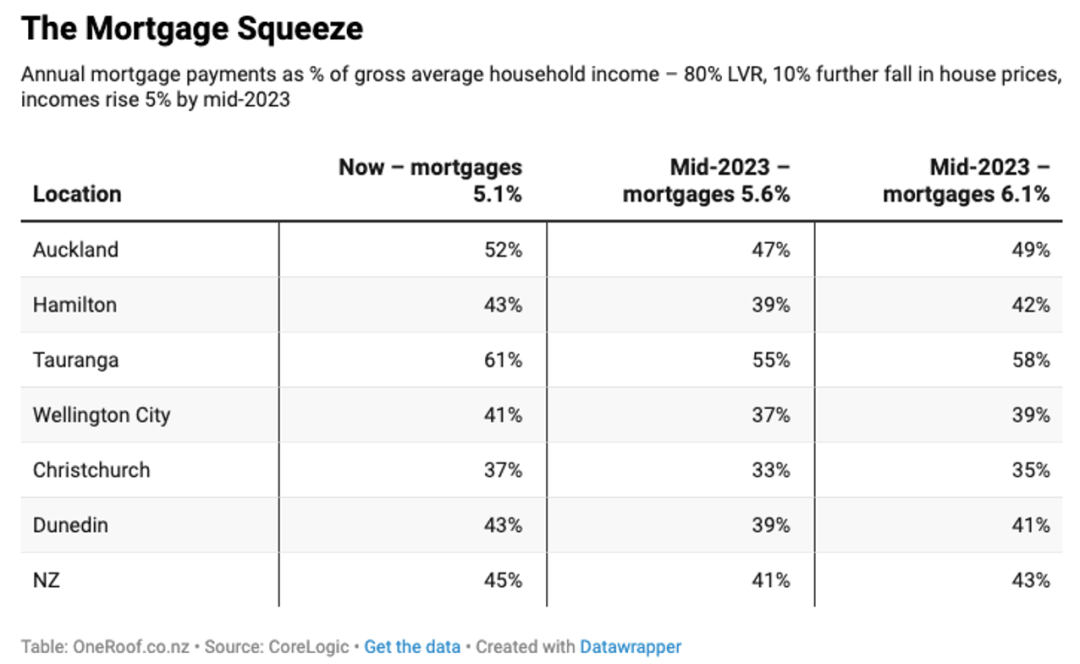
As the table below shows, if mortgage rates rise another 1% by the middle of next year, from 5.1% to 6.1%, while house prices fall 10% and incomes rise 5%, interest payments for new borrowers across New Zealand would still average 43% of their income, only slightly below the current 45%. The situation is more severe in Auckland, where average mortgage interest payments would account for 49% of borrowers' income, only a little better than the current 52%.
Have mortgage rates peaked?
Given that the Reserve Bank's OCR will continue rising for some time, and inflation in New Zealand and globally has yet to ease to any significant degree, it seems unlikely that we will see the end of rising mortgage rates during this cycle. Encouragingly, some major lenders have recently begun lowering fixed mortgage rates for several key terms, suggesting that competitive pressure between banks is restraining further increases. CoreLogic chief economist Kelvin Davidson said the property market could continue to face a testing period in the second half of 2022 and throughout 2023.
How borrowers can effectively cut spending
Some existing borrowers will soon face the challenge of higher interest rates. They are currently locked into last year's record-low fixed rates; Reserve Bank of New Zealand figures show the average interest rate on existing loans is still just 3.2%. This means that as those fixed terms expire and loans are repriced, countless borrowers will face the repayment pressure of rates between 5.19% and 5.35%, or higher. MortgageLab founder Rupert Gough advises homeowners to plan sensible cutbacks to manage their budgets. They can do this in the following ways:
There are plenty of free budgeting apps and websites, such as PocketSmith.com, as well as features within banking apps, such as Westpac's CashNav, that can categorise your spending. Before long, you will be able to see clearly where most of your money goes in any given month.
1
Everyday household groceries
Food and groceries make up a substantial share of the average household's spending, so this is an essential place to look for savings. With high inflation seriously affecting weekly household purchases, it makes sense to seek discounts on items you buy regularly and find lower-priced alternatives. This can save considerable money without sacrificing quality. Remember, the purpose of changing your shopping habits is to save money, rather than buying cheaper goods more often and ending up spending more. YIJU strongly recommends comparing prices on this website before heading to the supermarket to buy your regular items: https://grocer.nz/.
2
Transport costs
Once you have bought enough groceries within a stretched household budget, daily commuting costs are the next consideration. If high fuel prices and daily parking charges have become unbearable, consider public transport to reduce spending. As summer approaches in New Zealand, cycling or using an electric scooter could save even more. YIJU has learnt the good news that the government has just announced an extension of half-price public transport fares into 2023. Of course, the ultimate way to save on transport is to work from home. For example, an ordinary commuter spending NZ$200 of after-tax income each week on fuel, parking and vehicle maintenance could save the equivalent of around NZ$15000 in annual pre-tax earnings.
3
Leisure and entertainment spending
Further savings could come from leisure and entertainment, including takeaway coffees and food, cinema trips, and subscriptions to digital media apps you rarely use. Cutting spending does not mean giving up every leisure activity. For example, instead of spending NZ$200 each week on a date involving a film and dinner out, you could cook at home and watch a Netflix film for a total of around $30.
4
Increase your income wherever possible
Asking your employer for a pay rise at an appropriate time, or changing jobs to increase your salary, are both worth considering. If a pay rise is out of reach, starting a side business could also be a good way to bring in more income.
Enough said — this writer is already considering driving for Uber in my spare time, running a small online business, or setting up a stall at an Auckland Sunday market. Passing the time while making money: why wouldn't you?