
New Zealand’s latest August house price index is out, who are the biggest winners and losers?
The latest New Zealand house price index released today by OneRoof-Valocity shows no sign of the housing market downturn easing, with the national average house price falling 3.6% over the past three months. Most regions recorded varying degrees of negative or zero growth over the quarter. Greater Wellington was hardest hit, with prices plunging 8.6% (NZ$97,000) to an average of NZ$1,027,000. That is NZ$12,000 below the average at the end of July 2021.
The latest New Zealand house price index released today by OneRoof-Valocity shows no sign of the housing market downturn easing, with the national average house price falling 3.6% over the past three months. Most regions recorded varying degrees of negative or zero growth over the quarter. Greater Wellington was hardest hit, with prices plunging 8.6% (NZ$97,000) to an average of NZ$1,027,000. That is NZ$12,000 below the average at the end of July 2021.
{ad}
Although Auckland’s average property price has fallen a relatively modest 4.4% since May, this is its fifth consecutive quarterly decline. The average is up just 5.1% on the same time last year.
The slowdown in house prices has also spread to Canterbury, where the property market was very active in the first half of this year. Property sales rose 2.1% in the three months to the end of June, but the average property price fell 0.4% over the quarter to NZ$789,000.
In the capital, Wellington, the average property price fell 10% (NZ$132,000) over the quarter to NZ$1,187,000, down NZ$14,000 on the same time last year. Among other major cities over the same period, Tauranga’s average fell 5.1%, Dunedin and Hamilton recorded falls of around 3%, and Christchurch’s average declined 0.4%.
Few areas recorded house price increases over the past three months. Westport and Tasman rose 2.3% and 0.2% respectively. The Queenstown Lakes property market also retained some momentum, with its average property price rising 1.3% over the quarter to NZ$1,879,000.
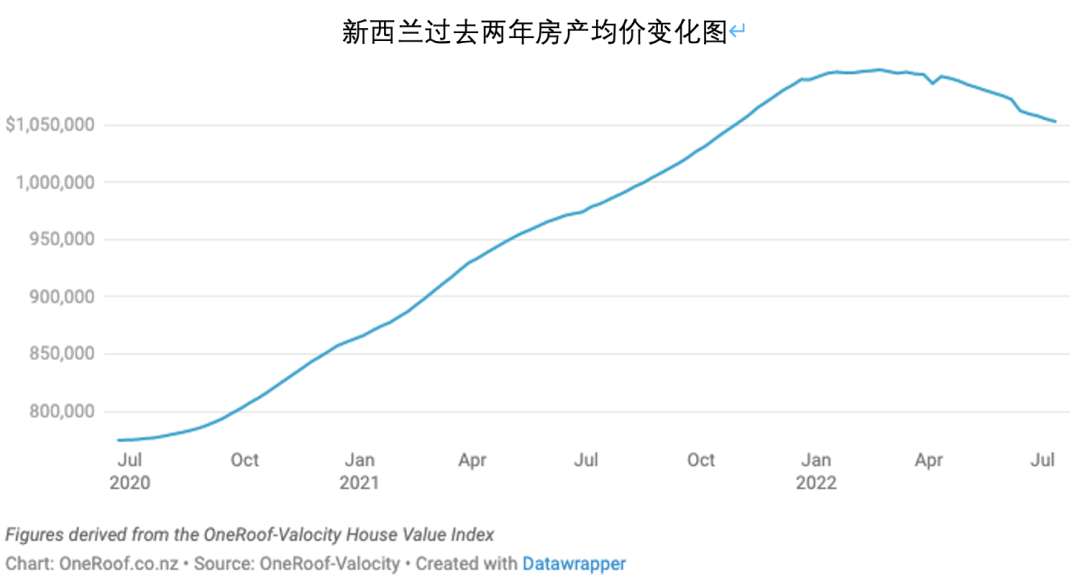
Changes in New Zealand’s average property price over the past two years
James Wilson, head of valuations at OneRoof’s data partner Valocity, says several factors have driven house prices down, including record-high inflation and rapidly rising lending rates. Most of the country has experienced falling prices over the past three months, with 13 of the 16 regions and 56 of the 72 residential areas recording negative price growth. That is a major shift from the start of this year, when property prices were still rising nationwide. Worse still, prices in Auckland, Bay of Plenty, Gisborne, Hawke’s Bay, Manawatū-Whanganui, Nelson and Wellington have fallen back to their levels of 6 months ago. Prices in Lower Hutt, Upper Hutt, Porirua and Wellington have even returned to year-earlier levels, with the downturn wiping out capital gains made in the second half of 2021 and early 2022.
Wilson says Greater Wellington has so far been the epicentre of the country’s house price falls, with six of its eight residential areas experiencing the biggest declines this quarter. By contrast, three of the five best-performing areas were in Canterbury, where lower prices continue to attract buyers. He also notes that falling sales volumes are another sign of market weakness. Nationwide, settled property sales dropped from 28,501 in the first quarter of this year to 17,609 in the second. Meanwhile, despite continuing price falls, affordability remains a problem for many buyers. The national average property price is still NZ$277,000 higher than in July 2020, before the latest nationwide price boom took off.
Valocity head of research Wayne Shum says mortgage registrations have been falling since peaking in March this year. However, first-home buyer mortgage registrations rose in June after the Government eased CCCFA lending application rules. By July, the overall number was broadly steady at 2500 a month. Some lenders have now stopped accepting applications from borrowers with deposits below 20%, which will undoubtedly affect application numbers next quarter.
OneRoof editor Owen Vaughan says changing market conditions may offer an opportunity for some buyers hoping to purchase in major cities. Only 9 Auckland suburbs recorded price increases this quarter, while prices fell in every suburb in Dunedin, Hamilton, Tauranga and Wellington. Some of the largest price movements were in expensive, highly sought-after suburbs that were beyond many buyers’ reach 12 months ago. The situation has now changed considerably. Prices in Auckland’s Ponsonby and Grey Lynn fell around 4% over the past three months, while Herne Bay’s average dropped by as much as NZ$327,000. The entry point for buying in Wellington’s Mount Victoria has also fallen substantially, with prices NZ$83,000 lower than 12 months ago. In nearby Roseneath, prices are down as much as NZ$185,000 from July 2021.
Which areas are the biggest house price winners nationwide?
And which are the biggest losers?
New Zealand’s most expensive suburb: Herne Bay remains New Zealand’s most expensive suburb, with an average property price of NZ$3,880,000. However, that is considerably below its previous average of NZ$4,000,000. Its average price has fallen 7.8% (NZ$327,000) over the past three months and 6.91% over the past six months. Although it is still 2.3% above the average in July last year, the current pace of decline suggests it may not be long before prices return to year-earlier levels. The most expensive suburb outside Auckland is Kelvin Heights in Queenstown Lakes, where the average property price rose just 0.1% this quarter to NZ$2,593,000.
New Zealand’s cheapest suburb: Runanga, in Greymouth, has the country’s lowest average property price at NZ$239,000, with quarterly growth of 1.3% (an increase of NZ$3000). Although New Zealand’s property boom in recent years has not lifted Runanga’s prices to big-city levels, homeowners in the town have still seen average property values rise from NZ$165,000 to NZ$239,000, a capital gain of NZ$74,000. Four other urban areas have average property prices below NZ$300,000: Mataura (NZ$249,000), Cobden (NZ$261,000), Blaketown (NZ$278,000) and Kaitangata in Clutha (NZ$285,000).
New Zealand’s fastest-rising house prices: Glenorchy in Queenstown Lakes recorded the strongest house price growth this quarter, rising 10.7% to NZ$1,423,000. It was followed by Waikato’s Pukekawa, up 9.3% to an average of NZ$1,236,000, and Pokeno, up 8.7% to NZ$1,163,000. Notably, the number of suburbs nationwide recording overall price growth fell from 330 in the three months to the end of June to 223 in the three months to the end of July. Among the country’s major cities, it is difficult to find rising house prices outside Queenstown and Christchurch. Only 9 Auckland suburbs recorded small price increases this quarter.
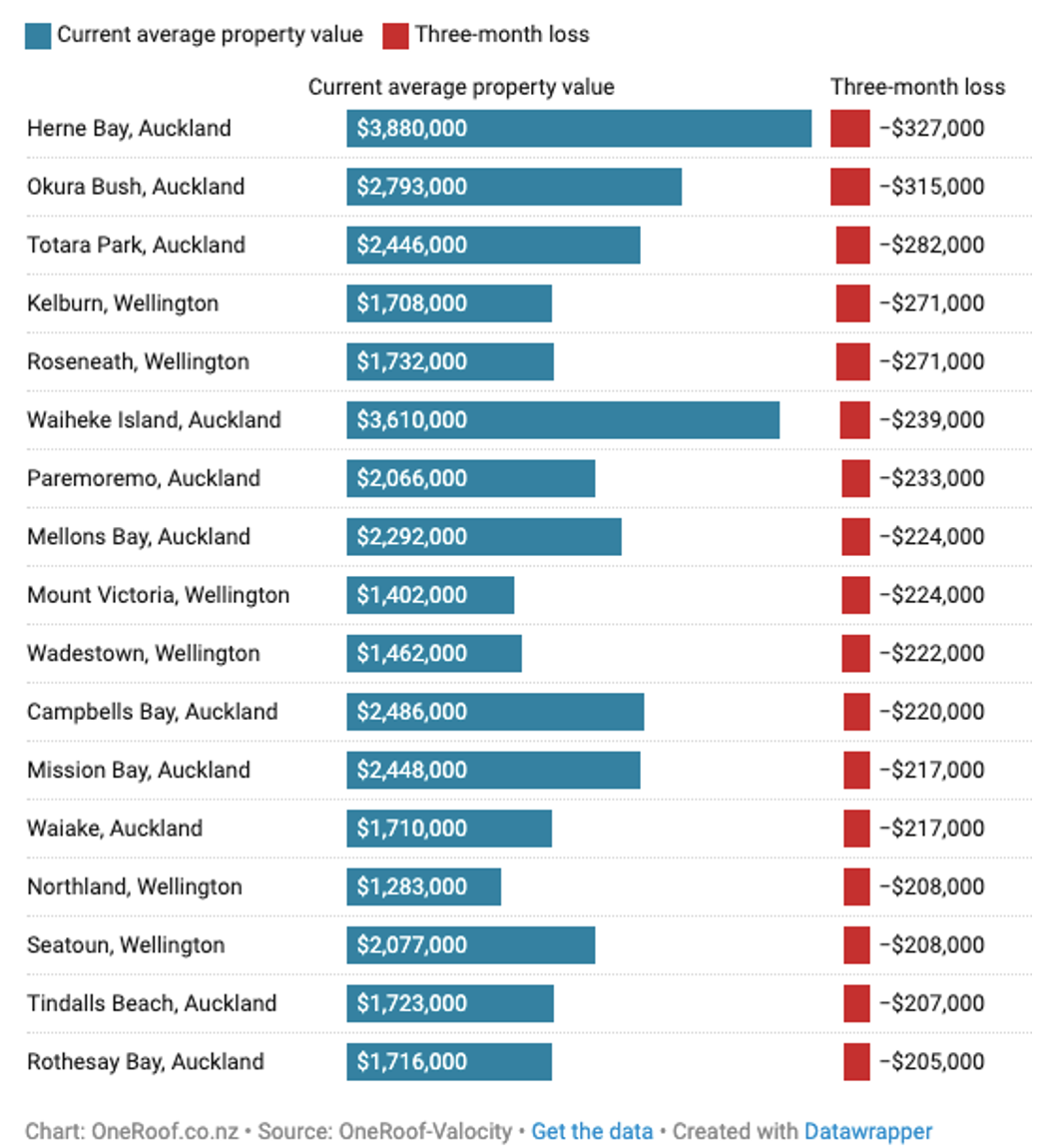
Largest house price falls across New Zealand over the past three months
New Zealand’s fastest-falling house prices: Brown Owl in Upper Hutt has recorded the country’s fastest-falling house prices for the second consecutive month. In the three months to the end of July, its average price fell 15.1%, a drop of NZ$155,000, to NZ$871,000. That is 7.9% below the same time last year. Nationwide, 52 suburbs, mainly in Greater Wellington, recorded double-digit falls this quarter, 18 more than in the three months to the end of June. Herne Bay recorded the largest dollar decline this quarter, with its average property price falling NZ$372,000. Across New Zealand, average property prices fell in 709 suburbs over the past three months, with combined losses exceeding NZ$40,000,000. In 135 suburbs, average prices fell by more than NZ$100,000. Of these, 523 suburbs have seen average prices return to their levels of six months ago, while 99 have returned to year-earlier levels. Wellington’s Roseneath suffered the biggest annual decline, with its average property price NZ$185,000 below its level in July 2021.
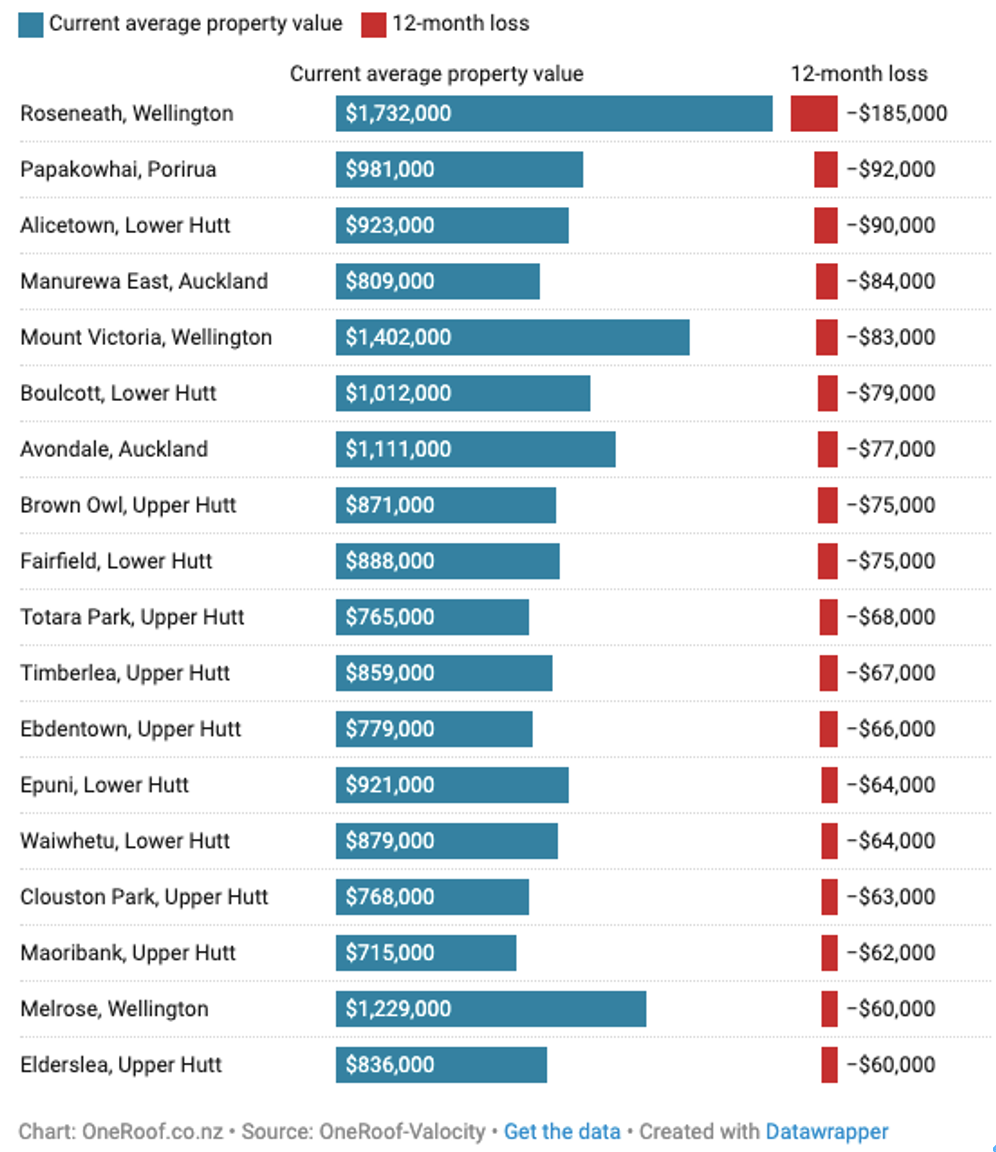
Largest house price falls across New Zealand over the past twelve months