
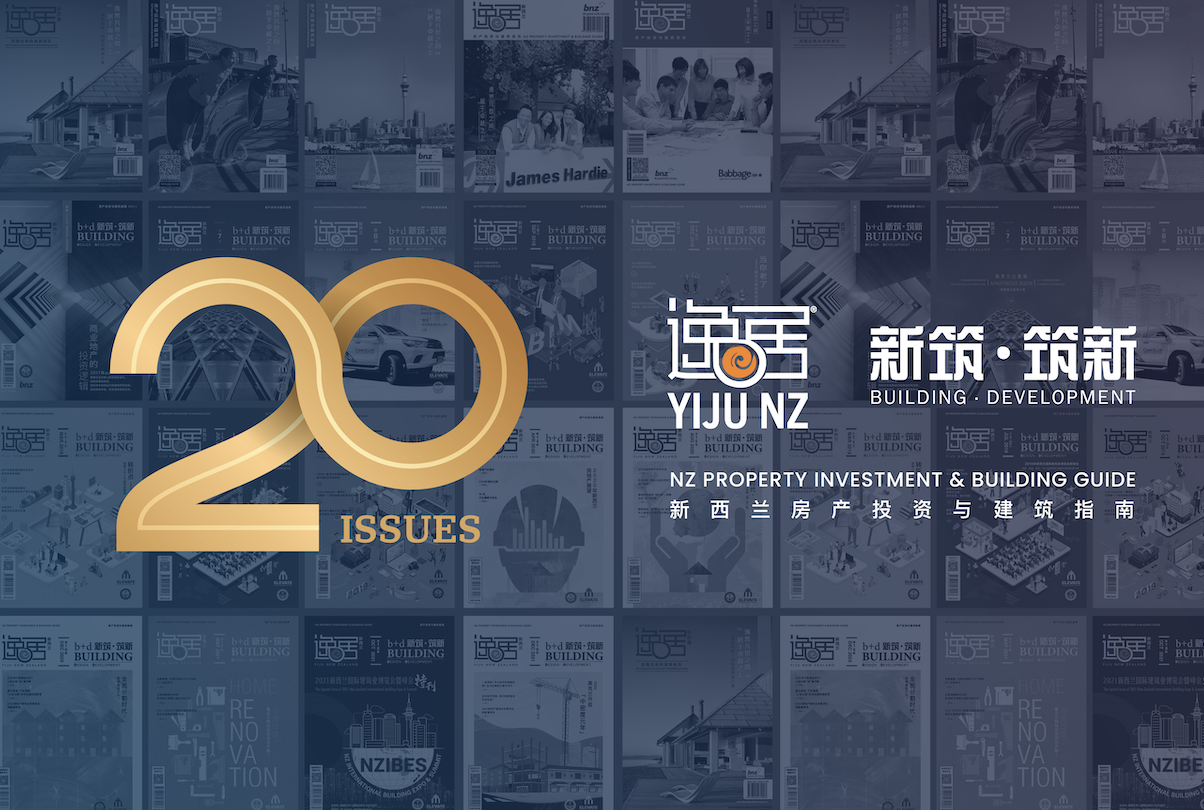
A look back at past issues of YIJU New Zealand
A look back at issues 1–19 of YIJU New Zealand
Yiju 1: The inaugural issue was YIJU’s first greeting to New Zealand’s Chinese community. It established the magazine’s role as a comprehensive source of information on property investment in New Zealand. From an overview of the property market and what buyers need to know to building a dream home, choosing materials, construction laws and regulations, and budget checklists, it shared detailed knowledge and information about New Zealand’s property and construction industry, helping readers avoid pitfalls and realise everything they imagined for their perfect home.
Yiju 2: Which location and type of property best suit your business? Should you lease premises or buy them outright? What factors should you consider to meet your business’s needs in New Zealand? Issue 2 offered a comprehensive introduction to commercial property in New Zealand. By analysing the strengths, weaknesses and considerations associated with different regions and property types, it helped readers find a foundation for a fulfilling working life after settling into a home in New Zealand.
Yiju 3: With house prices continuing to rise, how can you make the wisest property purchase in New Zealand? Once you have found a home you love, how should you maintain and renovate it? How can you turn a property you own into a financial planning tool? These are all questions you need to understand after choosing to make your home in New Zealand. Issue 3 sought to help readers address these concerns through broader market analysis, policy interpretation and architectural design.
Yiju 4: Both the proposed Auckland Unitary Plan and the Special Housing Areas jointly introduced by Auckland Council and the New Zealand Government indicated that higher-density housing would be an important way to increase housing supply. Issue 4 first advanced the view that Auckland’s apartment era was beginning. It offered a detailed, forward-looking analysis of the Auckland apartment market and explained the differences between apartments in China and New Zealand for readers considering a purchase.
Yiju 5: New Zealand’s property market surged ahead in 2016. Under pressure, the Government introduced a series of measures to contain house prices, including tighter lending and increased supply. With competing interests at play, where would the market head next? Maintaining its approach of bold analysis backed by verification from multiple sources, issue 5 examined the policies in depth, assessed how international conditions, the economic outlook and other factors affected the property market, and forecast its future direction.
Yiju 6: As lending policies tightened, the market changed rapidly and competition intensified, New Zealanders also faced a range of political and economic changes. Even when the old order is challenged, the economy’s underlying mechanisms continue to operate. A fresh start makes it all the more important to invest in line with prevailing trends. Issue 6 focused on the logic behind commercial property investment. It explained that success or failure depends on factors including tenants’ uses, street frontage, ease of conversion to other uses, zoning that determines permitted uses, and the economic circumstances of surrounding communities, and offered solutions.
This issue also marked an important experiment in YIJU’s evolution: a joint publication with the New Zealand Chinese Building Industry Association (NZCBIA). Building on its existing investment guidance, it incorporated more specialist construction knowledge and industry trends to better serve Chinese participants in the property and construction industry.
Yiju 7: Issue 7 focused on Auckland’s apartment boom, extending its coverage to medium-density housing and topics including design, project management and commercial construction contracts. The challenges facing apartments reflected Auckland’s wider shift towards medium-density development. Renowned New Zealand architect Paul Brown analysed what made this apartment boom different, while a senior development lending manager at a local bank offered a glimpse into Auckland’s lending environment in 2018.
Yiju 8: Issue 8 explored the contribution of Chinese people to New Zealand’s tourism infrastructure, primarily in Auckland and Queenstown. Previously, most Chinese investors in this sector invested in and operated motels. Now, as travellers’ accommodation needs changed, Chinese-operated Airbnb properties were springing up everywhere, while investors with deeper pockets were moving directly into hotels. These achievements were only a beginning. Would they carve out a place for themselves in the industry?
Yiju 9: Issue 9 explored the future of prefabricated construction in New Zealand. With the Government championing the technology and construction giants already incorporating prefabrication into their corporate strategies, the outlook appeared promising. Yet architects, structural consultants and other professionals had limited knowledge of prefabricated building systems. Banks and other financial institutions had yet to establish risk assessment frameworks for them, leaving buyers’ ability to secure mortgages uncertain. Could prefabricated construction take root and flourish in such an environment?
Yiju 10: As New Zealand’s population ages, both demand for and supply of retirement villages continue to grow. Issue 10 examined older New Zealanders’ housing choices. Some exchange large homes for smaller, more manageable properties, while others choose affordable rental housing. Their living environments also need to adapt promptly as their ability to manage daily life changes. All these issues deserve careful consideration and solutions.
Yiju 11: Issue 11 focused on how Chinese developers in New Zealand could overcome cooling sales, exploring development strategies to help the property and construction industry break through in 2019. Urban renewal and medium-density projects on the North Shore offered development potential with short timeframes and manageable costs. How could West Auckland harness the momentum of its development drive to enter a new phase of growth? Could Westgate become the next Albany?
Yiju 12: Issue 12 highlighted three key features of the 2019 New Zealand International Building Expo & Summit, reporting directly from New Zealand’s premier paired property and construction events. It explored how Chinese participants could lead rapid growth in New Zealand’s construction industry: a community that had already contributed so much needed to unite for shared success and weather the winter together. Prefabricated construction, with its immense potential, was an untapped goldmine that would also bring a disruptive revolution in construction history.
Yiju 13: New Zealand’s hotel industry had experienced a period of significant growth, but tourism slowed from 2019, leaving the hotel market’s outlook uncertain. Issue 13 focused on New Zealand’s tourism and hotel industries. In Auckland, hotels beyond the five-star standard were emerging, ushering the city’s hotel industry into a new era. Technological innovation would ultimately determine the industry’s future, while Auckland and Queenstown were the preferred destinations for overseas hotel investors.
Yiju 14: Issue 14 comprehensively reviewed the property and construction markets in 2019 and announced the companies featured in the 2019 construction industry honours list. It looked ahead to New Zealand’s property market in 2020, with a particular focus on construction industry trends. No construction safety issue is too small. Detailed coverage of the Asian Health and Safety at Work Summit gave readers unable to attend a thorough understanding of managing processes, reducing hazards, improving health and safety awareness, and related safety knowledge.
Yiju 15: The reporting, editing and publication of issue 15 coincided with New Zealand’s entire journey from full pandemic lockdown to the lifting of restrictions and the recovery of business activity. Its theme therefore centred on the COVID-19 pandemic. It comprehensively traced New Zealand’s pandemic response, particularly the Government’s economic support policies. Interviews with industry experts explored both the risks and opportunities facing New Zealand’s construction industry during the pandemic, offering readers thorough, in-depth reporting and market forecasts.
Yiju 16: Issue 16 focused on the promising financial prospects of land subdivision. Interviews with seasoned industry experts and experienced practitioners provided in-depth analysis of land development projects from the perspectives of policy, research, site selection, project initiation, planning and management. The aim was to help readers understand the full subdivision process and avoid development pitfalls.
Yiju 17: Renovating an older home has clear advantages: greater comfort and convenience for owner-occupiers, and potentially higher returns on sale. Yet approval procedures are complex, and many problems can arise during renovation. How can you effectively avoid renovation risks and achieve the best value for money? Issue 17 systematically answered readers’ questions about renovating older homes.
Yiju18:Six years after the founding of the New Zealand International Building Expo & Summit (NZIBES), issue 18 documented the entire occasion in a special edition, covering the exhibition, expo, awards and dinner. Through words and images, readers could see what happened on stage and behind the scenes at 2021 NZIBES, and learn how everyone involved overcame difficulties to deliver an outstanding event amid widespread uncertainty. It also sought to carry forward this spirit within the Chinese construction community, lighting the way at a time of building material shortages and scarce skilled workers.
Yiju19:Since the COVID pandemic began in 2020, medium-density property development, design, construction and transactions have quietly become market favourites. Issue 19 introduced the new view that 2021 marked the beginning of Auckland’s medium-density era in property and construction. Surging house prices, government policies supporting medium- and high-density housing, continued tightening of lending by the Reserve Bank of New Zealand and commercial banks, and the introduction of the strictest rental rules in history all contributed, to varying degrees, to bringing this new era into being.