
Major banks are poised for a mortgage rate-cutting battle, should homeowners take a gamble on floating rates?
With mortgage rates rising steadily this year, homeowners due to refix in the coming months may have to lock in higher fixed rates. However, some believe there are signs rates could fall before the end of the year. That leaves homeowners with a difficult question: is it worth choosing a floating rate over a fixed rate right now?

Major banks are poised for a mortgage rate-cutting battle, should homeowners take a gamble on floating rates?
With mortgage rates rising steadily this year, homeowners due to refix in the coming months may have to lock in higher fixed rates. However, some believe there are signs rates could fall before the end of the year. That leaves homeowners with a difficult question: is it worth choosing a floating rate over a fixed rate right now?
{ad}
Fixed mortgage rates at the major banks are now almost twice what they were a year ago. To tackle rising inflation, currently at 7.3%, the Reserve Bank has raised the Official Cash Rate (OCR) six times over the past nine months, from a record low of 0.25% to 2.5% today. It is very likely to raise it by at least another 25 basis points when it releases its next Monetary Policy Statement on the 17 of this month. Many economists and property commentators expect the OCR to peak at around 4%, and most banks have already begun factoring future increases into their mortgage application stress-test rates. ANZ has reportedly recently begun raising its stress-test rate for loan applicants from 7.6% to 7.95% in response to the current interest rate environment.
Independent economist Tony Alexander predicts a shift in interest rates before 2023. He believes inflation now appears to have peaked, mortgage rates could fall before the end of the year, and the peak of credit tightening has passed. Loan-to-value ratio (LVR) rules are also very likely to be eased late this year or early next year.
The most recent significant change to fixed mortgage rates at the major banks was a small adjustment by ASB on 8 July. Swap rates then rose by more than 30 basis points over the following two weeks, before one-year swap rates fell by more than 30 basis points and two-year swap rates dropped by 40 basis points. That fall directly prompted Kiwibank to re-enter the battle for mortgage market share.
Kiwibank has now cut its one-year fixed mortgage rate by 24 basis points to 4.95%, and its two-year fixed rate by the same amount to 5.45%. Yesterday, ANZ joined Kiwibank, making four changes to its fixed rates. Most notably, it cut its 18-month fixed rate by 36 basis points, bringing the special rate for that term down to 5.29%, the lowest among the major banks. ANZ also lowered its one-year rate below 5%, a reduction of 36 basis points. It also cut its three-year rate by 30 basis points to 5.69%, the lowest rate for that fixed term among the major banks.
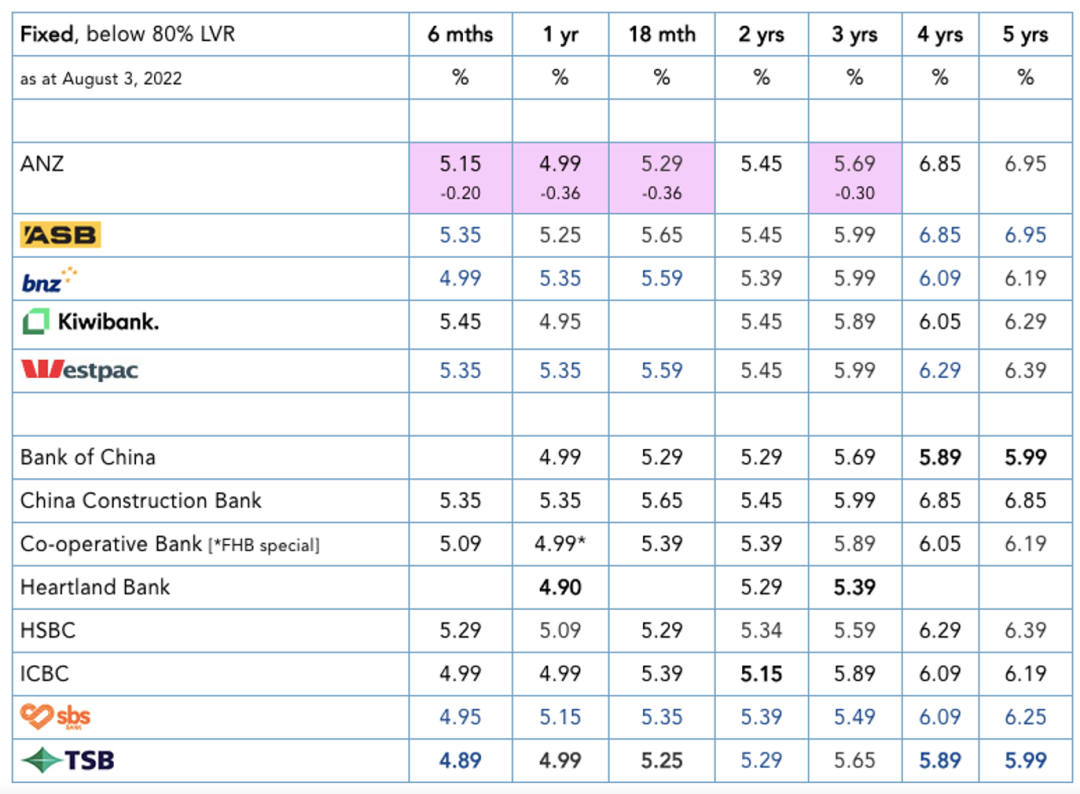
Fixed mortgage rates at major banks and financial institutions as at 3 August
So, with the major banks poised for a fixed mortgage rate-cutting battle, should homeowners take a gamble on floating rates and wait until rates fall to a reasonable level before refixing?
Floating rates generally move with overall interest rates and may be influenced by economic factors. To reduce uncertainty about rate changes, most New Zealand homeowners usually fix their mortgage rate for a set period, most commonly one or two years. Now, however, as rates keep rising, homeowners who locked in very low fixed rates a year or two ago face the considerable pressure of sharply higher repayments.
No one, including economists, can predict precisely how interest rates will change. When homeowners agree to a fixed mortgage rate with a bank for a set period, they are effectively taking a gamble. If rates fall, homeowners lose out because they must pay interest at the higher rate. Equally, if rates rise, the bank loses out because homeowners pay less interest than the prevailing market rate. In 2007 and 2008, when floating rates were 10.72%, many New Zealand investors fixed for two, three or five years, paying around 9.33% to 9.35%. Many believed that fixing for more than two years offered considerable savings over floating rates. What investors did not anticipate was that floating rates would fall to 6.37% a year later. Those who had fixed for longer terms therefore had to keep paying annual interest rates nearly 3% higher than floating rates.
Beyond interest rates, we also need to understand how mortgage repayments work.
Interest is the cost a borrower pays to borrow from a financial institution, expressed as an annual rate. For example, if someone borrows NZ$1,000,000 at 6% interest, the first year’s borrowing cost is NZ$60,000. The interest payable in the second year depends on how much of the original NZ$1,000,000 principal was repaid during the first year. If the borrower chooses to pay only interest and no principal, the second year’s interest will still be NZ$60,000. Repaying principal as quickly as possible to reduce interest costs is therefore an effective way for borrowers to benefit.
Calculating the total cost of mortgage repayments
Another issue worth considering is the total cost of a mortgage. This depends on several factors, including the interest rate and loan term. There is no denying that the longer the repayment period, the more the borrower will pay. For example, a NZ$500,000 mortgage at 5.89% over 30 years has a total cost of just over NZ$1,000,000. However, repaying the same NZ$500,000 at the same rate over 25 years reduces the total cost by around NZ$50,000, while repaying it over 20 years reduces it by NZ$150,000. First-home buyers often cannot afford repayments unless they spread them over a longer term of more than 30 years. Once they can afford to pay more, however, they can consider shortening their mortgage term.