
Are 10% of buyers who entered last year's hottest property market now in negative equity?
Analysis by Valocity, OneRoof's property data partner, suggests around 10% of those who bought during the market's hottest period, from October to December 2021, may now be in negative equity. Valocity reportedly reached its estimate of potentially affected buyers by comparing their purchase prices with current median house prices, then subtracting the minimum deposit of 20%, assuming these buyers purchased with a 20% deposit.

Analysis by Valocity, OneRoof's property data partner, suggests around 10% of those who bought during the market's hottest period, from October to December 2021, may now be in negative equity. Valocity reportedly reached its estimate of potentially affected buyers by comparing their purchase prices with current median house prices, then subtracting the minimum deposit of 20%, assuming these buyers purchased with a 20% deposit.
{ad}
As the chart below shows, Wellington homeowners have been hardest hit nationwide. Of those who bought in the final quarter of 2021, 21.1% may now be in negative equity, followed by 7% in the Bay of Plenty, 6% in Auckland and 5% in Canterbury. The percentage of buyers potentially in negative equity reportedly remained relatively stable until early 2022. However, the picture changed for buyers who purchased between month 4 and June this year: only 3.93% of these buyers may be in negative equity. Valocity's head of valuations, James Wilson, explains that these buyers purchased at lower market prices, leaving their homes less exposed to negative equity than those bought at the market's peak late last year. He adds, however, that if prices continue to fall, more buyers will face the threat of negative equity.
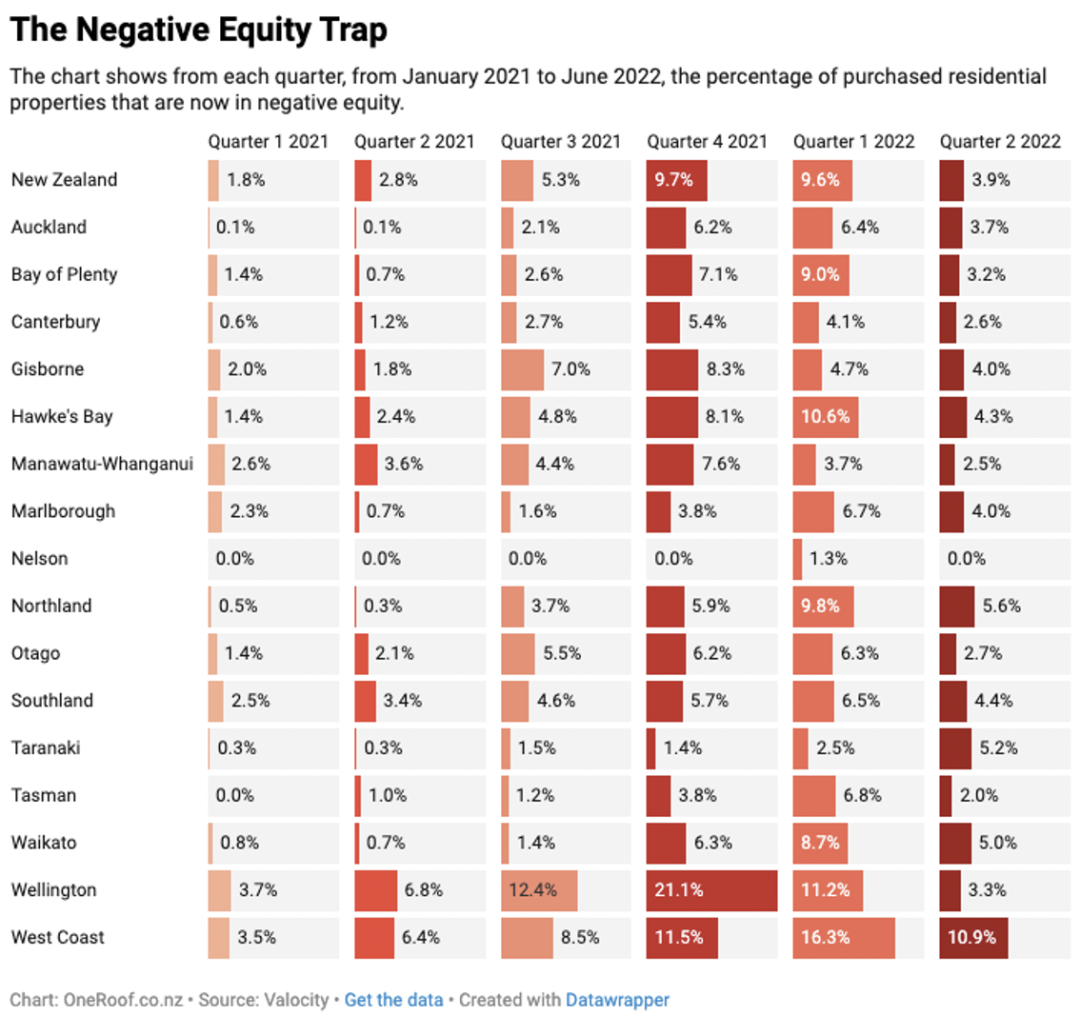
Nationwide, for purchases from 2021 year, month 1 to 2022 year, month 6, the
proportion of buyers potentially in negative equity
Notably, nationwide, around 5.5% of first-home buyers who purchased late last year are now in negative equity, suggesting they have been much less affected than other buyer groups. Wilson says that in most parts of New Zealand, the proportion of first-home buyers in negative equity is generally lower than among other types of buyers. He believes this is positive for the market, as nobody wants first-home buyers to face greater purchasing risks than other buyers...
Wilson also says it is reassuring that these figures are based on a 'worst-case' model. Although more than 1000 buyers who purchased at the market's peak may now be in negative equity, they represent a very small share of the overall market. While negative equity is a frightening position for any buyer, it does not really affect homeowners who do not plan to sell immediately. Wilson explains that falling prices may leave many homeowners' properties in 'negative equity', but this does not affect their lives because they generally have steady employment income to meet their mortgage repayments. Although they may be unable to buy and sell again in the short term to realise capital gains, most buyers have shown they can withstand external pressures during the market's toughest periods. By comparison, far fewer buyers who purchased during the property market downturn in 2020 are affected: only 1.75% may currently be in negative equity.
Umbrella Group mortgage adviser Sara Hartigan says that falling house prices clearly reduce homeowners' equity. However, when buyers apply for mortgages, banks assess their ability to repay. Those approved for loans should therefore be able to afford higher repayments even as interest rates rise.
Steve Lovegrove, head of McDowell Real Estate, has been receiving enquiries at his Rotorua business from people considering reselling their properties, provided they do not make a loss. He says most enquiries come from buyers who purchased over the past two years and now face mortgage rates three times their previous level. However, many homeowners who bought earlier can still see gains in their property values and sell for more than they paid. Lovegrove says that for someone who bought in 2020 and experienced a 20% rise in house prices in 2021, selling now is worthwhile, as the falling market is still nowhere near 2020 prices. He predicts that once homeowners regain some confidence in the market, more sellers will return, with many 'selling at reduced prices'. This is because many homeowners are considering whether they have an opportunity to reduce their mortgages and recover their property investment costs.