
House prices are falling, yet an expert says buying at a higher price three months ago could have saved buyers more than buying now?
The July House Price Index (HPI), released last week by leading property industry body the Real Estate Institute of New Zealand (REINZ), shows that New Zealand property prices have fallen 10.9% from their peak in November last year, returning to levels seen a year ago. Within the industry, the REINZ HPI is regarded as the most accurate measure of property price movements because it adjusts for changes in the mix of properties sold unconditionally each month. It is less affected by changes in conditions in smaller markets and provides an overall view of market sales activity.

The July House Price Index (HPI), released last week by leading property industry body the Real Estate Institute of New Zealand (REINZ), shows that New Zealand property prices have fallen 10.9% from their peak in November last year, returning to levels seen a year ago. Within the industry, the REINZ HPI is regarded as the most accurate measure of property price movements because it adjusts for changes in the mix of properties sold unconditionally each month. It is less affected by changes in conditions in smaller markets and provides an overall view of market sales activity.
{ad}
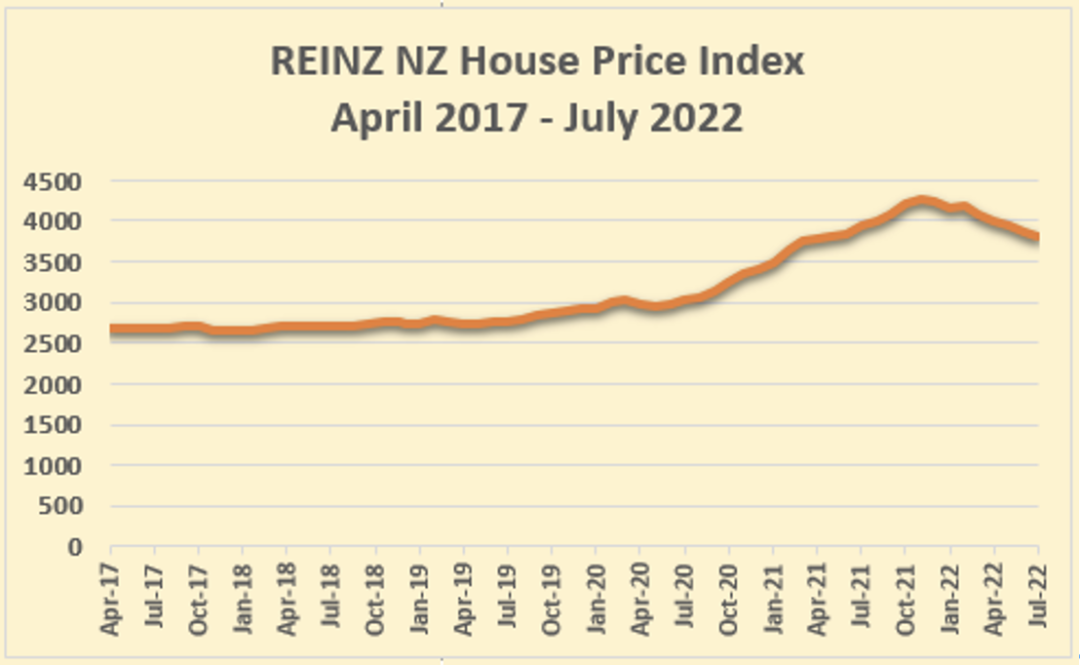
2017 year 4 month to 2022 year 7 month REINZ House Price Index movements
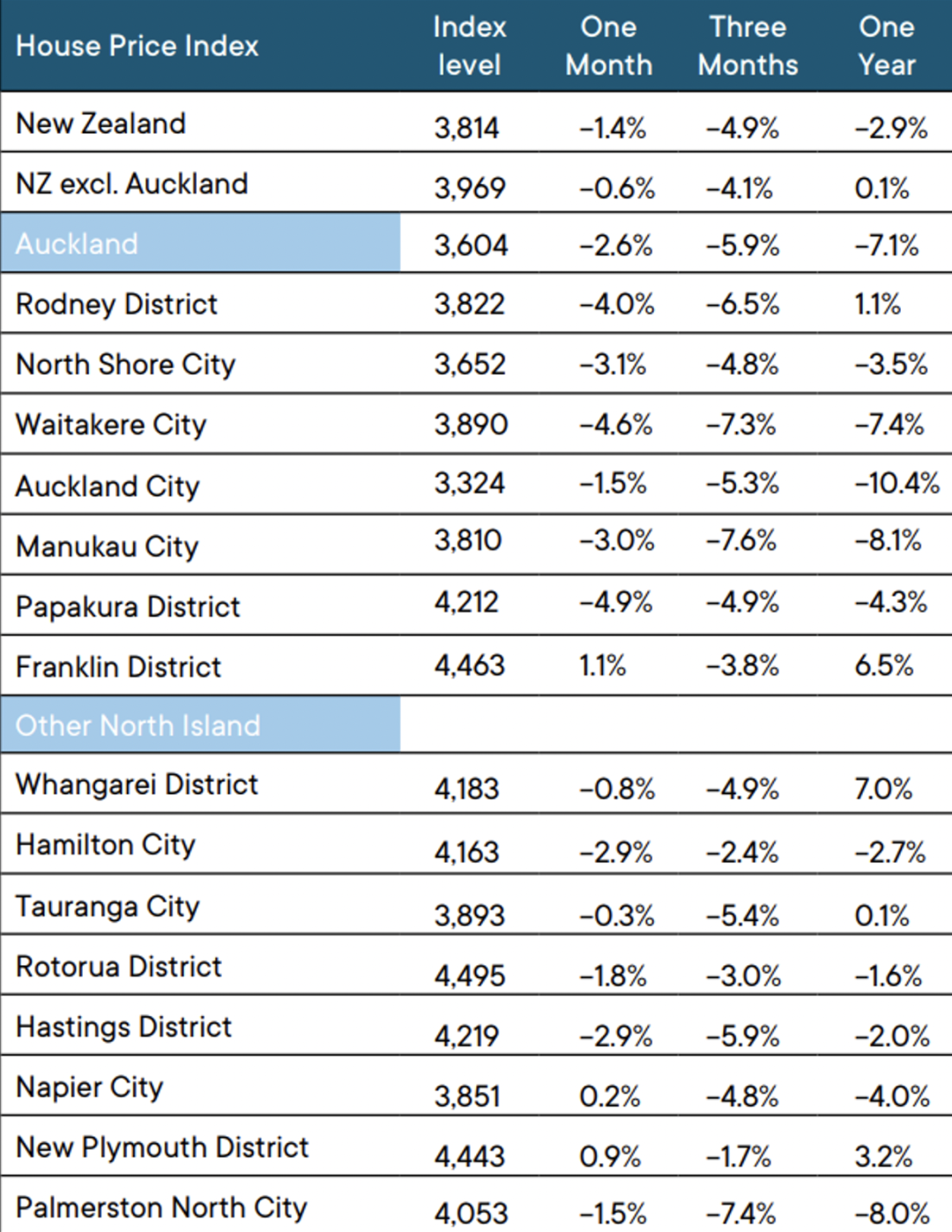
The table above shows changes in the House Price Index for major cities and regions over the past 1, 3 and 12 months. Notably, prices in most regions have fallen compared with 12 months ago, while areas that did not experience substantial declines over the past year have seen marked falls in the past three months. This suggests that the difference between Wellington's and Christchurch's price adjustments largely reflects when those adjustments occurred. Wellington recorded the largest decline over the past year, while Christchurch's prices remained relatively stable. Nationwide, however, the overall downward trend is clear. Even the few areas that recorded price growth, such as Queenstown-Lakes, may see declines in the period ahead. Many investors are therefore holding on to their cash, waiting for further falls before considering entering the market...
Meanwhile, the latest QV House Price Index shows that the national average house price fell by -4.9% over the three months to the end of July, to NZ$989,790. This is the first time it has dropped below NZ$1,000,000 since September last year. So what does this -4.9% decline, equivalent to around NZ$50,000, mean for buyers seeking a mortgage? Is obtaining a mortgage easier now than it was three months ago? If so, how much more can buyers borrow? With these questions in mind, let us look at the interpretation offered by Mortgage Lab founder Rupert Gough.

Mortgage Lab founder Rupert Gough
Let us start with some assumptions:
A typical New Zealand first-home buyer can obtain a mortgage with a loan-to-value ratio (LVR) of up to 90%, meaning the household needs a deposit of just 10%. Using the average house price of NZ$1,040,927 in early May, a 10% deposit would be approximately NZ$104,000. The -4.9% decline over the past three months means buyers now need a deposit of just NZ$99,000. Although this NZ$5000 difference is not insignificant for an average-income household, falling house prices will not greatly improve the prospects of buyers who cannot afford a deposit.
So what is happening in practice?
Mainstream banks currently use a mortgage test rate of around 7.95%. This is the rate used to assess your ability to cope with repayments when reviewing your application, rather than the current market fixed rates of 5–6%. At this higher test rate, the mortgage cost of buying at today's prices is NZ$6,500 a month. The fall in the average house price reduces monthly mortgage costs by around NZ$350, which sounds very good. However, the test rate three months ago was 7.35%, meaning it was easier to obtain finance for a more expensive property then than it is now. Furthermore, as interest rates continue to rise, mortgage repayments on a property now averaging NZ$890,000, calculated at today's cheapest one-year fixed rate of 5% p.a., are considerably higher than repayments on a property averaging 930,000 three months ago, calculated at the lowest one-year fixed rates then of 3.8%–4% p.a.
Why is this happening?
Rupert Gough explained that this lies at the heart of the much-discussed question of when to buy at the bottom of the market. Getting the timing right matters far more than predicting movements in average house prices. Particularly when a buyer's mortgage exceeds 80% of the property's value, bank lending policies at the time of application, interest rates, and property supply and demand all deserve close attention.
Buyers with savings who simply wait for prices to reach their lowest point in this cycle may miss their opportunity, because they may be unable to borrow enough later this year. If interest rates keep rising, servicing repayments will also become more challenging. Gough believes buyers who act now may lose out somewhat on price compared with buying a few months later, but that is still far better than missing the opportunity altogether. Buyers who already have mortgage pre-approval also need to understand that reported price declines represent averages across an area. For example, if prices nationwide fall 5%, some areas may fall 10%. Could properties in those areas be more worthwhile purchases, given that prices elsewhere may have barely changed?
Finally, Gough advised against assuming that obtaining a mortgage will become easier in the future. Despite the fall in average property prices, buyers' mortgage affordability appears to have changed little. Whether the property market is rising or falling, astute investors can always find good-value homes, particularly in the current market, where there is less competition from other buyers.
Disclaimer: The views above do not represent YIJU's position and are provided for reference only.