
Is a subdued property market good or bad for buyers? Experienced property advisers explain
Robyn Ellson, a real estate agent at Ray White Mt Eden in Auckland, says every property market has advantages and disadvantages for buyers. For example, the current market is much more stable than it was two years ago. A more stable market may be a better option for prospective buyers with clear goals and ideas about their next property. A stable market means people can be more certain about the value of their own property and comparable homes. Buyers and sellers alike need sufficiently reliable valuation data to give them confidence in their next transaction. Although the current market favours buyers and competition among sellers is fiercer, Ellson

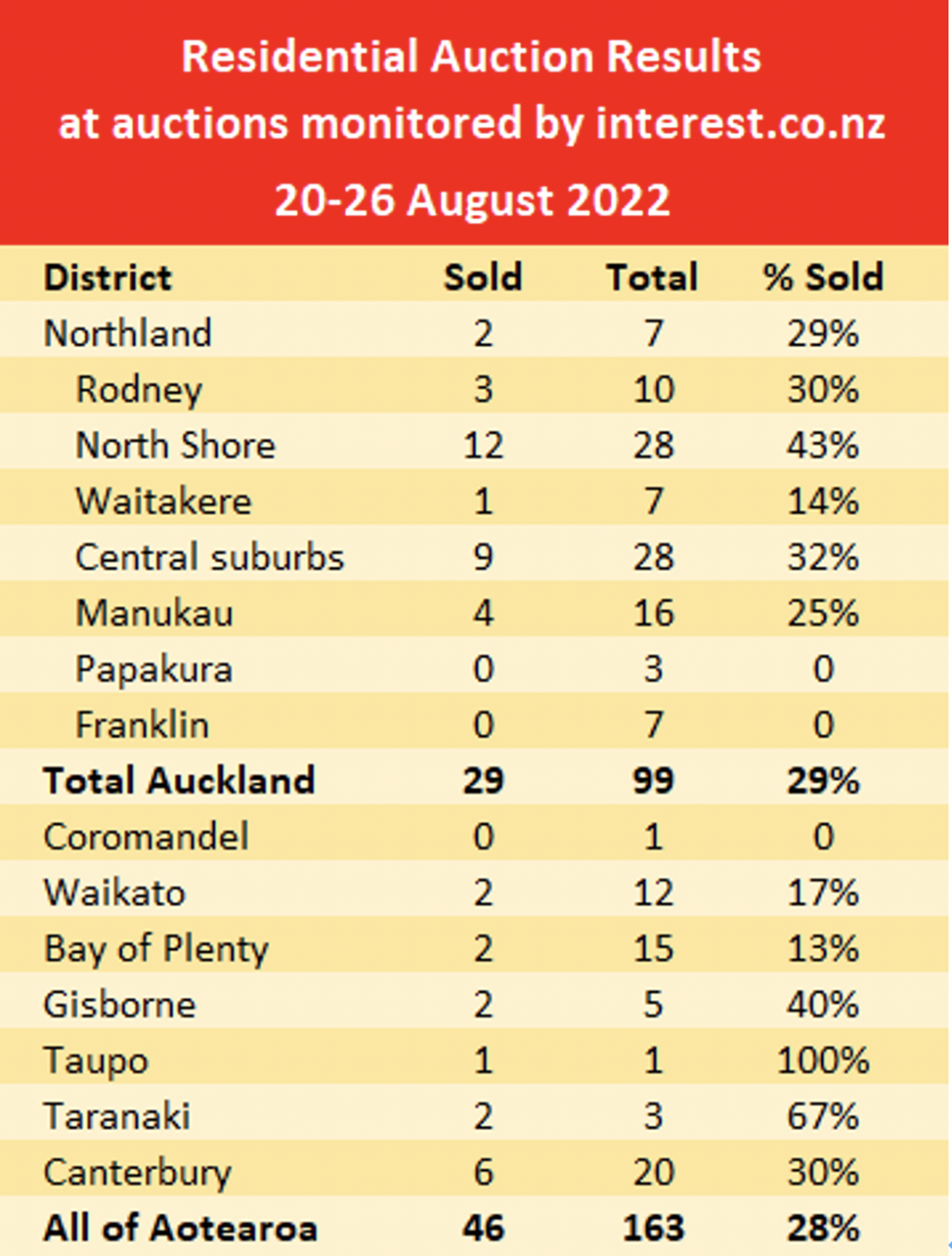
Overview of property auctions nationwide last week
Nationwide property auction data published by property website interest.co.nz shows that although more properties went to auction last week than the week before, the clearance rate fell noticeably. A total of 163 properties went under the hammer across New Zealand last week, up from 130 the previous week. Of these, 46 sold, giving a clearance rate of 28%, down from 33% the week before. Regionally, Auckland's clearance rate was 29%, slightly above the national figure. Notably, the 99 properties offered at auction in the region last week accounted for 6 tenths of the national total.
{ad}
With the property market so subdued, many prospective buyers fear further price falls. Their preference for buying in a rising market rather than a falling one leads them to believe this is a poor time to buy. However, property experts say a declining market offers buyers looking to move to a better neighbourhood and upgrade their homes a good opportunity to secure a bargain. They also warn that buyers must make sure they can obtain finance, otherwise they could put themselves in a dangerous position.
Robyn Ellson, a real estate agent at Ray White Mt Eden in Auckland, says every property market has advantages and disadvantages for buyers. For example, the current market is much more stable than it was two years ago. A more stable market may be a better option for prospective buyers with clear goals and ideas about their next property. A stable market means people can be more certain about the value of their own property and comparable homes. Buyers and sellers alike need sufficiently reliable valuation data to give them confidence in their next transaction. Although the current market favours buyers and competition among sellers is fiercer, Ellson says Auckland's property sales market remains healthy, with plenty of prospective buyers still looking for an opportunity to purchase.
Ellson also stresses the importance of securing sufficient funds and finding a real estate agent buyers can trust. Once buyers have sufficient mortgage finance, a reliable agent can help them understand a property's true market value. Ellson often sees keen Auckland buyers considering popular properties across several suburbs, with their search extending from Avondale to Kingsland, for example. These residential neighbourhoods close to workplaces consistently attract buyers, as their homes make it easy for working people to appreciate the convenience they offer for both work and daily life.
Ellson has also noticed a subtle market shift. When mortgage rates were lower last year, buyers had considerable flexibility in their budgets, potentially exceeding NZ$1,000,000. The market has now changed fundamentally, and buyers are more conservative with their budgets. Anyone wanting to increase their budget must first speak to their mortgage adviser and ensure it is safe to do so before making a confident offer.

Homes in many traditionally sought-after suburbs, such as Remuera, are highly sought after by many buyers in the market
Photo/Fiona Goodall
Ray White real estate agent Steve Koerber, who has long sold properties through its Remuera branch, says homes in the area are always in demand, whatever the state of the market. He believes now is the time for these prospective buyers to act. The pandemic has made many buyers realise they need extra office and bedroom space to accommodate long periods spent working and living at home. As a result, they are raising their budgets for their next property from NZ$4,500,000 to NZ$5,500,000. Steve says he has seen several instances of buyers increasing their budgets by NZ$1,000,000. These prospective buyers come from nearby suburbs such as Grey Lynn, Sandringham, Point Chevalier, Mt Eden and Epsom. For many, access to high-performing school zones is the main reason for wanting to move to Remuera.
Duncan Macdonald, a senior project adviser at Colliers, shares this view. The Symphony303 development enjoys a prime location at 303 Manukau Road in Epsom, one of Auckland's most sought-after suburbs. He says properties in central Epsom are usually difficult for first-home buyers to secure. The subdued market now offers a rare opportunity to buy a brand-new home in such a desirable suburb, with eligible first-home buyers also able to receive assistance under the first-home grant scheme. Buying in this development gives families access to school zones coveted by Auckland parents. Leading New Zealand schools within walking distance include St Cuthbert's College, just a stone's throw away, Dilworth private school, and the Epsom boys' and girls' grammar schools.

Symphony303 The development benefits from excellent school zones and a prime location
Kim Lyons, who heads a mortgage finance company, says buyers keen to complete a purchase currently have certain advantages. The market has clearly slowed, and fewer properties are being sold by auction, making it easier for prospective buyers to make an offer on favourable terms rather than having to bid at auction. However, Lyons also highlights the issue of high interest rates, which cannot be overlooked. Major banks' mortgage test rates have now exceeded 7%, putting unprecedented financial pressure on many homeowners looking to move. Even a strong borrowing and credit history is of little help when faced with these high test rates. People turned down by banks often approach second-tier mortgage lenders, which usually means accepting higher interest rates and additional fees. Another concern is that some buyers may be forced to sell their existing homes quickly because they need sufficient funds to settle on their new homes, leaving them obliged to cut their asking prices.
To explore these views, YIJU also spoke with three property adviser friends who have remained active in Auckland's property market. Through these conversations, we hope to give readers an accurate picture of current market conditions.

YIJU: How do you view the current market? Does it offer buyers advantages or disadvantages?
Gavin Han:Current housing market conditions are certainly good for buyers. The previous buying frenzy has disappeared, purchasing power has generally weakened, and competition is far less intense. Buyers have more choice and room to negotiate, which considerably reduces the pressure of buying. When they find a property they like, they do not necessarily have to go straight to auction. There are now more opportunities to negotiate with owners and secure the best value for money.
Rose Hu:Everything has two sides. Tighter lending conditions mean there are far fewer buyers than at last year's market peak. Even among investors with funds available, most are watching and waiting rather than rushing to buy. With fewer people participating, buyers who genuinely need a home naturally face less FOMO, or fear of missing out, and have time to view, compare and choose before purchasing. On the other hand, homeowners in no hurry to sell are also choosing not to list now, so fewer properties are available than before. These homes being held off the market include plenty of quality properties.
Jiang Shu: Although the market is quieter than last year and both prices and sales rates have fallen, that does not mean it has become a bad market. Rather, the current market is healthier and more reasonable. People approach it more rationally, without the impulsive buying and blind following of others seen previously. The current market can be said to favour buyers because many properties being listed now belong to sellers who are serious about selling. Prices are generally reasonable rather than as frenzied as before. Many properties are also staying on the market longer, giving buyers more time to research, compare and choose a home they like. Furthermore, during this unusual Covid period of rising interest rates and persistently high unemployment, obtaining a bank loan is already difficult for some buyers. Competition among buyers has also eased, giving cash buyers more opportunities to find a suitable property.
YIJU: As the saying goes, people generally prefer buying property when prices are rising rather than falling. What advice would you give buyers who are currently viewing homes and considering a purchase?
Gavin Han:For first-home buyers or people moving for family reasons, the need for a home remains essential regardless of market changes, so act when the time is right. Buyers must establish their borrowing limit and repayment capacity in advance. This means understanding both the price range they can afford and the repayment pressure that could follow any rise in interest rates. Even without going to auction, an unconditional offer, or one with very few conditions, can help buyers secure a more competitive price. Once you find a property you like, do not neglect essential work such as having a lawyer review the relevant documents and carry out due diligence. A building inspection is also very important. Its purpose is not simply to find faults, but to give you a comprehensive understanding of the property, including repairs and maintenance needed soon, after 1 year, and over the following 3–5 years.
Rose Hu:Ultimately, buying a home is a decision made when your personal family plans and financial plans have reached a point where you can act. There is no need to follow the crowd or be influenced by what 'most people' do. Take marriage as an example. Most younger people today only consider marriage after turning thirty, but if you meet someone you want to marry in your twenties, you can make your own decision without deliberately waiting. You may never find another suitable person, and whoever comes later may not be the best choice. You need your own judgement and the ability to make decisions.
Jiang Shu: Nobody can say for certain when the housing market will bottom out. But if you need to buy and can comfortably afford the repayments, any time is a good time. The Reserve Bank of New Zealand has not stopped raising interest rates, and they may continue climbing. Research indicates that every 1% rise in interest rates means a 10% reduction in purchasing power. Buyers who already have bank pre-approval therefore have an advantage in both interest rates and borrowing limits if they buy a home they like sooner, rather than waiting until rates rise again.
Many properties currently on the market are well suited to first-home buyers, with reasonably priced two- and three-bedroom homes available. Buying an entry-level property while the market is quieter could deliver considerable capital growth when the market becomes buoyant again.
For first-home buyers in particular, if your savings and bank finance are already in place, there is no need to keep waiting. You can buy once you find a suitable home, without worrying excessively about potential gains and losses. For most people, their first home will not be their home for life. As incomes rise and families grow, people move on average every 7–10 years. The priority is to buy first, turning hard-earned savings into property to counter inflation and the declining value of money, while also gaining capital growth over time: two benefits from one decision.