
An in-depth look at the 'good' and 'bad' sides of falling house prices
According to the recently released QV House Price Index, by the end of August New Zealand's average house value had fallen by around NZ$89,917, or approximately 8.5%, from its peak in January. In other words, New Zealand homeowners have been experiencing an average loss of about NZ$424 a day.

According to the recently released QV House Price Index, by the end of August New Zealand's average house value had fallen by around NZ$89,917, or approximately 8.5%, from its peak in January. In other words, New Zealand homeowners have been experiencing an average loss of about NZ$424 a day.
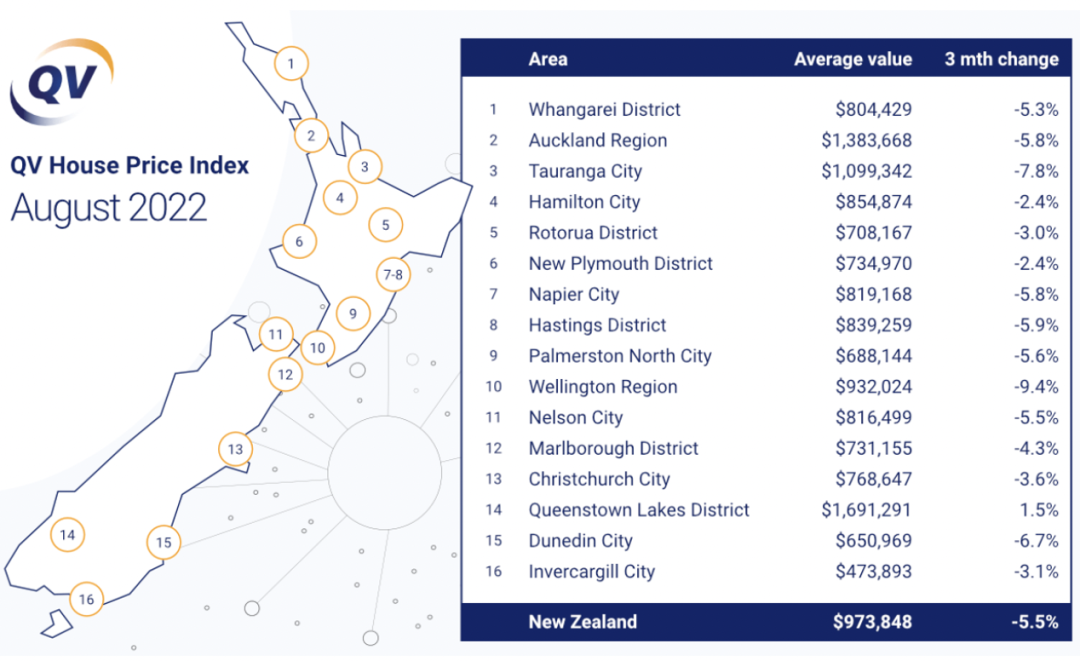
QV latest house price index released in August
In Auckland, average house values have fallen by NZ$157,500, or 10.2%, since January this year. That is equivalent to an average daily decline of NZ$743 over the first eight months of the year. In the capital, Wellington, the decline looks even more severe. Average house values in the region have plunged 14.7% from their January peak, a sharp drop of NZ$160,941, equivalent to an average daily fall of NZ$759. QV's report shows that average house values nationwide fell 5.5% over the past three months.

Reserve Bank of New Zealand Governor Adrian Orr
Speaking recently about the bank's house price forecasts, Reserve Bank of New Zealand Governor Adrian Orr said New Zealand house prices could fall by as much as 20% from their peak. Admittedly, few people would probably have believed him had he said this a year ago. However, the latest data from several property research organisations show that house price falls are accelerating and increasingly approaching the declines seen during the global financial crisis. ASB economists have even warned that the property market is experiencing the largest house price downturn in New Zealand's history, and that it is only just past the halfway point, with the end still some way off.
Such news may make many property owners uncomfortable. But we cannot ignore the indisputable fact that housing has long been unaffordable for many people in New Zealand, particularly in Auckland, and that the problem has become increasingly severe since the pandemic. As early as 2016, former Reserve Bank Governor Arthur Grimes called on Auckland Council to regulate house prices and bring the median back to around NZ$500,000 to address affordability.
Some will surely ask: are sharp house price falls a disaster for investors generally, or can some people benefit? Next, we take an in-depth look at the advantages, disadvantages and market changes brought about by falling house prices.
The good
CoreLogic research shows that housing affordability in New Zealand had deteriorated to its worst level on record by the start of this year, with average property values in the first quarter reaching 8.9 times average incomes. Housing affordability researcher Hugh Pavletich said this showed New Zealand's house-price-to-income ratio was at a dangerous level and seriously out of step with other countries. He believes rising house prices create poverty rather than wealth, because they make home ownership difficult for most people, particularly first-home buyers and those on low incomes. Falling house prices can therefore help us better address housing affordability, and he warmly welcomes the decline.
CoreLogic chief property economist Kelvin Davidson shares a similar view. He said falling prices were good news for first-home buyers, giving them an opportunity to buy if they could obtain bank finance. Although mortgage rates have risen, lower house prices mean more choice and a better chance of buying a home they like in their preferred area, provided they can afford the repayments.
Davidson said frankly that there was a misconception about this issue. Many homeowners see falling prices as bad news because they can no longer sell for the high prices achieved at last year's peak. In reality, however, if they have owned the property for more than two years, its current value may still be well above its pre-pandemic value. Most sellers can therefore still expect a healthy capital gain. For homeowners who do not intend to sell, falling prices matter even less, because over time house prices always recover through their fluctuations.
Falling house prices are also good news for first-home buyers. The market now favours buyers more, and with prices falling across the board, those on limited budgets have a better chance of finding a bargain.
{ad}
The bad
Homeowners who bought at last year's market peak face the greatest risk from falling prices. Many could face negative equity, meaning their mortgage exceeds their property's current value. CoreLogic data show that more than 500 first-home buyers who purchased late last year may already be in negative equity. If house prices fall by 15% to 20%, more people will find themselves in that position. Davidson said that although negative equity was psychologically uncomfortable, it was not a problem if owners did not intend to sell and could afford their repayments. He also said falling house prices, combined with rising mortgage rates, were having widespread negative effects on the economy, creating substantial headwinds for growth in household disposable income and the wider economy. Although this presents a potential risk to financial stability, we remain a long way from that risk materialising: unemployment is currently low, banks' stress tests have ensured borrowers can service loans at higher rates, and there are signs that interest rate rises may already have peaked.
From the Jiayuan Finance advisory team, Johnny Ma said medium-sized and large developers were actually the group most threatened by falling house prices at present. Last year, they took on substantial debt to buy large sites with subdivision potential when prices were at their highest. This year's price falls could make it difficult for them to refinance with banks and second-tier lenders, but his team has been doing everything it can to help developers through these difficulties.
The reality of the housing market
Mortgages Online director Hamish Patel said the current market had changed dramatically from its peak. Many sellers were no longer insisting on a particular price as they had late last year. He knew of an Auckland homeowner who wanted NZ$1,700,000 for their property earlier this year. Their real estate adviser received an offer of 1,600,000 and advised the buyer to consider current market conditions, saying it was already a good offer. The seller ultimately rejected it and listed with another company. Three months later, after market prices fell further, the property finally sold for NZ$1,400,000.
Harcourts managing director Bryan Thomson said he was not surprised by falling house prices. The pool of buyers had shrunk compared with last year, but over the longer term the property market and prices were adjusting to more normal levels. Those who wanted to sell at a high price last year had now left the market, as had property traders seeking quick profits. People who genuinely wanted to sell were accepting market realities and making decisions accordingly. Meanwhile, buyers were gradually returning. The number of open homes and auctions had increased in recent weeks, and he was optimistic that the market would recover further next year.