
Be alert! Will government assistance encouraging first-home buyers really benefit them, or leave them struggling?
This year's government Budget changed the house price caps for buyers seeking a First Home Grant and removed the price caps for First Home Loans entirely. YIJU sees these incentives as the Government's attempt to give more buyers access to first-home grants and loans, addressing the affordability difficulties that high house prices have created for first-home buyers. The price caps have long faced public criticism, particularly in Auckland, where they have lagged well behind the median sale price of properties in the region.

This year's government Budget changed the house price caps for buyers seeking a First Home Grant and removed the price caps for First Home Loans entirely. YIJU sees these incentives as the Government's attempt to give more buyers access to first-home grants and loans, addressing the affordability difficulties that high house prices have created for first-home buyers. The price caps have long faced public criticism, particularly in Auckland, where they have lagged well behind the median sale price of properties in the region.
{ad}
Buyers qualify for the government assistance only if their annual income is no more than NZ$95,000 for a single person or NZ$150,000 for a couple. The government-backed assistance scheme allows first-home buyers to purchase their first property with a 5% deposit. In addition, buyers using their KiwiSaver funds to purchase a home can each receive a government grant of up to NZ$5000, or NZ$10000 for a new build. The changes to the grant criteria reportedly took effect on 19 May, while the changes to the loan criteria took effect on 1 June.
How has the government's home-buying assistance scheme performed?
According to the latest figures released by Kainga Ora, applications increased significantly in the three months to 30 June, a month after the loan criteria changed and 6 weeks after the grant criteria changed. Applicants purchased 1163 properties during the quarter with government grant assistance, with buyer numbers up 49% on the previous quarter. Meanwhile, Kainga Ora approved 2257 first-home grants, almost double the number approved in the previous quarter. Here, 'approved' means applicants have signed a sale and purchase agreement and have been deemed eligible by the relevant agency, but the property purchase has yet to settle. Reportedly, 462 First Home Loans were approved, up 27% on the previous quarter. Unlike the wider property market, where sales have continued to shrink this year, 15,751 residential properties were sold through the government assistance scheme in the second quarter, showing no significant downward trend compared with 16,483 in the previous quarter.
How are first-home buyers faring in the current property market?
David Hart, director and mortgage adviser at Mortgage Supply Co, said first-home buyers had become more active since the Government announced these changes. More first-home buyers seemed to be entering the market, he said, and more were approaching his company for mortgage pre-approval. Squirrel founder John Bolton, however, poured cold water on the government policy. He said bluntly that while more clients were meeting the criteria for government assistance, obtaining approval from banks and Kainga Ora was a relatively slow process. In Auckland, where house prices are so high, grants rarely resolve the deposit problem. Buyers are still struggling to find suitably priced properties, and although prices are continuing to fall, their choices remain limited.
Can first-home buyers really benefit?
Research by OneRoof and its data partner Valocity found that first-home buyers now have to pay NZ$300,000 more for a property than they did three years ago, before house prices surged. First-home buyers who purchased in the past two years have already taken on substantial debt, and may well still be paying off their mortgages when they retire.
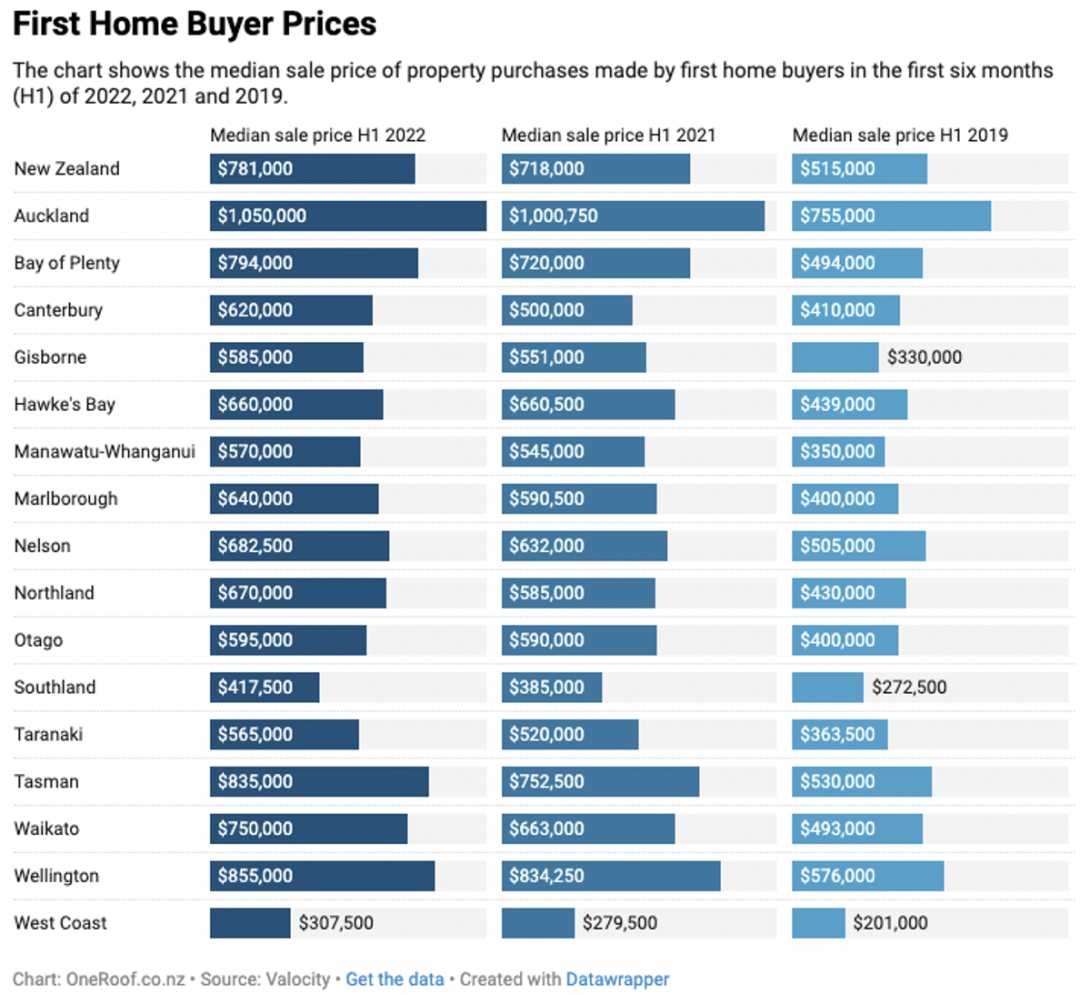
OneRoof and Valocity compared the median price paid by first-home buyers in the first half of this year with the corresponding figures for 2021 and 2019. The analysis found that, despite falling house prices, first-home buyers in every region except Hawker's Bay paid more in the first half of 2022 than in the first halves of last year and the year before. Nationwide, the median price paid by first-home buyers jumped from NZ$718,000 in the first half of 2021 to NZ$781,000 in the first half of this year, an increase of 8.7%. Compared with the first half of 2019, it was 51% higher, or NZ$266,000 more.
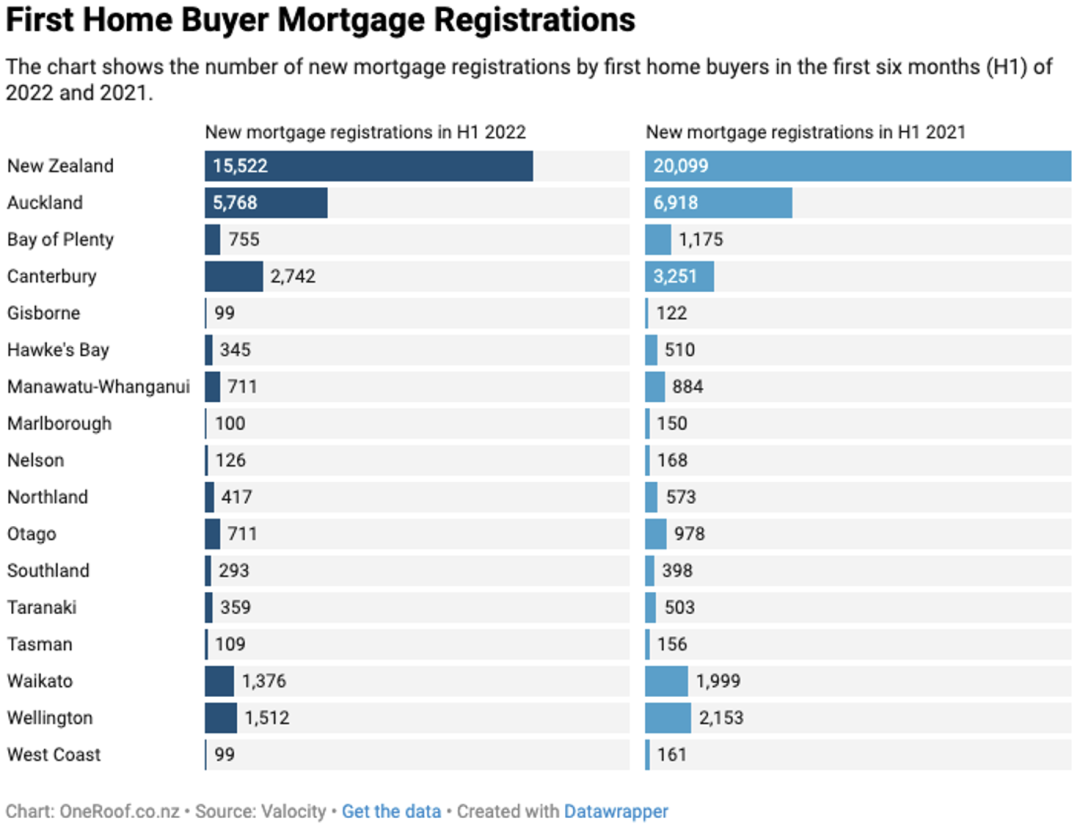
This surge in house prices means first-home buyers are taking on larger debt burdens. Assuming a 20% deposit, we can calculate that first-home buyers in Auckland would have needed to pay more than NZ$1,000,000 for a property in the first half of this year, taking on a mortgage of more than NZ$800,000. The OneRoof-Valocity analysis noted that although there were fewer first-home buyers in the first half of this year than in the same period last year, they remained more active in the market than other groups, such as investors and other types of homeowners. As the chart below shows, mortgage registrations by first-home buyers nationwide fell 22.8% over the past year, from 20,099 to 15,522. In Auckland, registrations fell 16.6%, from 6918 to 5768. Notably, first-home buyers still accounted for 41% of all property buyers, with their share rising slightly from 39.5% a year earlier to 41%.
Auckland remains New Zealand's most expensive region for first-home buyers, and even buying below the median price can leave them feeling under enormous pressure. One buyer, who wished to remain anonymous, said she and her husband spent almost NZ$800,000 on a unit in one of Auckland's cheaper suburbs in the middle of last year. Now in their 40s, they expect to still be paying off their mortgage in their 70s. They live very frugally, but are deeply concerned about the huge repayment pressure they will face when their fixed mortgage rate jumps from below 3% to around 5% in a year's time. On top of that, there are insurance and home maintenance costs. With living costs continuing to rise, she said that although she did not regret their decision, she advised first-home buyers to consider these potential problems and prepare as well as possible for difficulties. They should seek help from experienced professionals before deciding to buy. Some people focus so heavily on buying a property that they overlook the continuing rise in the costs of doing so.
Hannah McQueen, founder of financial advice firm enable.me, said her mortgage advisers had noticed some clients taking on debt equivalent to seven or eight times their income, which was concerning. The issue was not the specific repayment amount, but the ratio of income to debt. 'If that ratio exceeds 1:6, it squeezes you to the point where you can barely breathe. Your life will be weighed down by debt for decades.'
Infometrics chief forecaster Gareth Kiernan said New Zealand house prices had kept rising, sometimes rapidly, creating a mindset that rising prices were a reliable 'bet'. This had encouraged people to take on substantial debt in the expectation that their assets would grow in value over time. But rising mortgage servicing costs could affect their quality of life and even force difficult choices, such as delaying having children. He said that unless first-home buyers had a substantial deposit, anyone over 35 taking out a 30-year mortgage could find themselves continuing to make repayments beyond retirement age.