
Warning: high inflation and high unemployment will sharply increase mortgage default risks for New Zealand borrowers
On Tuesday, New Zealand's largest mortgage lender, ANZ, sharply increased its fixed mortgage rates. Its 6-month rate rose by 35 basis points; its 1-year, 18-month and 2-year rates each rose by 30 basis points; and its three-year rate rose by 26 basis points (see the table below for details). All ANZ's main mortgage rates are now well above those of its main competitors, making it the first mover in a new wave of rate increases.

On Tuesday, New Zealand's largest mortgage lender, ANZ, sharply increased its fixed mortgage rates. Its 6-month rate rose by 35 basis points; its 1-year, 18-month and 2-year rates each rose by 30 basis points; and its three-year rate rose by 26 basis points (see the table below for details). All ANZ's main mortgage rates are now well above those of its main competitors, making it the first mover in a new wave of rate increases.
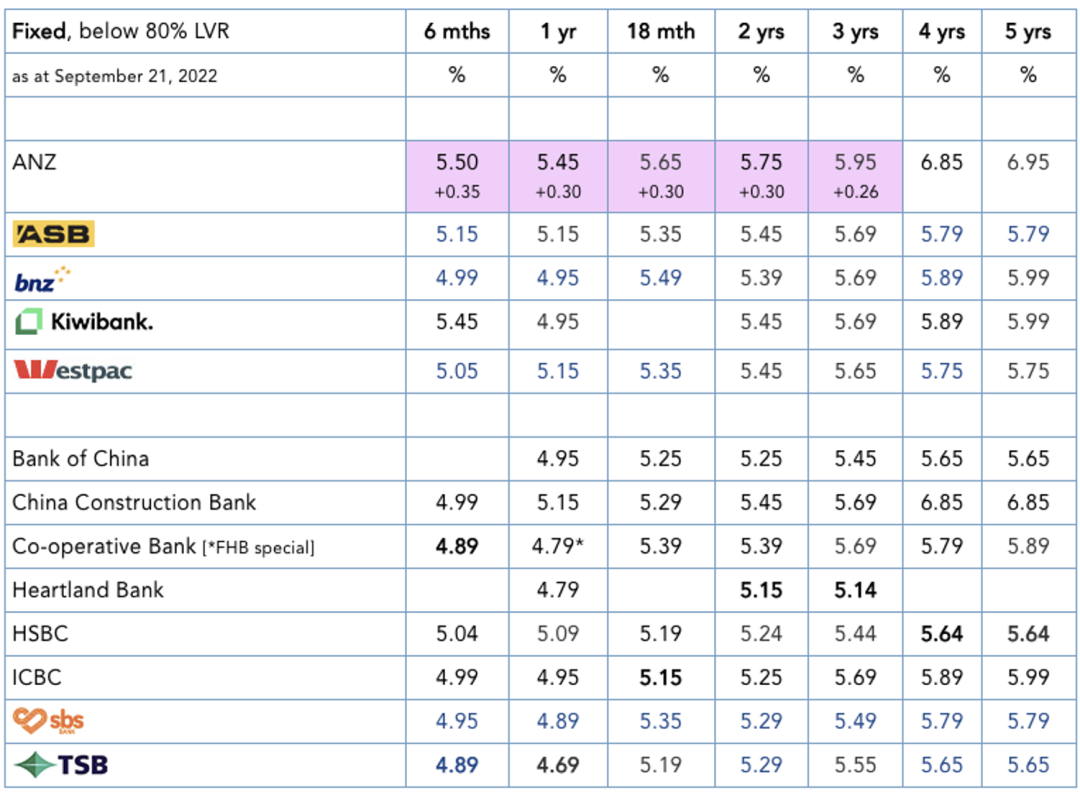
Comparison of mortgage rates at New Zealand's major banks (as at month 9, day 22)
ANZ explained that the increases reflected stronger domestic inflationary pressures caused by global market volatility, alongside higher wholesale interest rates. It suggested that customers struggling to afford their home loans because of changing interest rates could discuss extending their loan terms with the bank.
{ad}
While debate over where the official cash rate (OCR) will peak in this cycle is far from over, the serious financial consequences of rising mortgage rates for borrowers are an even greater concern. Renowned credit rating agency Moody's Investors Service recently said deteriorating housing affordability in the local property market would continue to increase New Zealand's mortgage default risk. In its latest report on covered bonds issued by New Zealand banks, Moody's said it expected housing affordability to remain low, well below its average over the past 10 years. It consequently reached a negative credit assessment for mortgage-backed covered bonds.
The report said rising interest rates meant households taking out loans for new home purchases from August this year would spend 39.1% of their household income on repayments, up from 35.4% a year earlier. The situation was even more severe in Auckland, where new borrowers needed an average of 47.1% of household income to meet mortgage repayments. Across every New Zealand region, the share of household disposable income needed for mortgage payments was at its worst level in a decade. The main cause was continuing interest rate increases, which would further raise the risk of borrowers falling behind on repayments. In assessing covered bonds issued by New Zealand's five major banks, Moody's found that most outstanding mortgages had fixed interest rates. More worryingly, however, 70%–80% of those fixed terms would expire within the next two years. Borrowers would then have to refix their loans or move to floating rates. Either way, they would face interest rates far higher than their previous fixed rates, meaning substantially higher repayments. The report also warned that Auckland's severe lack of housing affordability posed a particularly significant risk to covered bonds issued by New Zealand banks, because 46.1% of the homes securing them were in the city.
Current mortgage data from New Zealand's five major banks shows that ASB has the greatest exposure to the Auckland market, with homes in the city accounting for 58% of its total collateral properties, followed by ANZ at 47%,BNZ at 43%,Westpac at 40% and Kiwibank at 39%. Moody's said it expected interest rates to keep rising this year, although falling house prices would mitigate their impact on housing affordability and mortgage default risk. Downward pressure on the property market from rising interest rates and high inflation would keep house prices falling into 2023.
Definition: covered bonds (Covered Bonds) are debt securities. Issuing banks seek to ease credit constraints by issuing bonds backed by assets, opening new funding channels for financial institutions such as banks. These bonds are secured against a pool of assets; New Zealand banks' cover pools consist of residential mortgages. If an issuing bank becomes insolvent, the assets in its cover pool are separated from the issuer's other assets to protect covered bondholders' interests.
Following these forecasts from leading credit rating agency Moody's, independent New Zealand economist Cameron Bagrie also recently issued a warning. He said the Reserve Bank was facing a struggle to choose the lesser of two evils between inflation and unemployment, reflected in OCR forecasts far higher than initially hoped.
ANZ sharply raised its forecast for the OCR peak last week. Previously, it expected the OCR to reach 4% next year; it now forecasts a peak of 4.75%. If mortgage rates change accordingly, tens of thousands of New Zealand borrowers will face greater repayment pressure.
Cameron Bargrie believes that while headline inflation is falling, core inflation remains unchanged, forcing the Reserve Bank to work harder by continuing to raise interest rates. He said central banks around the world, including the US Federal Reserve, were also facing stubbornly high inflation. The Reserve Bank of New Zealand faces a struggle between high unemployment and high inflation. The trade union council (Council of Trade Unions) has said high unemployment has a far greater negative impact on people than high inflation. Quarterly data released by Stats NZ on 3 August showed the consumers price index (CPI) had reached a 32-year high of 7.3%. Unemployment rose from 3.2% in the previous quarter to 3.3% in this year's second quarter, above the expected 3.1%. Commenting on the figures, Council of Trade Unions chief economist Craig Renney said his research found that high unemployment had as much as ten times the negative impact on people as high inflation. For many workers, wages were not spiralling upwards, but their real purchasing power was spiralling downwards. A survey showed that 1/3 of employees received no pay rise last year, while only 26% received an increase of 5% or more.
One current market illusion is that restricted supply and excess demand make economic growth look strong. The OCR is currently 3%, and a Reserve Bank of New Zealand increase to 3.5% early next month is considered almost certain. The impact of an OCR of 4.75% would depend on how long it remained at that level. So what should we do if the OCR stays around 4.75% for a prolonged period?
Cameron Bagrie said that if the cash rate stayed around 4.75% for some time, fixed mortgage rates across all terms would remain permanently above 6%.