
One-year fixed mortgage rates rise to 5.99%! What has given banks the confidence to raise rates so sharply?
Yesterday, ANZ announced substantial increases in its fixed mortgage rates, effective today. Rates for terms ranging from 6 months to 5 years have risen by between 34 and 55 basis points, with its 1-year fixed rate reaching a high of 5.99%.
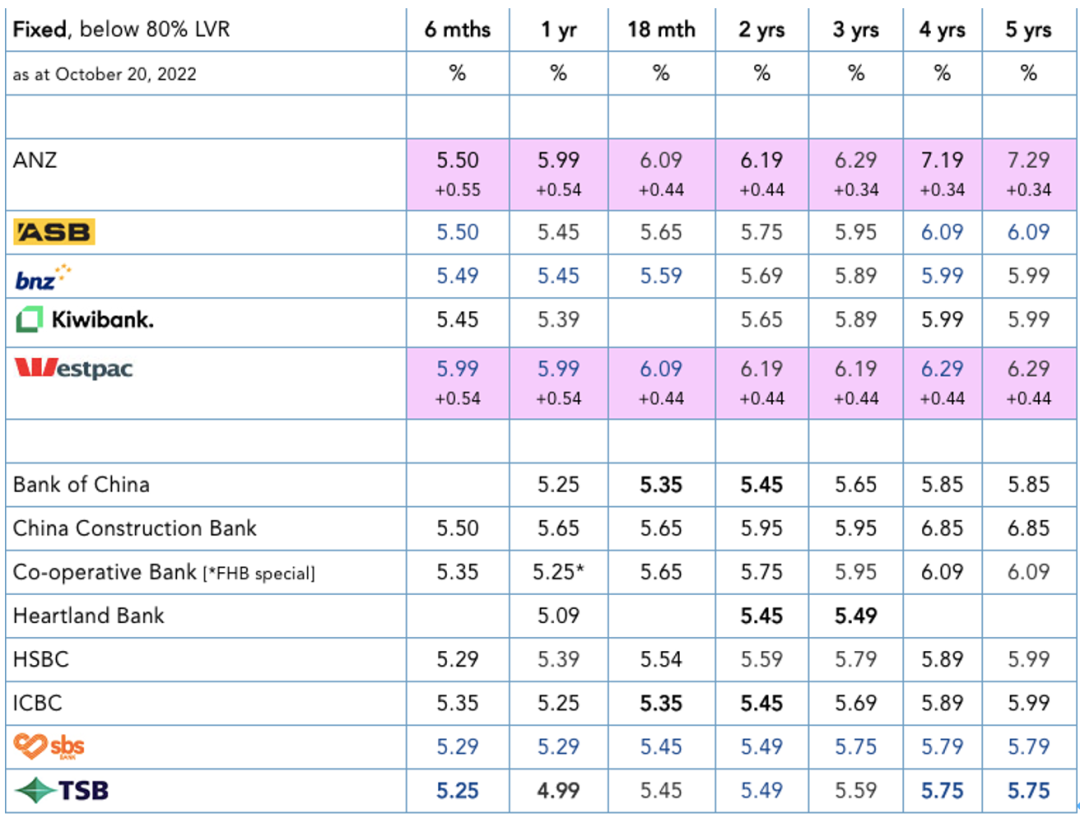
Yesterday, ANZ announced substantial increases in its fixed mortgage rates, effective today. Rates for terms ranging from 6 months to 5 years have risen by between 34 and 55 basis points, with its 1-year fixed rate reaching a high of 5.99%. Its 2-year rate has reached 6.19%, a level not seen since November 2011. Westpac has followed as the next major bank to raise fixed mortgage rates sharply. Today, it increased rates across all fixed terms, raising its 6-month and 12-month rates by 54 basis points each, and its other fixed rates by 44 basis points each. See the chart below for details.
Latest bank interest rates
As New Zealand’s largest banks, their sharp rate increases have a major impact on the market. YIJU believes there is no longer any need to debate whether ANZ and Westpac’s competitors will follow suit; it is simply a matter of time. Borrowers whose existing two-year fixed terms are about to expire face a very difficult repayment journey. In October 2020, ANZ’s two-year fixed rate was 2.55%. From today, that rate jumps to 6.19%. For an 80% mortgage on the then national median house price of NZ$725,000—a loan of NZ$580,000—weekly repayments would rise from NZ$532 over the past two years to NZ$818. That weekly increase of NZ$286 (54%) will put considerable repayment pressure on many working households.
This raises a question: with house prices still falling and both the housing and mortgage markets remaining subdued, why have banks suddenly raised rates so sharply?
After the Reserve Bank of New Zealand raised the Official Cash Rate by another 50 basis points to 3.5% on the 5 of this month, observers were still speculating about whether the OCR’s influence on bank rates was diminishing. Yesterday, ANZ finally acted. The immediate trigger was the latest Consumers Price Index (CPI) data released by Stats NZ this Tuesday. It showed annual consumer price inflation of 7.2% in the third quarter of 2022, only 0.1% below the previously reported second-quarter annual rate of 7.3%, a 32-year high. It was also above the first-quarter annual rate of 6.9%.
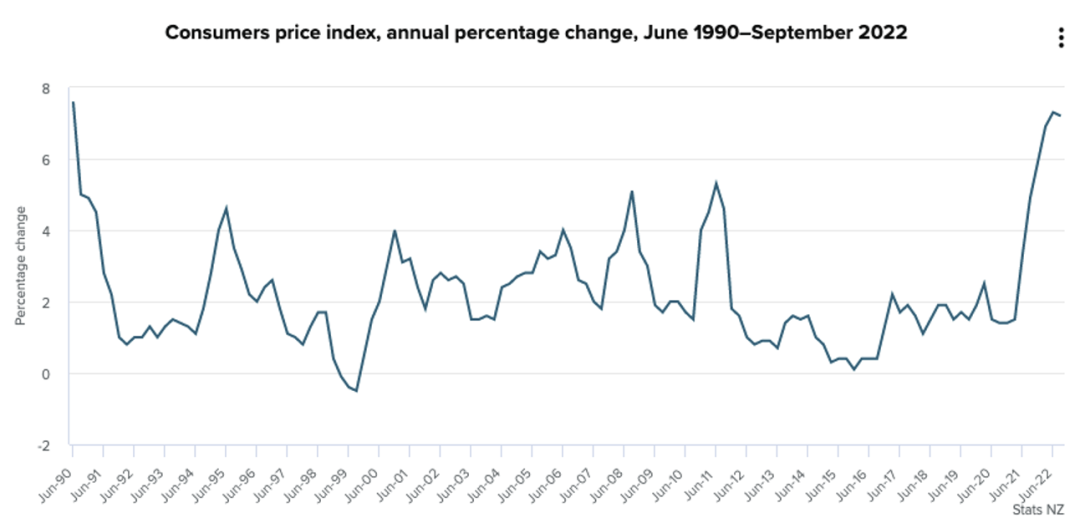
1990 to 2022 New Zealand CPI Annual change
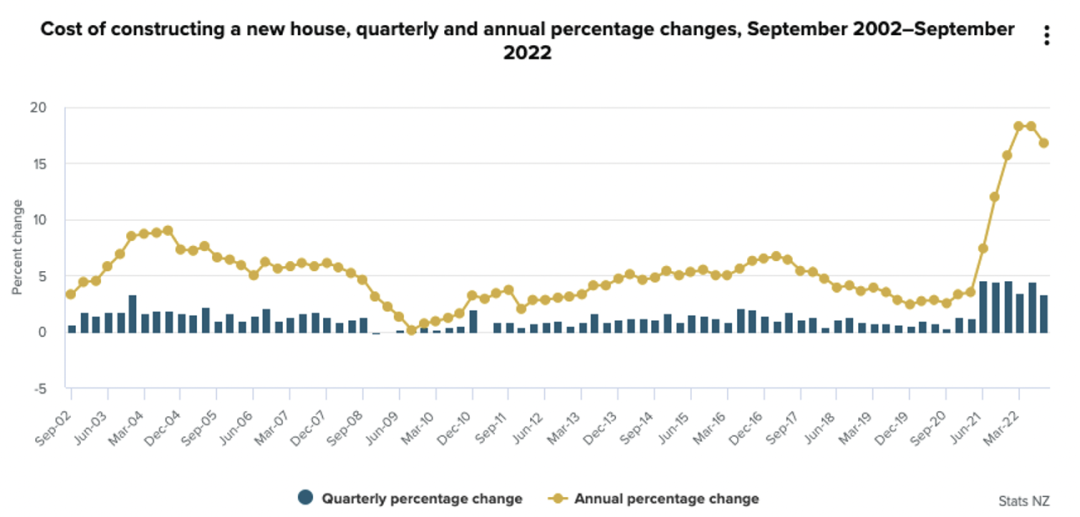
According to Stats NZ’s report, annual inflation of 7.2% in the third quarter was primarily driven by increases in house construction costs, household energy costs such as electricity and gas, rents and council rates. Construction costs rose 17% compared with the third quarter of 2021. Prices senior manager Nicola Growden said building material supply chain problems and rising construction labour costs had together pushed up the cost of building new homes. Notably, after annual increases of 18% in both the first and second quarters this year, annual growth in new-home construction costs remained at 17% in the third quarter.
Rents also rose 4.6% annually in the third quarter this year, slightly above the second quarter’s 4.3%. Council rates increased 7.3% in the third quarter, slightly above the annual increase of 7.1% in the corresponding period of 2021.
Rate rises are far from over
One fact we cannot ignore is that the Reserve Bank’s successive rate rises have not prevented the CPI from declining. Inflation in September this year was 2.2%, well above earlier market expectations. This may mean the Reserve Bank will raise the OCR further in November, by 75 basis points, to demonstrate the government’s determination to curb CPI increases. The inflation shock also affected wholesale interest rate markets, with the two-year swap rate surging 19 basis points. This prompted speculation that the likelihood of a substantial 75-basis-point OCR increase next month had risen to 85%, while the likelihood of another 75-basis-point increase in February next year had exceeded 50%.
Based on current wholesale interest rate pricing, many economists predict that the OCR will peak at around 5.3% in 2023.
After Stats NZ released its inflation figures this Tuesday, ASB economists were the first to forecast an OCR increase of 75 basis points next month, followed by another 50 basis points early next year, taking the OCR to a peak of around 5.25%.
ANZ economists previously expected the OCR to peak at 4.75% in the middle of next year, but have quickly revised their view. They now forecast that the Reserve Bank of New Zealand will deliver consecutive 75-basis-point increases in November and February. This would bring the OCR to a peak of 5% in February, compared with their previous forecast of 4.75% in May. ANZ economist Finn Robinson and chief economist Sharon Zollner said the two increases depended entirely on global financial market developments and whether the Reserve Bank of New Zealand needed to keep pace, but Tuesday’s CPI figures had left it with no choice.
BNZ head of research Stephen Toplis also agreed with the prospect of a 75-basis-point OCR increase in November, but said it ‘could be the straw that breaks the camel’s back’. Whatever happens, he does not believe the OCR will ultimately reach 5.4%; if interest rates approached that level, New Zealand’s economy would be finished.
Kiwibank economists have actually raised their forecast for the OCR peak twice, from an initial 4.0% to 4.50%, and then to 5.0%. Kiwibank chief economist Jarrod Kerr said bluntly that the CPI report was a shocking piece of negative news for the market, leaving no choice but to expect a more aggressive response from the Reserve Bank of New Zealand.
In August, the Reserve Bank of New Zealand forecast inflation of just 1.4% for the quarter and annual inflation of 6.4%. Many bank economists, meanwhile, expected inflation in 2022 to remain between 6.5% and 6.9%. The Reserve Bank of New Zealand has little influence over imported inflation, but can try to control domestic inflation by raising the Official Cash Rate. So far this year, the OCR has risen by a record 275 basis points to 3.50%. At its latest rate review earlier this month, the Reserve Bank of New Zealand pointedly noted that it had seriously considered raising the OCR by 75 basis points, but ultimately chose an increase of 50 basis points. Since those comments were reported in the media, the market has widely viewed a 75-basis-point increase at the next review as more likely. A 75-basis-point rise is now regarded as inevitable. The only question, then, is whether the Reserve Bank of New Zealand will raise the OCR in a single move by 100 basis points?