
If commercial banks all raise their test rates above 8%, how should borrowers choose a fixed mortgage term?
After ANZ announced a record annual profit of nearly NZ$2,300,000,000, chief executive Antonia Watson recently said 57% of the bank's mortgages were still fixed at rates below 4%.
ANZ bank's mortgage test rate is set to reach 8.15%, a new high
After ANZ announced a record annual profit of nearly NZ$2,300,000,000, chief executive Antonia Watson recently said 57% of the bank's mortgages were still fixed at rates below 4%. The bank had previously set its test rate at a low of 5.8%, but rates for all fixed terms have now risen well above 6%. Borrowers approaching a rate reset will therefore face considerable pressure from higher costs. The current test rate is 7.95% and will soon be raised to 8.15%.
{ad}
To address this challenge, ANZ has established a “special team” to “keep a close eye” on financial difficulties customers may face and support their financial wellbeing. Watson also said some buffers were working, with “many, many” customers making repayments ahead of schedule. “We can see that employment conditions remain good. Although unemployment may rise over the coming months, we are in a very good position.”

ANZ chief executive Antonia Watson Ms
We wonder what YIJU readers make of the ANZ chief executive's comments. It is worth recalling that, as early as its Monetary Policy Statement in May this year, the Reserve Bank of New Zealand warned that a “significant number” of first-home buyer households that began repaying mortgages in 2021 might gradually find it difficult this year to cover both their monthly mortgage repayments and all their other regular household expenses. Reserve Bank figures show that mortgage repayments made ahead of schedule by New Zealand borrowers in September were the lowest this year apart from January. Meanwhile, interest charged in the third quarter rose above NZ$3,000,000,000 for the first time since 2017. We cannot help asking: with the global economy struggling, share and currency markets falling, and personal wealth shrinking sharply, why have lending banks alone seen their profits reach record highs? In fact, the NZ$3,210,000,000 in interest charged that quarter was also the highest figure since the Reserve Bank of New Zealand began collecting these data in 2014. This means borrowers' total scheduled repayments for the third quarter of this year will reach a record NZ$5,622,000,000.
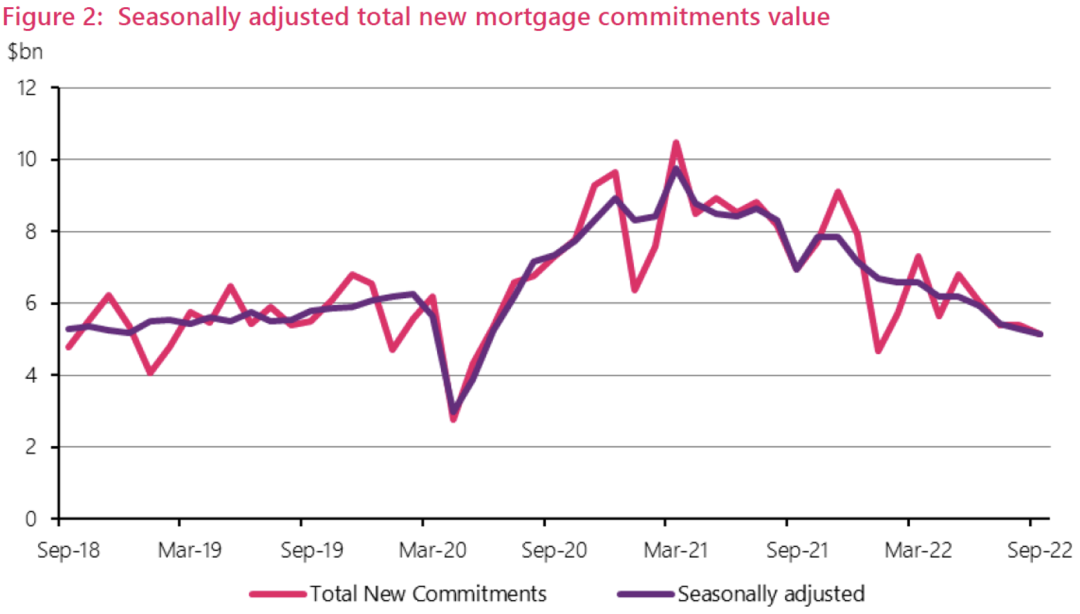
2018 year 9 month to 2022 year 9 month: changes in the value of new mortgages sought by New Zealand borrowers
While borrowers' repayments are soaring, new mortgage applications continue to decline. Reserve Bank of New Zealand figures show that 14,578 mortgage contracts were signed in September, down 3.5% from 15,109 in August. Compared with September 2021, the number of new mortgages fell 27% from 19,961. It was also the lowest monthly figure since the Reserve Bank began collecting these data at the end of 2013.
Annual inflation for New Zealand households reaches 7.7%
We know the Reserve Bank keeps raising interest rates to curb high domestic inflation, but repeated large OCR increases appear to have had little substantive effect. According to the latest household living-costs price indexes (HLPIs) released by Stats NZ, annual household inflation rose by 7.7% in the year to the end of September, while household mortgage interest costs increased sharply, by around 39% compared with a year earlier. The figures show that the high inflation rate of 7.7% was driven by substantial increases in property prices and living costs such as food. This was clearly above the inflation figure measured by the consumers price index (CPI) that Stats NZ released last week.
The report notes that the main difference between the HLPIs and CPI is that the CPI includes the cost of building new homes, which rose 17% in the year to September, whereas the HLPIs include mortgage interest costs paid by households with home loans. Put simply, the two inflation measures serve different purposes. The CPI's main role is to provide a timely indication of whether current monetary policy is appropriate, while the HLPIs focus on understanding changes in living costs for different household groups. The annual increase of 7.7% was also the largest rise in household living costs since the indexes began publication in 2008.
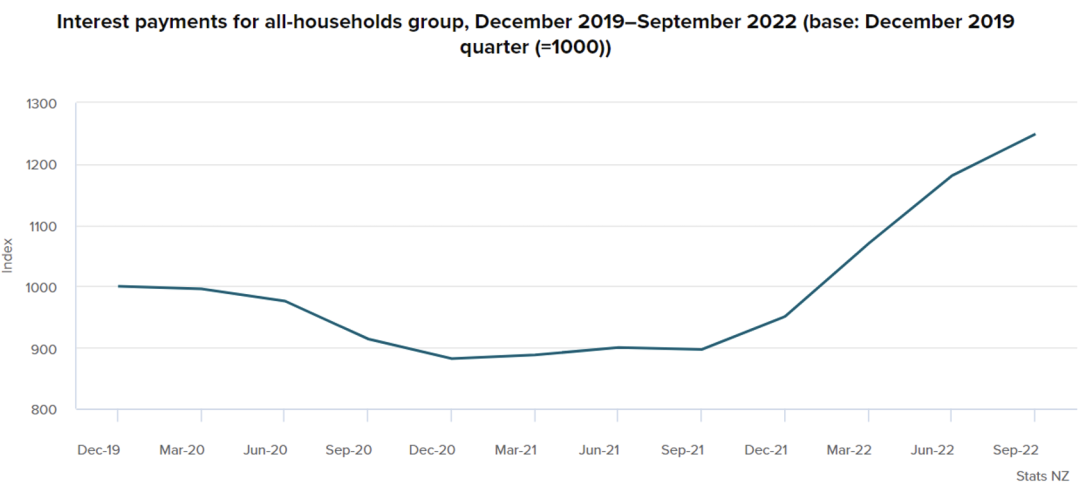
2019 year 12 month to 2022 year 9 month: changes in the index of loan costs paid by New Zealand households
So the question is: will New Zealand's inflation rate and cash rate keep rising?
Prominent independent New Zealand economist Tony Alexander has offered some distinctive views. In a recent article, he said economists and financial experts around the world were making incorrect forecasts for inflation and mortgage rates, particularly as current high inflation had forced them to raise their cash rate (OCR) forecasts. He said reality had demonstrated countless times that we cannot accurately predict inflation and interest rate trends. Recently, market forecasts for the peak OCR in the United Kingdom have exceeded 6%, while forecasts for the United States and New Zealand are also well above 5%. But will interest rates really reach such heights? Not necessarily.

Prominent independent New Zealand economist Tony Alexander
Alexander believes there is no denying that we are experiencing a period of high inflation, but that the impact of rising inflation on interest rate increases is showing up too early. Over the coming months, we may see continued sharp fluctuations and adjustments in financial markets. This means homebuyers and borrowers need not be overly pessimistic about future interest rates. As rates rise further, many people may believe they will remain high for years and consider fixing for 3-5 years, but they need to be particularly careful. The reasoning is much the same as when many people firmly believed two years ago that interest rates would remain at historic lows for years to come.