
Interest rates keep rising. How should you fix your mortgage now?
On 2 November, the US raised interest rates by 75 basis points, its fourth 75-basis-point increase this year. The federal funds rate has rapidly risen from 0–0.25% at the start of the year to 3.75–4%.

On 2 November, the US raised interest rates by 75 basis points, its fourth 75-basis-point increase this year. The federal funds rate has rapidly risen from 0–0.25% at the start of the year to 3.75–4%. There is no sign of the increases stopping, either. Comments following the press conference suggest another increase of 0.5% may follow in December, with further rises continuing into early 2023.
{ad}
The US Federal Reserve acts as the world's central bank: US interest rate increases mean the rest of the world needs to raise rates too. Major OECD countries (developed economies) have followed suit, seeking to curb the wave of inflation sweeping the globe. As a small economy, New Zealand also needs to raise rates alongside the rest of the world. Since quarter 4 of last year, the Reserve Bank of New Zealand has repeatedly raised rates, taking the OCR from 0.25% to 3.5%.
For mortgage holders, rates fixed for 3–5 years have soared from lows of 2.49–2.99% just 1 year ago to 6.25–6.5%, with monthly repayments almost doubling. Many regret not fixing for 3–5 years at the best opportunity last year. They also worry that inflation has no end in sight and will keep pushing rates higher for some time. They are now weighing up whether to fix for 3 years rather than their usual 1 or 2 years.
So how should we approach this question?
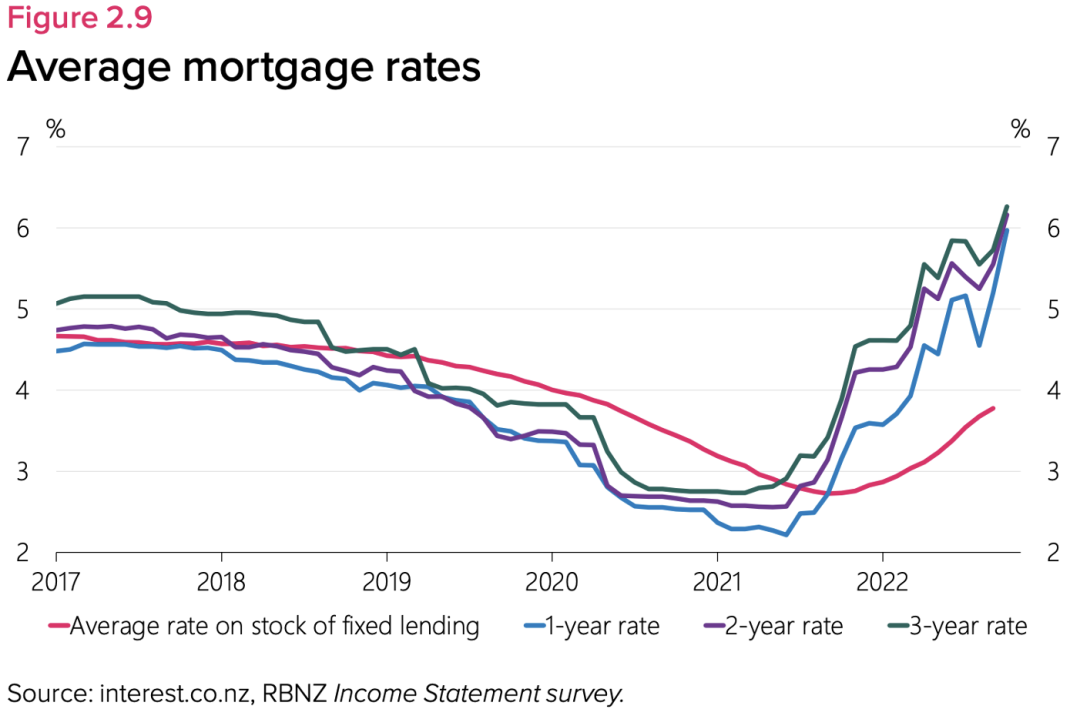
The chart shows changes over the past 5 years in mortgage rates fixed for 1、2、3 years
Recognise that everyone's forecasts were wrong
Independent New Zealand economist Tony Alexander recently wrote about how, as the pandemic began spreading in early 2020, some KiwiSaver members saw the value of their aggressive investment funds fall by 30% and switched to conservative funds for fear of further losses. In doing so, they locked in their losses and missed the huge rebound over the following months. The same thing is happening today, just in different markets.
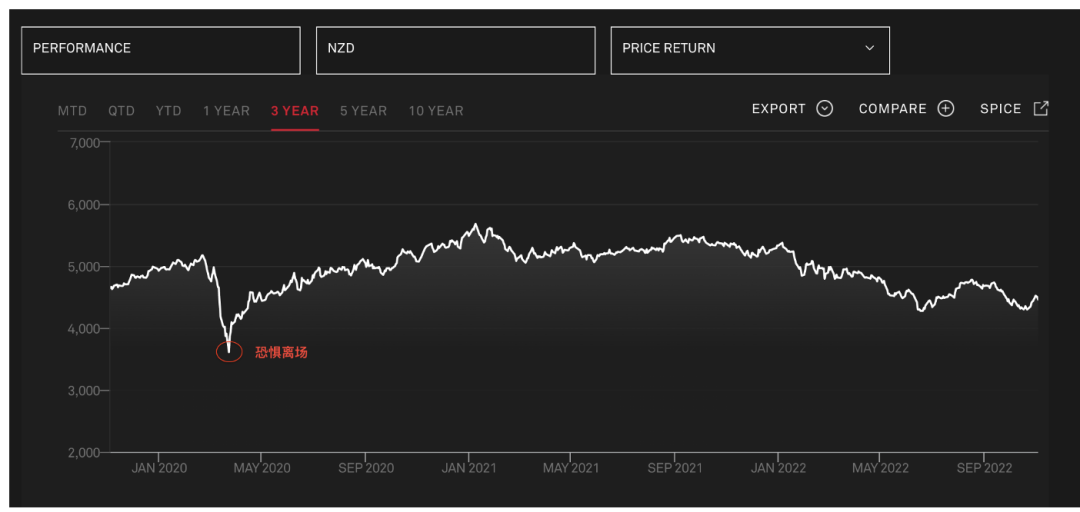
Tony said: “Just last week, I received an email from an elderly couple asking whether they should move the money they invested in funds late last year back into bank term deposits. I pointed out that all they would be doing was locking in the past year's losses, and that they had no ability to predict where share prices would go from here. Like young people in early 2020, they had been driven by the desire to avoid further losses.”
On the outlook for inflation, he said: “The same thing is happening among economists and professional financial market participants around the world. Everyone has forecast inflation and interest rates incorrectly. Everyone has been forced to revise their inflation forecasts upwards, and they are truly tired of doing so.”
In the real world, ordinary investors are not the only people whose forecasts go wrong; experts frequently get things wrong too. Very few successfully predicted this bout of inflation. Ordinary people's forecasts are therefore very likely to be wrong as well, including those now considering fixing their mortgage rates for 3 or 5 years.
Do not panic
After repeatedly being proved wrong over the past 1 year, economists and other experts are becoming more aggressive, offering various forecasts of prolonged inflation. Expected peak interest rates are also being pushed higher. We have lost count of how often the major banks have revised their forecasts; all we remember is that each revision raises their forecasts for future interest rates. This has intensified panic in the market.
Tony said: We are going through a period in which we hope inflation will fall, but it is still too early to see the effect of interest rate increases on inflation. This is very likely to continue over the next few months. We should all therefore expect financial markets to remain highly volatile. For home buyers and homeowners, this means not panicking.
Ordinary people are constantly influenced by the media. It is important to accept that our judgements are often wrong and learn not to panic. If your instinct now says interest rates will keep rising and you should fix for 3 or 5 years, think back to the arrival of the pandemic. Did you also feel then that it would be best to sell everything?
Alternatively, if you failed to consider fixing for 3–5 years when rates were low in 2021 and missed that opportunity, your current inclination to fix for 3–5 years may very well be wrong too.
Assess the current situation calmly
The chart below shows interest rates in the world's major developed countries. It reveals a period of rapid increases beginning in 2022. For central banks that failed to prevent inflation by raising rates earlier, this is an attempt to repair the damage after the event.
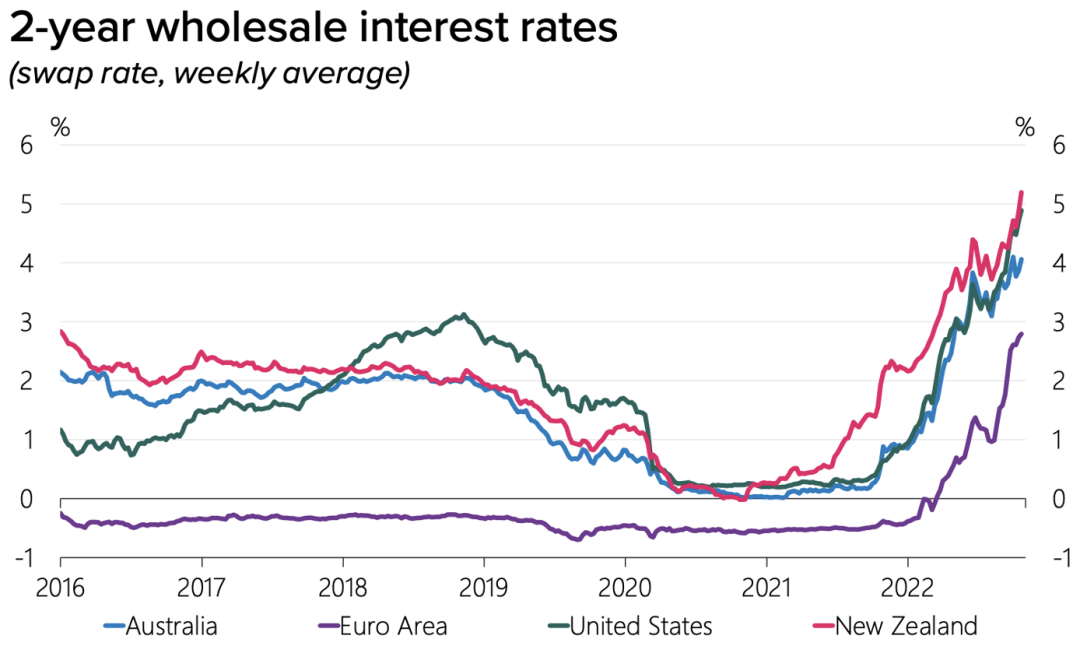
But as Tony says, the economy is complex, and it takes time for interest rate increases to have an effect. Experience generally suggests a lag of at least 6 months, and potentially as long as 18 months. Economies are therefore only just beginning to feel the effects of the first few increases, with several subsequent rises yet to take effect. Inflation remains high with no sign of cooling, but that does not mean these increases have been ineffective or that many more large rises must follow.
The central bank does not actually intend to keep raising rates indefinitely. The chart below is a forecast from the Reserve Bank of New Zealand's August Monetary Policy Statement. It shows that most increases would take place in 2022. That means the rate-hiking cycle is now nearing its end, and the central bank's next step is to wait for its policy to take effect.
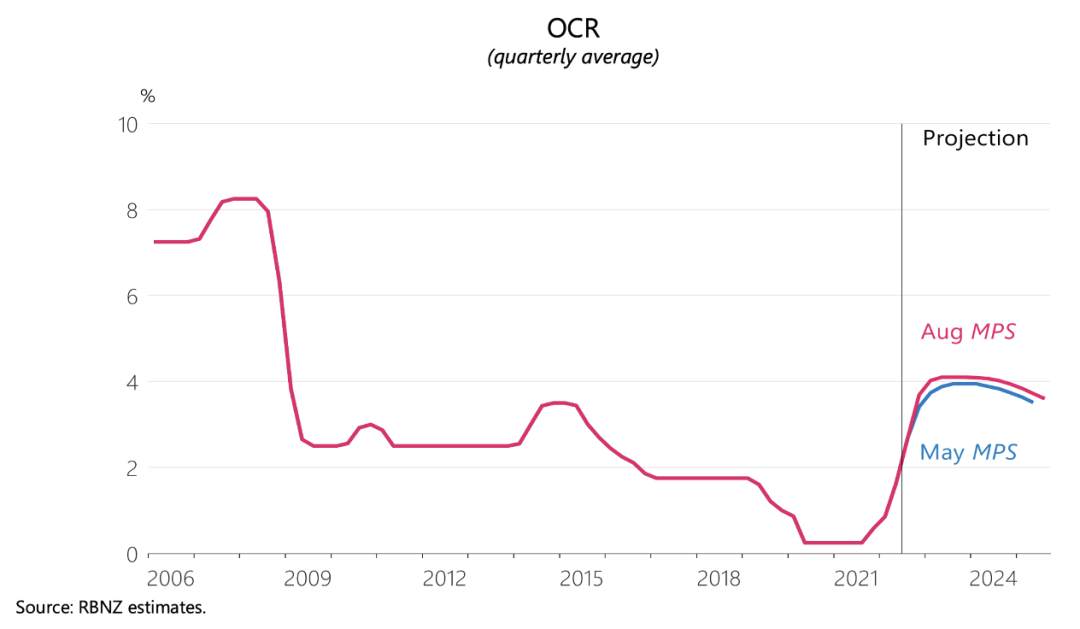
Fixing for 3 or 5 years could therefore lock your mortgage in at a high rate for a period when you might otherwise be able to secure a lower fixed rate, such as 2024–2026. Choosing a long fixed term now requires considerable caution. If you cannot reach a clear decision, stick with the simplest approach: fix for 1–2 years at a time.
Property remains the best investment
Any discussion of mortgages inevitably involves the property market itself. The current decline in house prices is simply a normal correction following a major surge.
There are 3 factors affecting property prices: population, land supply and finance.
01
Population is a long-term factor, with effects lasting decades. New Zealand lies in the Southern Hemisphere. As conflict grows in the Northern Hemisphere, people will continue to move here.
02
Land supply is a medium-term factor, with effects lasting 5–10 years. The New Zealand Government's infrastructure capacity is limited, making large-scale city building impossible. In major cities such as Auckland, the supply of well-located land suitable for housing is limited.
03
Frequently discussed financial policies, such as interest rate increases and cuts, have an effect for only 3–5 years. Viewed over the longer term, today's correction is therefore just a ripple in the long history of rising house prices.
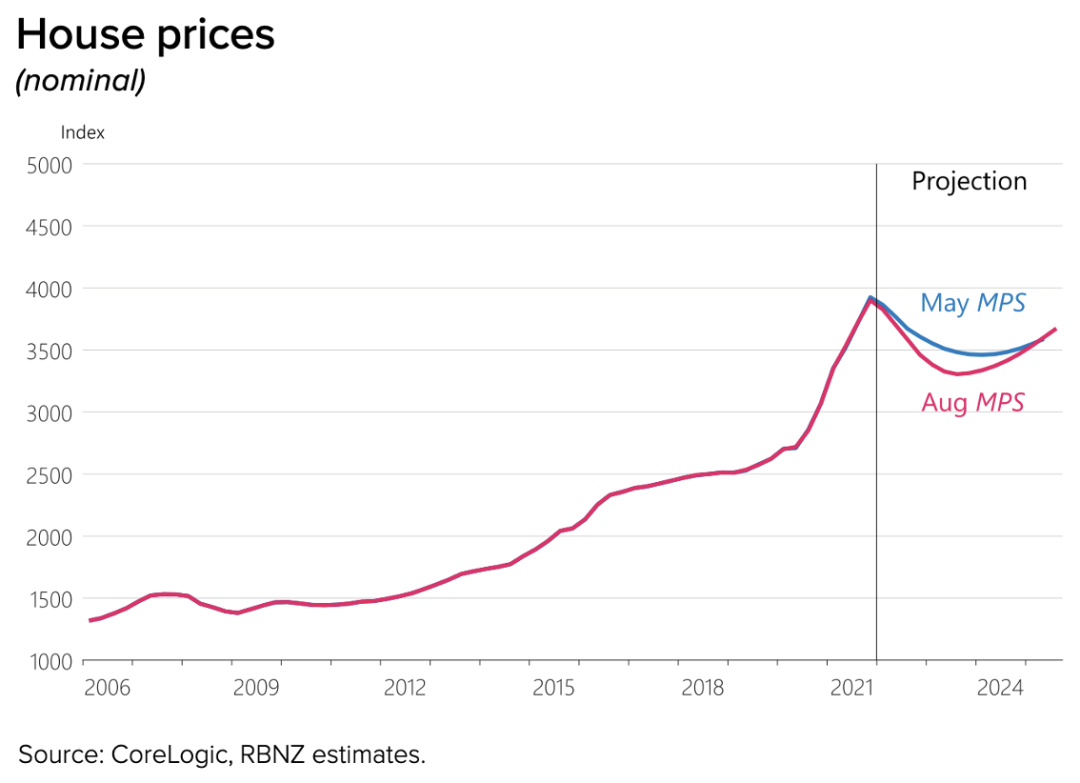
House prices in the Reserve Bank of New Zealand's report this year, month 8, covering 2005 to 2025 (2022-2025 are forecasts)
Over the long term, time smooths everything out, and fluctuations are eventually absorbed into longer-term trends. The current decline is also laying the groundwork for future increases. For owner-occupiers, the approaching summer and 2023 offer a good opportunity to find a suitable home. Do not waste the opportunity created by falling prices. For investors, little more needs to be said: opportunity always favours those who are prepared.