
How far will house prices fall in this downturn?
Since New Zealand house prices peaked in November last year, speculation about how far they will fall in this downturn has never stopped.

Since New Zealand house prices peaked in November last year, speculation about how far they will fall in this downturn has never stopped. Early this year, ANZ broke with convention by forecasting a house price decline of 7% this year. The forecast caused a stir and was quickly challenged by many economists and market analysts. However, in March, ANZ increased its forecast decline to 10%, then revised it to 12%, and again to 15% in June. By late October, it had settled on a forecast decline of 18%, equivalent to a fall in real house prices of as much as 27% after accounting for inflation.
{ad}
Commercial banks' forecasts
ANZ is certainly not alone in its forecasts. Other banks and forecasters have also repeatedly revised their projected declines. Even those who initially challenged the forecasts have had to acknowledge that the property market downturn will be substantial. So far, national house prices have fallen by 8%–12% from last year's peak. Some regions have suffered larger declines, with Auckland and Wellington down 15% and 18% respectively. Investment banking firm Jarden forecasts that house price falls will continue to accelerate through to March next year.
As is widely recognised, predicting when house prices will bottom out and how far they will fall may itself be an impossible task. Just as with earlier attempts to predict when prices would peak, forecasters only recognise the turning point after a clear decline has emerged. CoreLogic head of research Nick Goodall believes we might be able to predict market developments more accurately in a more idealised market: one without the historically low interest rates triggered by the pandemic, without LVR restrictions, and without buyers being driven by FOMO (fear of missing out) over the past two years.
The Reserve Bank of New Zealand's forecasts
The Reserve Bank itself acknowledges that its forecasts have had an average error of 5.2% since 2010 (the actual error is likely larger). In May 2020, during the last nationwide ban on property sales, it forecast that house prices would fall by 9% by the end of 2020. Reality proved it wrong: prices rose rather than fell. From July 2020 to July 2021, the national median house price rose by 25.2% year on year, with increases of as much as 32.7% in some regions.
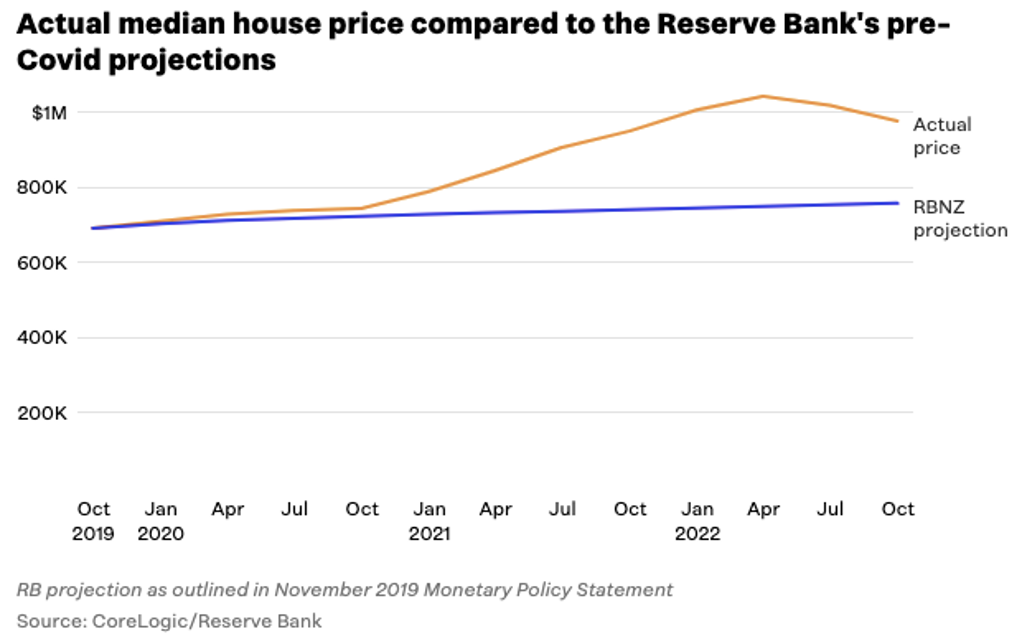
2019 to 2022: the difference between actual house prices and the Reserve Bank's forecasts
For property investors, the property “gold rush” is over, and the pace of the economic downturn is accelerating. In the three months to the end of October, house prices fell by 4.5%, a larger decline than during the global financial crisis in 2008. However, in absolute terms, the median house price remains well above the Reserve Bank's forecast, at NZ$964,202.
Analysis from property research organisations
CoreLogic's latest data shows that falling house prices have completely erased the past year's capital gains nationwide. It has increased its forecast decline to 18%, in line with ANZ. This would bring the national median house price down to NZ$855,000, a level expected to be reached in the middle of 2023. Although that would be NZ$250,000 below the average house price at the pandemic peak, it would still be NZ$127,000 above the level in March 2021.
Nick Goodall said house prices would not easily return to their level of two years ago. In February 2020, before the pandemic reached New Zealand, the national average house price was just NZ$723,000. Returning to that level would require an overall decline of 31%. Goodall noted that the biggest factor potentially pushing prices lower was New Zealand's persistently high inflation. The latest inflation figures, released in mid-October, showed prices had risen by 7.2% over the past year. This stunned many who thought inflation was under control, yet it has proved more persistent than expected. This means further increases in the Official Cash Rate will be necessary, the market will face greater challenges, and house prices will need a longer period of adjustment and recovery. Goodall said this could have knock-on effects on the national economy and employment, causing a sharper fall in property prices.
ANZ senior economist Miles Workman said the bank's current forecast indicated that the pandemic's negative effect on housing affordability had been completely reversed: wages were rising while house prices were falling, making it easier for buyers to purchase homes. He said: “We need to disregard the post-pandemic house price peak, because that market was far too frenzied, with too many people driven by FOMO disrupting it. But looking at the long-term trend, I think house prices could soften further.” Workman believes that if inflation and employment pressures in the labour market persist, the Reserve Bank will be unable to stop raising rates. The OCR could well exceed 5%, placing further downward pressure on house prices.
If house prices fall by 30%, what impact would that have?

Jade Kake
Recently, property writer Jade Kake studied the potential effects of a property market crash. She assumed a homeowner bought a property in July 2021 for the national median price at the time, NZ$826,000, with an initial mortgage of 80% and a 30-year loan term. She assumed inflation of 2%, in line with the Reserve Bank's target. On these assumptions, she concluded that a typical buyer would retain positive equity after a house price fall of 10% or 15%. A decline of 20% would leave many in a weak equity position, with slightly negative equity for 13 years after purchasing. A fall of 30% would be a devastating blow for most homeowners.