
A good chance to get on the property ladder? New Zealand house prices fall by $90,000, returning to pre-pandemic lows!
In just two weeks, all of New Zealand’s major banks have announced interest rate rises. ANZ, ASB, Kiwibank, Westpac and BNZ have successively announced increases to a range of mortgage rates, with floating mortgage rates at almost all banks now approaching 8%.
In just two weeks, all of New Zealand’s major banks have announced interest rate rises. ANZ, ASB, Kiwibank, Westpac and BNZ have successively announced increases to a range of mortgage rates, with floating mortgage rates at almost all banks now approaching 8%.
As interest rates rise, the latest figures show that average house prices in some parts of New Zealand have fallen by NZ$90,000.
{ad}
For some homeowners, this is undoubtedly bad news, particularly those who bought at the peak of the property boom in late 2021. Their mortgages may already exceed the value of their homes, especially in Auckland and Wellington.
For first-home buyers, however, falling prices have given more people a chance to get on the property ladder.
New Zealand house prices fall by 90,000
The recently released OneRoof Property Report for 2022 shows that the market has changed dramatically over the year, with homeowners facing risks ahead.
OneRoof editor Owen Vaughan said the pandemic boom had given way to falling prices, tighter lending and uncertainty over the coming year. The property market had shifted from a “fear of missing out” to a “fear of overpaying”.
Nationwide, the average property value has fallen 8.15% from its peak of NZ$1,100,000 at the end of February, and now stands at nearly NZ$90,000. House prices have fallen in every region except the West Coast, with Wellington and Auckland homeowners hardest hit.
Since prices peaked in March, the average house price in Greater Wellington has fallen 17.7% (NZ$201,818), with falls of more than NZ$400,000 in some inner-city suburbs. In Auckland, the average house price has fallen 12% (nearly NZ$180,000) from its peak.
The main reason for the decline is the departure of Auckland investors, who drove much of the price inflation during the pandemic.
In some areas, the decline has taken average house prices back to levels seen two years ago, or even below them.
House prices in these areas are lower than two years ago
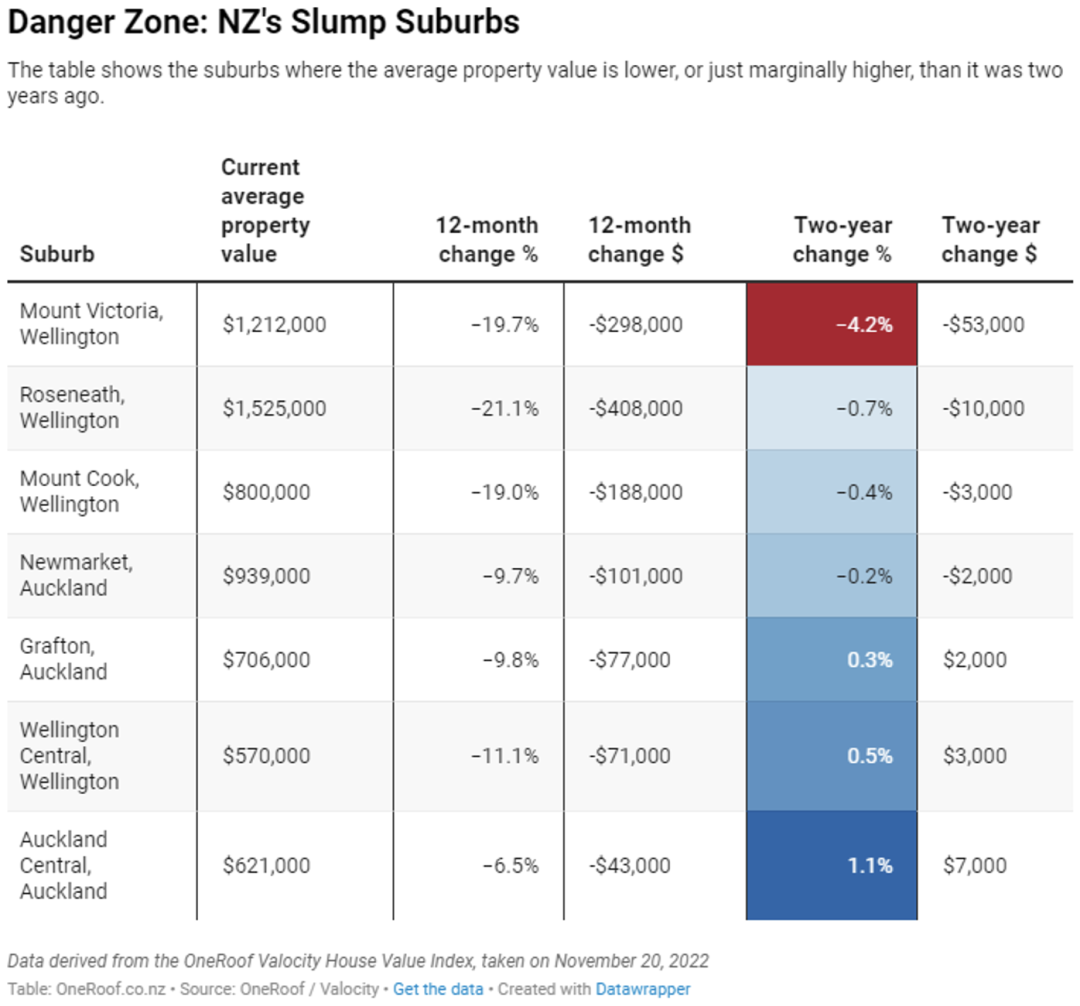
According to the latest OneRoof-Valocity House Value Index, average house prices in three Wellington suburbs are now lower than two years ago. This is not the result of any adverse event; these markets may simply have more investors and fewer first-home buyers.
Mount Victoria in Wellington has been hardest hit, with its average property value falling 4.2% to NZ$1,212,000, compared with NZ$1,265,000 in 2020. Compared with the same period two years ago, the average property value in Wellington’s Roseneath has also fallen 0.7% to NZ$1,525,000, while Mount Cook’s has dropped 0.4% to NZ$800,000.
Mount Victoria and Mount Cook have many owner-occupiers and investors, who are more cautious than first-home buyers in the current market. Mount Cook’s price decline may also reflect its large amount of student accommodation. With few investors currently in the market, demand for these rental properties is much lower.
Some central Auckland suburbs have also seen small adjustments, with Newmarket’s average property value falling 0.2% to NZ$939,000. Grafton, Auckland Central and Wellington Central are close to their 2020 figures.
Loan Market mortgage adviser Sanjeev Jangra said his client base had shifted from 40–50% investors to around 80% first-home buyers. After house prices fell 15–20%, investors no longer had enough equity.
For owner-occupiers with a pressing need to buy and for first-home buyers, being able to purchase at prices from two years ago is undoubtedly good news. Those who already own property need not be overly anxious about falling prices either.
Valocity head of valuations James Wilson said a decline in paper value meant little for owner-occupiers or long-term investors who could comfortably weather the current crisis.
“If you can afford your mortgage and haven’t stretched beyond your means, this really doesn’t mean anything for you in the short term.”
Nicki Cruickshank, who heads Tommy’s Real Estate in Wellington, said house prices in 2021 had exceeded expectations, so this year’s decline was expected, although she had not anticipated such an abrupt turnaround. “But looking at the overall picture, most people have owned their homes for more than 10 years, so overall they are still doing well.”
So, is buying now a good idea for first-home buyers?
Could buying now save money?
CoreLogic chief property economist Kelvin Davidson said fixed mortgage rates would rise further over the coming months, but house prices would continue to fall, eventually reaching an estimated 20% below last year’s peak.
“Paying a lower price upfront is better for buyers because they save money from the outset, and won’t have to pay interest on that money later.” He said the longer buyers waited now, the higher the interest rate they would face.
“These factors, along with uncertainty in the labour market, may cause some first-home buyers to pull back. But others will be able to afford it and believe they won’t lose their jobs. These people will buy so they can own their own home.”
Others take the opposite view. Infometrics chief economist Brad Olsen said he did not think now was a good time to buy a first home.
He said higher mortgage rates were on the way, but house prices would not fall as sharply, so the ability to service a mortgage would remain a major issue. “Over the past year, the average household has spent around half its income on housing costs, and many prospective first-home buyers simply cannot afford mortgage repayments.”
Whether to buy now depends on each buyer’s financial circumstances. Either way, however, transactions in the market are already speeding up.
Buyers are speeding up property transactions
Continuing interest rate rises have made homebuyers anxious and brought another consequence: many are bringing forward settlement dates or negotiating shorter settlement periods to lock in rates, fearing further increases.
Sometimes both buyers and sellers are in a hurry: sellers are keen to lock in while rates are lower, and also want to settle matters relating to their new property sooner.
As well as worrying about higher fixed mortgage rates, buyers are concerned that their existing pre-approvals will expire. Banks may tell some borrowers that they can no longer borrow as much under the new test rates.
Industry professionals therefore advise locking in an interest rate as soon as the purchase agreement becomes unconditional, because rates are highly likely to rise.