
Housing market records its biggest fall in 14 years! Yet an expert says: take heart, the worst is over!
People tend to think of Auckland house prices as having risen steadily in recent years. In the year to February 2021, Auckland’s median house price jumped from NZ$885,000 to NZ$1,100,000, an astonishing annual rise of +24.3% that set a new record.

Auckland house prices fall by a record amount
People tend to think of Auckland house prices as having risen steadily in recent years. In the year to February 2021, Auckland’s median house price jumped from NZ$885,000 to NZ$1,100,000, an astonishing annual rise of +24.3% that set a new record.
{ad}
In a dramatic reversal, prices have fallen this year as sharply as they previously rose. According to November figures from the Real Estate Institute of New Zealand (REINZ), Auckland house prices have declined steadily this year after surging last year. In the year to November, prices in the city fell by 18.1%, or NZ$235,500. That is equivalent to every Auckland homeowner losing an average of NZ$643 a day in property value.
Specifically, house prices in Auckland City have fallen from a peak of NZ$1,540,000 in November last year to NZ$1,190,000. In Franklin, prices fell from NZ$974,000 to NZ$900,000; in Manukau, from NZ$1,230,000 to NZ$1,050,000; on the North Shore, from NZ$1,550,000 to NZ$129; in Papakura, from NZ$1,130,000 to NZ$850,000; and in Waitakere, from NZ$1,190,000 to NZ$920,000.
Although the price data show Auckland homeowners’ assets shrinking in value every day, not everyone will notice the change. This is because, unless owners buy or sell property, these changes remain purely “on paper”, with no practical significance.
Commenting recently on the annual Auckland price decline of NZ$235,000, REINZ said that despite a year of correction, the city’s median house price remained above NZ$1,000,000, far higher than in other regions. Affordability therefore remained an issue for many buyers.
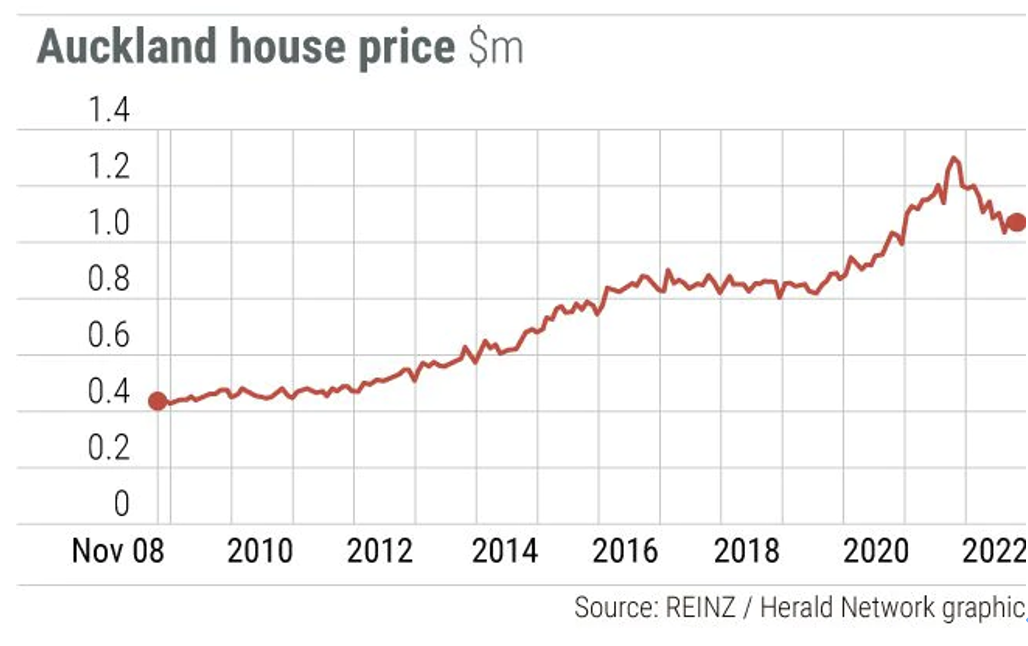
2010 to 2022: Auckland house price movements
REINZ’s market survey shows that owner-occupiers are usually the most active buyer group in Auckland’s property market. However, with rising interest rates, high inflation and weak consumer confidence, both buyers and sellers are less active than before.
First-home buyers face the additional burden of rising interest rates as they struggle to secure mortgages. Property investors are also gradually withdrawing from the market following government tax policy changes. For many buyers, declining capital gains mean property investment is no longer attractive.
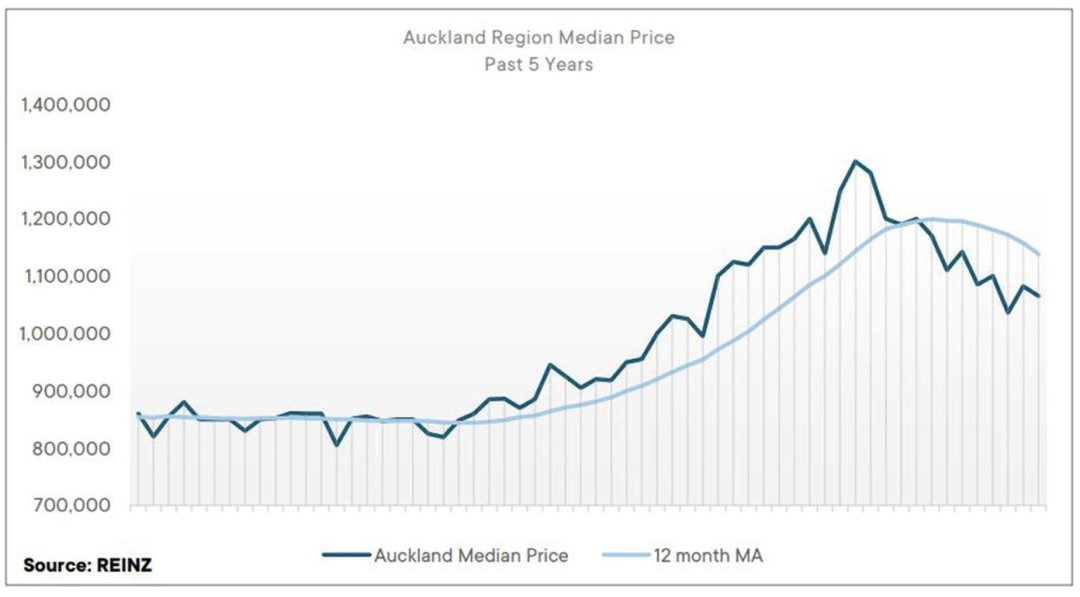
Auckland’s median house price over the past five years
Property sales fall sharply,
while listings rise
The latest property figures from Auckland’s largest real estate company, Barfoot & Thompson, show that the number of unsold residential properties listed in Auckland and Northland reached a 12-year high last month, with 5052 listed properties yet to find buyers. The company averaged 1119 sales a month last year, but recorded only 700 sales in November this year. In stark contrast to the sharp fall in monthly sales, the number of properties available for sale continues to rise, well above last year’s monthly average of 3353 listings and the 3759 recorded in 2020.
The company’s median sale price in November fell to NZ$1,065,000 from NZ$1,092,500 in October, a decline of 2.4%. However, managing director Peter Thompson maintained that although current sale prices and volumes were below the same period last year, he believed property sales activity was continuing in a normal, orderly manner.
Queenstown Lakes district stands out
Turning to the rest of the country, QV figures show that New Zealand’s average house value fell by 2.9% in the three months to the end of November, a smaller decline than the 3.9% recorded in the three months to the end of October.
QV says the largest house value declines since the start of this year have been in Wellington, down 18.7%; Palmerston North, 14.5%; Hastings, 12.5%; Auckland, 12.2%; Napier, 12.0%; Dunedin, 11.5%; Hamilton, 11.3%; and Tauranga, 9.3%. Queenstown Lakes was the only district nationwide to record an increase, with its average house value up +5.4% since the start of the year. The table below shows average house values in the main urban centres at the end of November and their declines over the preceding three months.
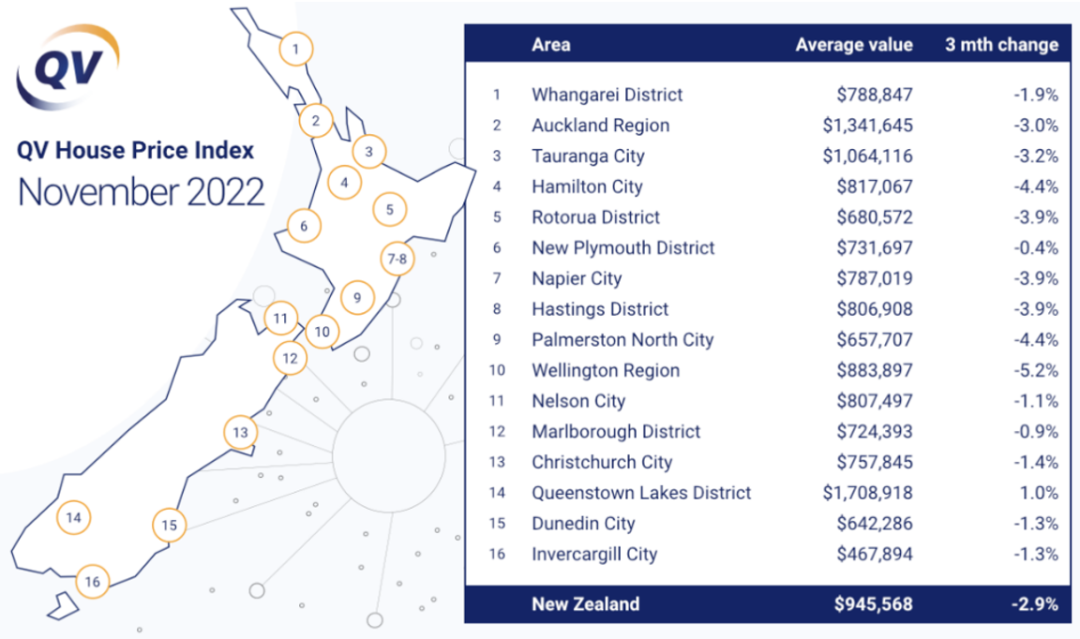
QV chart showing average house values in New Zealand’s main cities
An expert gives the following number of reasons why house prices will not crash next year: 6 key reasons
Independent economist Tony Alexander recently argued that although property sales are falling and prices continue to retreat, he has reason to believe the worst is over. He identified 6 compelling pieces of evidence that the housing market will not crash next year:
1
First, falling house prices and strong wage growth have brought a marked decline in the nationwide house-price-to-income ratio, which is now only 4% above its pre-COVID level.
2
Second, net migration is also recovering rapidly, improving from -14,000 people at the end of 2021 to -4,000.
3
Third, current bank fixed interest rates already reflect expectations that the cash rate will reach around 5.5%, leaving almost no further upward pressure on fixed rates. This means we may already be at the peak of the fixed-rate cycle, a very positive signal for prospective property buyers.
4
Fourth, the number of homes listed for sale peaked at 28,400 in August this year. Stock is now trending down and has fallen to 26,500.
5
Fifth, commercial banks are gradually easing their lending criteria. They have clearly learnt how to work with the CCCFA, while weak property sales have affected their profits. Discounted interest rate offers are likely to emerge soon to encourage more borrowers to apply.
6
Sixth, increasing numbers of new housing developments are suffering major setbacks. This will lead buyers to reconsider existing homes, potentially bringing renewed prosperity to the resale market.