
Mortgage enquiries from homebuyers rise sharply! But this measure paints a less encouraging picture…
So how has the mortgage market been performing recently? We have heard from several sources that many mortgage brokers have received more enquiries than usual since January

Mortgage enquiries from homebuyers rise sharply
Recently, many real estate agents have reported seeing more homebuyers returning to the market, with open homes for entry-level properties attracting plenty of first-home buyers. So how has the mortgage market been performing recently? We have heard from several sources that many mortgage brokers have received more enquiries than usual since January.
Mortgage adviser Gareth Veale says enquiries from first-home buyers and people looking to replace their current homes have risen by almost 50% since the start of this year compared with a month earlier. He generally sees a marked increase in mortgage enquiries at the beginning of each year, as many buyers set their goals during the holidays. What is different this year is that enquiries started earlier and more people are getting in touch.
Veale believes the number of people submitting mortgage applications has fallen in recent years because many applicants fear being turned down by banks. However, following the easing late last year of requirements under the Credit Contracts and Consumer Financial Act governing banks' assessment of loan applications, more applicants are eager to try again and return to the market.
Veale says enquiries about mortgage applications had actually begun increasing in October last year, but the biggest obstacle for borrowers is banks' unaffordable test rates of more than 8%. Many people are daunted by rapidly rising mortgage rates. In practice, however, rejection rates for applications submitted through mortgage brokers are relatively low, because most mortgage advisers only submit applications they believe have a strong chance of approval.

Banks' mortgage stress-test rates were 7% last year and have risen to a record high of 8.5% this year
Another mortgage adviser, Dave Williams, has had a similar experience of the market. He says his phone has been ringing constantly with enquiries since he returned to work in early January, mostly from first-home buyers. He adds that although enquiries have surged, not everyone who enquires will end up buying a property. Each first-home buyer's financial circumstances are different, so their chances of mortgage approval also vary. They include buyers who lack a sufficient deposit and hope to obtain government assistance through Kāinga Ora, as well as those with deposits of at least 20%.
Jarrod Kirkland, general manager of Mortgage Lab, says they have never been this busy, with enquiry calls coming in continuously since January. Many borrowers whose fixed mortgage terms are about to expire are seeking help to cope with the negative effects of rising mortgage rates and falling house prices. Property investors are shifting their focus from existing homes to new builds to secure better tax outcomes.
{ad}
Kirkland believes that although banks' current high test rates of 8.155% to 8.5% make mortgage applications more difficult, this is not necessarily a bad thing, as they provide borrowers with a greater safety margin. When people put off applying for a mortgage for fear of being turned down by a bank, they need to develop a plan to improve their finances so they can successfully apply three months later.
Squirrel Mortgages founder John Bolton shares this view. As bank lending approval becomes harder to obtain, mortgage advisers need to work harder, using extensive asset restructuring and refinancing to help borrowers out of difficulty and negotiating better rates with banks for their clients. Bolton is relatively optimistic about current financial market conditions. He explains that he saw this kind of environment during the global financial crisis in 2008. For borrowers who passed stress tests and obtained mortgages last year, the new rates are painful but still affordable.
Affordability remains a challenge for first-home buyers
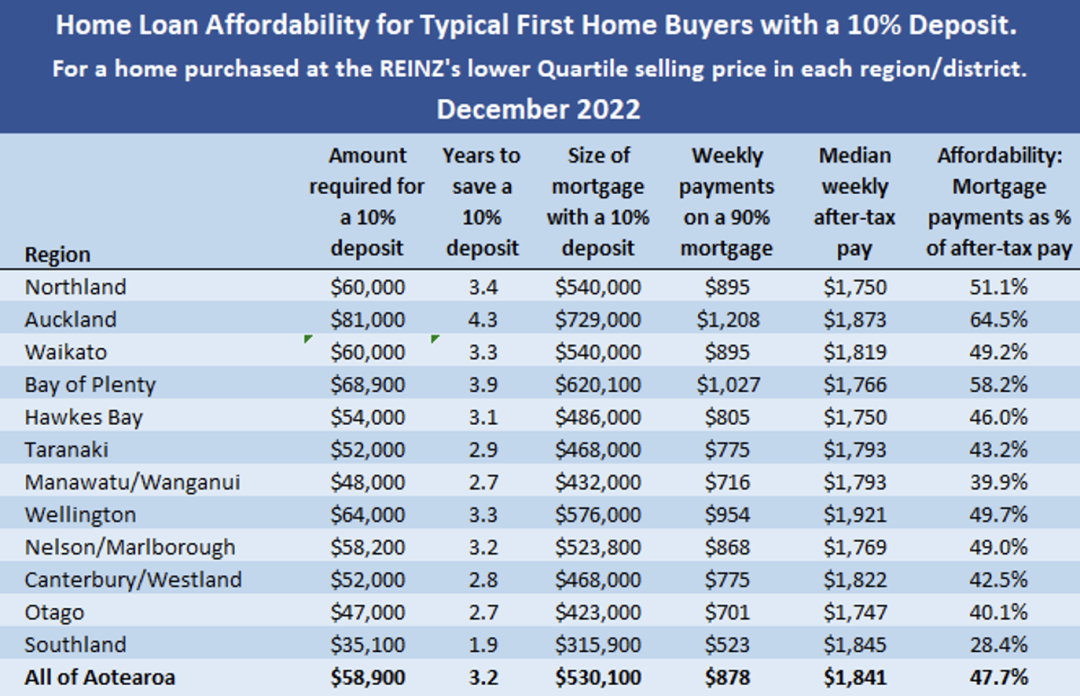
That raises a question: can first-home buyers eager to enter the market also afford today's high mortgage rates? The latest home loan affordability report from interest.co.nz shows that despite last year's sharp fall in house prices, affordability has worsened for first-home buyers. Rising mortgage rates have offset the benefits of falling house prices, putting home ownership further out of reach.
The home loan affordability report tracks three main measures affecting affordability for first-home buyers:
-
Lower-1/4 sale prices for properties sold in each region of New Zealand, collected by the Real Estate Institute of New Zealand (REINZ).
-
Mortgage interest rates, based on the average two-year fixed rate offered by the major commercial banks
-
Median after-tax wages for couples aged 25–29
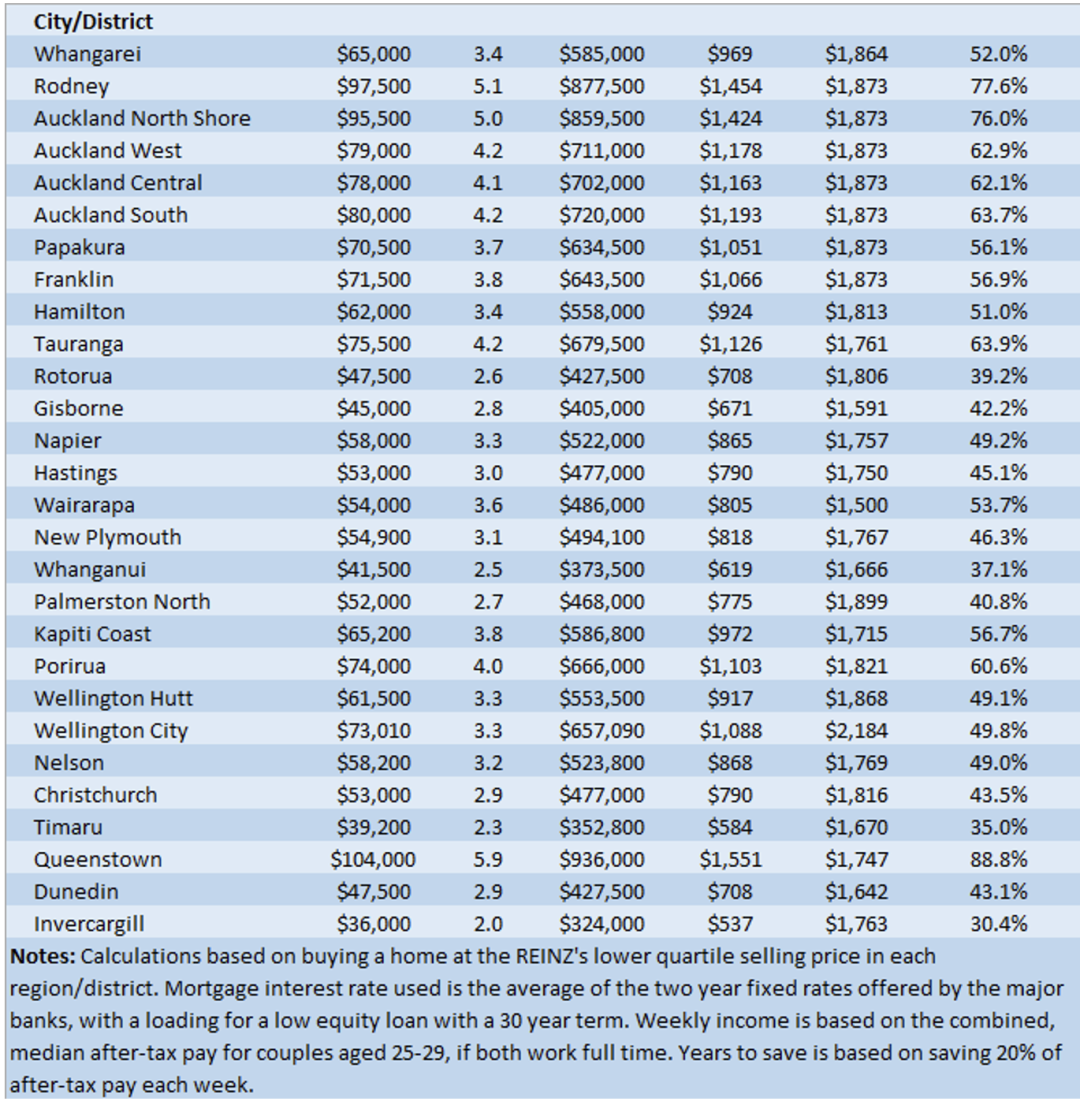
The report tracks mortgage repayments on properties bought at lower-1/4 prices in each region of New Zealand, assuming a 30-year loan term and deposits of 10% and 20%, respectively. Mortgage repayments are considered unaffordable when they reach 40% of after-tax income.
Over the year from December 2021 to December 2022, REINZ's national lower-1/4 property sale price fell by NZ$66,000 (-10.1%), from NZ$655,000 to NZ$589,000. Over the same period, the average two-year fixed mortgage rate rose from 4.21% to 6.58%. Meanwhile, first-home buyer households' after-tax incomes increased slightly (+2.1%), giving them an extra NZ$37 a week.
So what effect did all these changes last year have on mortgage affordability?
For example, based on REINZ's lower-1/4 property sale prices for each region, Aucklanders would need 4.3 years to save a 10% deposit and a mortgage of NZ$729,000. Repayments would take up 64.5% of their after-tax income, a strikingly high proportion.
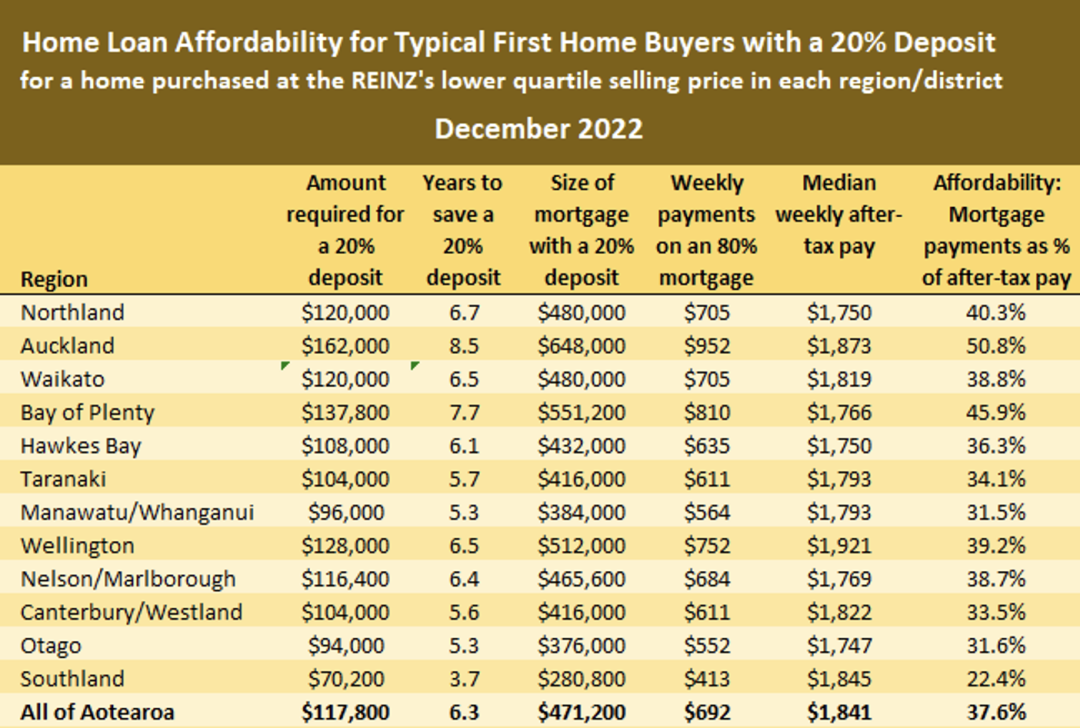
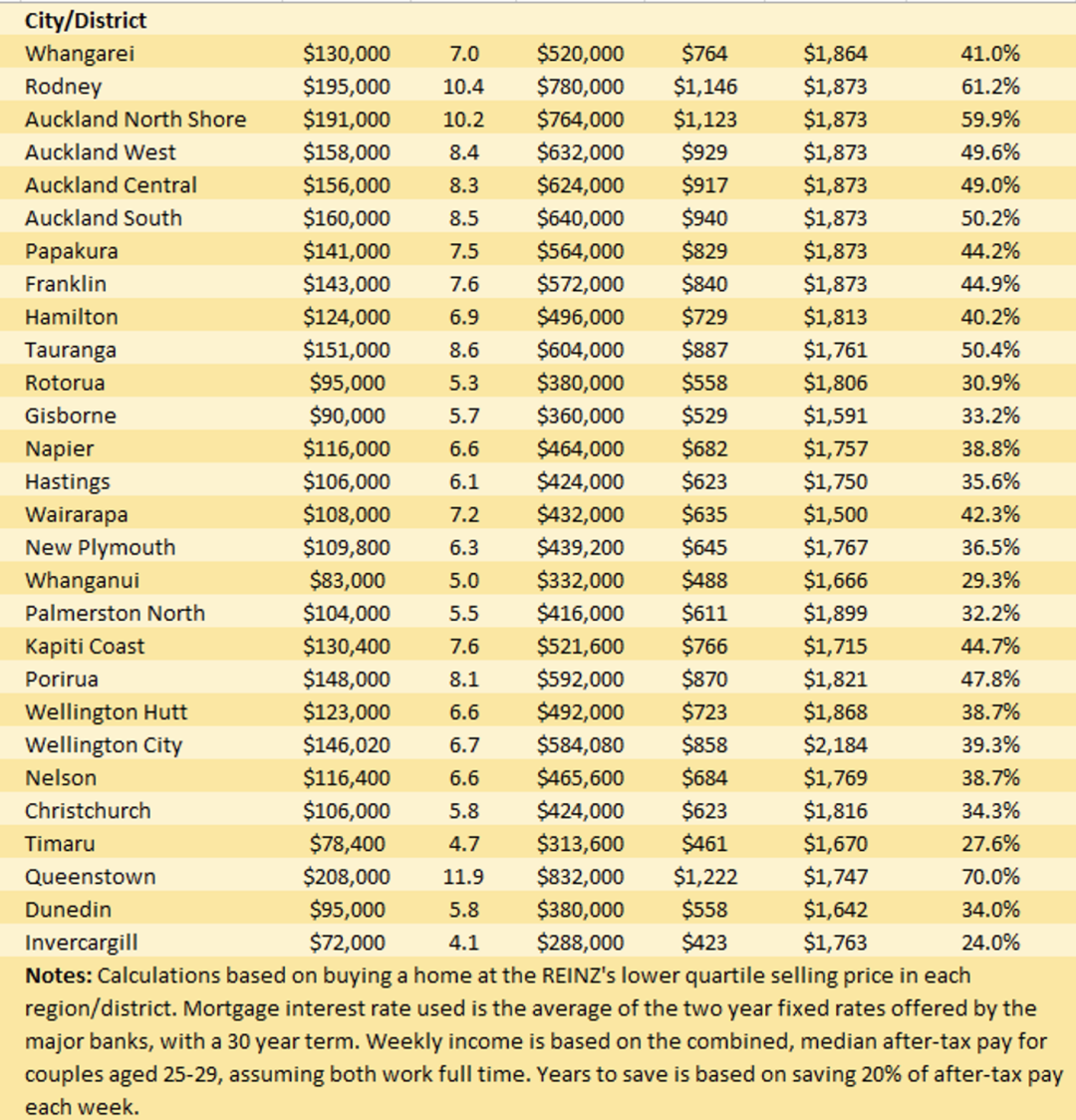
For a first-home buyer household purchasing a property in December 2021 at the then national average lower-1/4 sale price, with a 20% deposit, weekly mortgage repayments would have been about NZ$592. That represented 32.8% of the after-tax income of a young household aged 25–29.
A year later, in December 2022, the same calculation would put weekly mortgage repayments NZ$100 higher at NZ$692, equivalent to 37.6% of average household income for that age group. This means that despite the substantial fall in house prices, affordability has worsened markedly for young first-home buyer households. It is also worth noting that if we assume this typical household has a 10% deposit, mortgage repayments would be unaffordable for first-home buyer households in almost every region of New Zealand.