
Bank lending rates keep shifting. Where will interest rates go next? These factors are key!
Data shows employment growth slowed in the final quarter of 2022, with unemployment rising from 3.3% to 3.4%

Latest New Zealand unemployment figures released
Over the past week, Stats NZ released a key economic indicator with implications for the property market: New Zealand’s unemployment rate. The figures show employment growth slowed in the final quarter of 2022, with unemployment rising from 3.3% to 3.4%.
Stats NZ senior manager Becky Collett said: “The unemployment rate has remained at or near historic lows since the third quarter of 2021.” The labour underutilisation rate rose from 9.0% in the previous quarter to 9.4%, mainly because of an increase in the potential labour force. In the fourth quarter, labour force participation held at 71.7% and the employment rate remained at 69.3%, both record highs since the series began in 1986.
Although the latest unemployment rate was only 0.1% higher than in the third quarter, it was a marked departure from the central bank’s earlier expectation of a slight decline. Frankly, the widespread expectation was that domestic unemployment would rise in the second half of this year. The central bank also forecast that unemployment would reach a high of 4.8% by year-end. Instead, unemployment has begun rising earlier than expected.
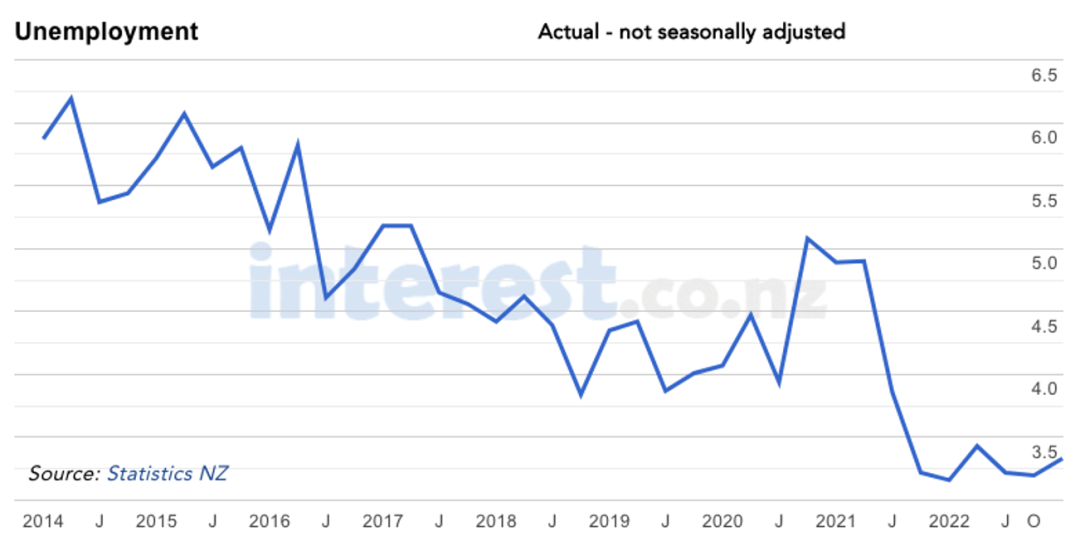
Changes in New Zealand’s unemployment rate over the past 8 years. Source: Stats NZ
The importance of these figures is clear: labour market performance directly affects consumer spending, property transactions, construction activity and wages. The rise in unemployment also pushed down both the New Zealand dollar against the US dollar and wholesale interest rates. This makes the data a key factor in the central bank’s next Official Cash Rate (OCR) decision on 22 February.
Bank economists’ forecasts for the next OCR decision
{ad}
The Reserve Bank of New Zealand had previously indicated another substantial OCR increase of 75 basis points from its current 4.25%, but the unemployment figures now appear likely to have a significant bearing on that increase.
BNZ economists were the first to respond, saying the latest labour market data had prompted them to lower their forecast for the central bank’s February rate increase from 75 to 50 basis points. BNZ head of research Stephen Toplis said the December Consumer Price Index was lower than expected, while labour market data pointed in the opposite direction. Although they had lowered their forecast cash rate peak from 5.5% to 5.0%, they remained firmly of the view that the Reserve Bank of New Zealand was unlikely to cut the OCR substantially before 2024.
ASB senior economist Mark Smith said that, in his view, the Reserve Bank of New Zealand’s need for a large OCR increase appeared less urgent, so the increase would be smaller than previously expected. They now forecast an increase of just 50 basis points in February, followed by another modest 50-basis-point rise in April, taking the OCR to a peak of 5.25%. He believes rising unemployment will eventually lead the Reserve Bank of New Zealand to start cutting the OCR in the second quarter of 2024, several months earlier than previously forecast.
How are banks’ mortgage rates changing?
Falling wholesale interest rates in international markets have prompted major banks to actively adjust their fixed lending rates. Indeed, some mainstream New Zealand banks have lowered their longer-term fixed mortgage rates over the past week. Clearly, most longer-term fixed mortgage rates may well have peaked.
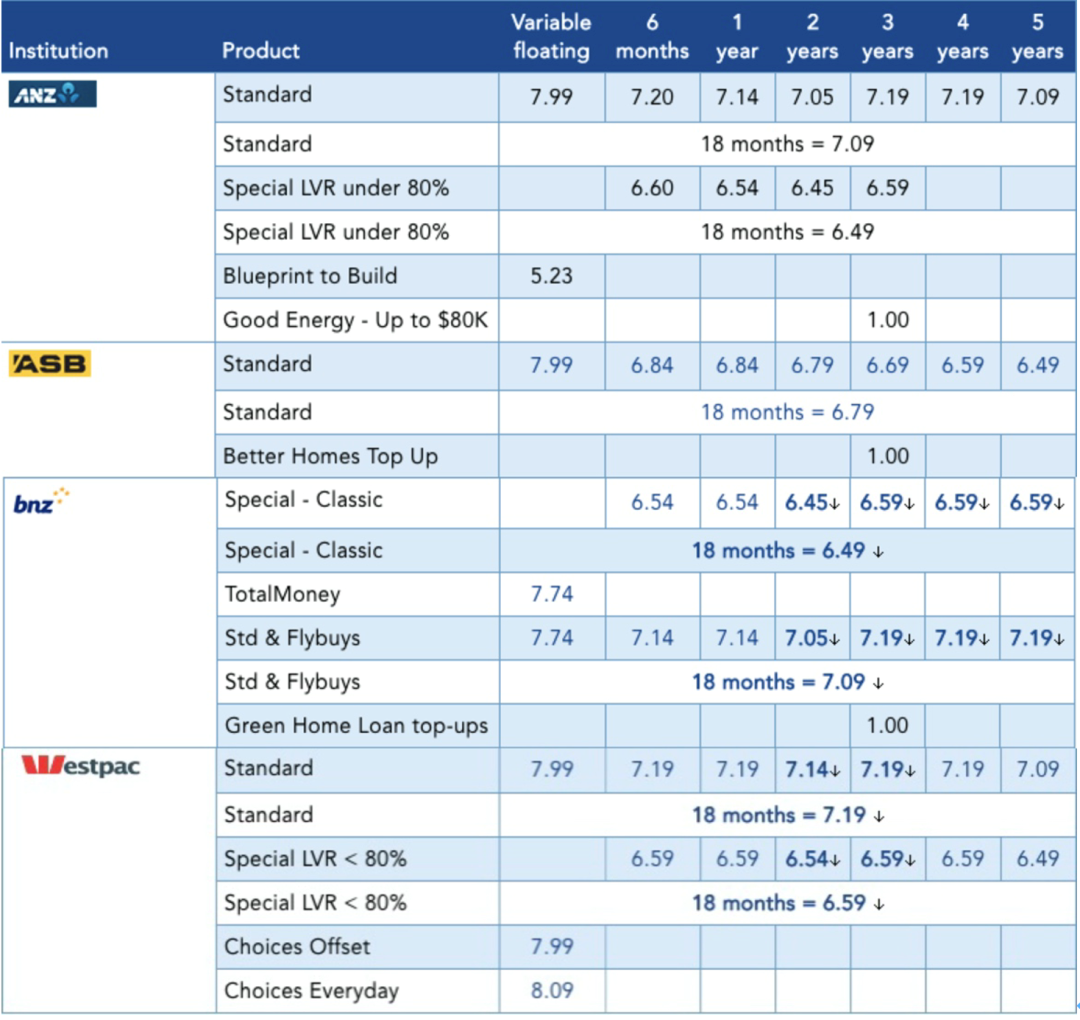
Latest mortgage rates from major banks as at 9 February
Well-known independent economist Tony Alexander recently said he expected banks’ latest round of cuts to fixed mortgage rates for terms of two years or longer to continue. However, banks would not cut the “most popular” one-year fixed rate unless inflation fell to the central bank’s expected level. He expects monetary policy could be eased within 9 months. This means the Reserve Bank of New Zealand will maintain its existing monetary policy at the next interest rate review on 22 February. We may therefore find the answer at the 6 April review.
Just as the prevailing view was that banks’ 1-year fixed mortgage rates would not change soon, recent reports suggest BNZ will accept mortgage applications for a 1-year term at an annual interest rate of 4.99%. The conditions are as follows:
- The loan-to-value ratio for owner-occupied homes must not exceed 80%;
- The loan-to-value ratio for investment properties must not exceed 60%;
- New and existing homes are treated equally, provided they have a valid Code Compliance Certificate (CCC) and title;
- The period following bank approval must not exceed 60 days, and applications must be submitted and approved before 8 March 2023;
- Available only to BNZ customers, with no cashback offered at this rate.