
As the housing market fluctuates, desirable mid- to high-end suburbs are still ‘winning’! Is this your chance to trade up?
In the three months to the end of December 2022, the national average property value fell 3.4%

The latest One Roof house price report for January 2023 shows that, in the three months to the end of December 2022, the national average property value fell 3.4% (NZ$35,000) to NZ$990,000. Auckland’s average property value fell 4.1% (NZ$58,000) to NZ$1,369,000, its ninth consecutive decline since the end of March.
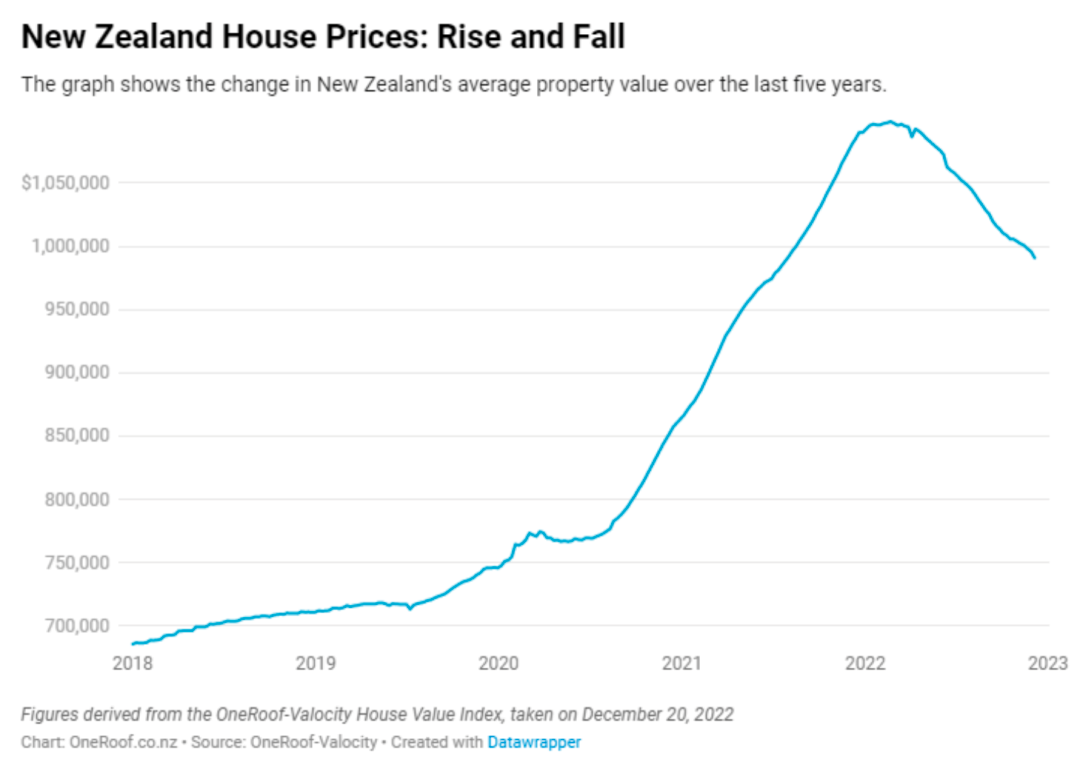
However, there are still substantial differences in how well property values hold up across suburbs. Some apartment-dominated ‘high-risk areas’ saw little growth during the housing boom, yet experienced varying degrees of price decline in this widespread downturn. Meanwhile, despite the general fall in prices, many desirable mid- to high-end suburbs have retained their value better than other areas, with prices still considerably higher than two years ago.
This has prompted many people to consider trading up: with prices falling in mid- to high-end suburbs, they could sell a property they are unhappy with and buy a better, larger home in a better neighbourhood.
Mid- to high-end suburbs are worth buying into
Auckland house prices have fallen 12% compared with the same time last year. The decline from their previous peak is even greater, at 13.4%.
Even in a housing downturn, some areas hold their value better than others, particularly established mid- to high-end suburbs. Prices in these areas may fall in the short term, but they offer greater security and value retention over the long term. Take Auckland’s Remuera, for example: its average house price in January this year was NZ$2,851,000. Although this was NZ$348,000 lower than last year, it was still NZ$288,000 higher than two years ago.
By contrast, average house prices in apartment-dominated central Auckland and Newmarket in January this year were already below their levels two years earlier. These areas may not have many problems in themselves, but they find it harder to withstand a market downturn.
Mid- to high-end suburbs are usually among the country’s strongest housing market performers. Valocity’s head of valuations, James Wilson, said that, across several past housing cycles, Remuera and similar suburbs had consistently outperformed other areas.
“Compared with other suburbs, desirable areas such as Remuera do not see their house prices fall significantly when the market is weak. Even when prices fall, the decline does not last very long.”
For homeowners already established in these mid- to high-end suburbs, today’s market fluctuations need not occupy too much of their attention: over the long term, the fluctuations will pass and their homes will retain their value. For buyers looking to trade up, however, buying now could readily save a substantial sum.
Why do mid- to high-end properties hold their value so well? The answer is simple: scarcity commands a premium, and desirable suburbs have limited housing supply but strong demand. Whether it is sought-after school zones, convenient transport, attractive surroundings, abundant healthcare resources or comprehensive amenities, these suburbs offer advantages that other areas struggle to match. Every piece of land is precious, and properties are usually highly sought after as soon as they are listed.
Take Remuera in Auckland: despite widespread house price falls in 2022, a five-bedroom home there still sold for more than NZ$1,000,000 above its CV.
Prices and demand in other suburbs are relatively less stable. Prices may rise when a development matching buyers’ needs comes onto the market, or when investors become more active for a time. But if those suburbs cannot meet homeowners’ other needs, prices may also fall rapidly under pressure. With the economic outlook uncertain, it is worth considering trading up into assets that offer greater security and better value retention.
Meanwhile, people are still seeking lifestyle changes. Over the past year, New Zealand’s skills shortages and exceptionally low unemployment have also fuelled widespread pay rises. Employers have tried every means of raising wages to retain staff, with pay increases in some roles reaching 33%. These increases have given more New Zealanders extra income, while growing families and the experience of working from home during the pandemic have prompted more people to consider moving to a larger home. Chinese families place great importance on their children’s education, and many parents choose to move into a better school zone as their children grow older. In these circumstances, mid- to high-end suburbs with better facilities and locations can undoubtedly meet a wide range of needs.
In a falling market, those who seize opportunities can come out ahead
The market’s most fearful moments are also when the best opportunities arise. High interest rates will not last forever, and the market’s low point may well be close at hand.
A recent World Bank report highlighted downside risks to the global economic outlook, saying that the crisis facing global development was intensifying and setbacks to global prosperity could persist. The Reserve Bank of New Zealand also warned of the risk of recession at the end of 2022, but every economic environment has winners and losers.
CoreLogic chief property economist Kelvin Davidson believes those who did well during the global financial crisis were people able to pick up bargains as prices fell. He said New Zealand house prices were currently about halfway through their downturn.
“House prices have already fallen about 10%, and the total decline could be 20%, so they may fall another 10% over the next six to seven months.”
No one can predict the market bottom precisely, but it is now a buyer’s market, with significantly more properties for sale, making this a good time to buy. As a buyer, you have more bargaining power. Sellers are much more willing to accept sale conditions, such as a longer or shorter settlement period. In a cooling property market, you will often have room to negotiate purchase terms, such as making the purchase conditional on selling your existing home.
In 2023, New Zealand’s property market will face greater uncertainty: the general election, OCR increases, easing inflation, house prices bottoming out, recession, an influx of overseas workers and falling construction costs could all have a major impact on buyers’ and homeowners’ lives. So is now a good time to trade up? We invited Cici Wang, a real estate agent at Barfoot & Thompson’s Remuera branch, to answer your questions.
Q: In your experience, how much interest is there in trading up in the current market?
Cici Wang:Throughout last year, or the 2022 financial year, trading up was unaffected. In my own experience, over the past six months I sold two properties on Arney Road in Remuera for more than ten million dollars each: one for close to NZ$16,000,000 and the other for close to NZ$11,000,000. Because the buyers chose not to disclose the sale prices, neither property appeared among Auckland’s ten most expensive sales, but the NZ$16,000,000 property could easily have ranked fifth.
Neither seller was Chinese, while both buyers were Chinese and neither needed a mortgage. They were unaffected by the pandemic because buyers in this group have no mortgage pressure; they simply need to wait long enough to find the property they want. Both buyers had clear requirements for their homes and the streets they were on, so when a suitable property came onto the market, they moved without hesitation. But properties in this category are clearly scarce, so buyers may need considerable patience.
{ad}
Q: Is now a good time to trade up? Why?
Cici Wang:That depends on the price bracket the buyer is looking at. For properties worth more than ten million dollars, any time is a good time; it depends on what is available. If you are moving from a home worth one or two million dollars to one worth three or four million, upgrading to a desirable suburb, or moving from a relatively less desirable school zone to a better one, now is definitely a good time.
Most sellers now understand that this is a buyer’s market. If they have followed the market last year and in the first half of this year, they already know it cannot deliver the prices they previously wanted. In a strong market, auction prices can far exceed the owner’s minimum. Now we provide an objective price expectation and only list the property once the owner accepts it.
With that in mind, buyers trading up now will generally face far fewer competing buyers than at the peak, giving them a better chance of securing a home they love at a reasonable price. At the peaks last year and the year before, buyers had to pay ten or twenty per cent, or even thirty or forty per cent, more than they had intended to secure a home they liked.
There are many ways to trade up: from a smaller home to a larger one, from an outlying suburb to a desirable one, or from a poorer-quality house to a newer, higher-quality home. The current market offers good opportunities for all of these. If your lending is arranged or you have sufficient cash, you will be in a very strong position because there are fewer buyers competing with you. At the same time, owners listing now are generally willing to meet the market and listen to its feedback. What matters most is that every home is different, with its own features and strengths. Once you miss out, you may not find another property you like as much. So I hope buyers can seize the opportunity to find a home they love.
Q: Which suburbs would you recommend to buyers looking to trade up? What should they watch out for?
Cici Wang:Buyers looking to trade up should focus on stable areas that hold their value, rather than those prone to dramatic rises and falls. If you buy in a good suburb, it will also be much easier to sell and release your equity when you need money.
After all the changes during the pandemic, most people should have clearly seen how well good locations in central Auckland retain their value. Remuera, for example, has been very resilient. It also has major advantages in schools and educational resources, alongside convenient transport, with the CBD only four kilometres away. These strengths put it in a very favourable position.
Over the past year, I have seen many Chinese and European friends choose suburbs that remain very resilient despite falling prices. Remuera, Parnell, Mt Eden and Epsom are all very good options. From these suburbs, you can reach schools, the CBD, nearby hospitals and shopping centres without using the motorway, avoiding the major problem of traffic congestion.
For buyers looking to move, the first step is to listen to yourself. Be clear about your purpose: is it better schools, a newer home, or selling your house for retirement and moving into a good-value apartment with a view? You need to weigh up all aspects of your circumstances.
You also need to consider your finances, because today’s market is different. In a very hot market, you could buy first and sell later, because once your home was listed, its auction would inevitably be brought forward or it would sell on auction day. Now, if your home has not yet sold, or you intend to buy before selling, first consider whether you should list your existing home.
If you are moving, I recommend selling your home first, or at least buying and selling at the same time, rather than committing to a purchase and then selling. The sale could take longer than you expect and bring in slightly less than you anticipated, so prepare your budget carefully and discuss your lending arrangements with the bank.
In this subdued market, many sellers may choose not to sell if they cannot achieve their desired price. Unless they face serious financial problems, they will not be forced to cut their price to sell. So many of the good homes you have your eye on are already on the market at very realistic prices, and there is no need to keep waiting. The prices you see in today’s market are actually the best in several years. Try not to miss this favourable timing and opportunity.