
Struggling with soaring mortgage interest costs? These approaches may help homeowners ease some repayment pressure
Mortgage rates have remained high for some time

Mortgage rates have remained high for some time. As the chart below shows, fixed mortgage rates at the major commercial banks have risen to levels that leave countless homeowners feeling overwhelmed. As YIJU New Zealand previously reported, almost half of the market's fixed-term mortgages will expire within the next 12 months. This means soaring rates are bound to put borrowers under greater financial strain, with some facing the pressure of paying an extra NZ$500 a week.
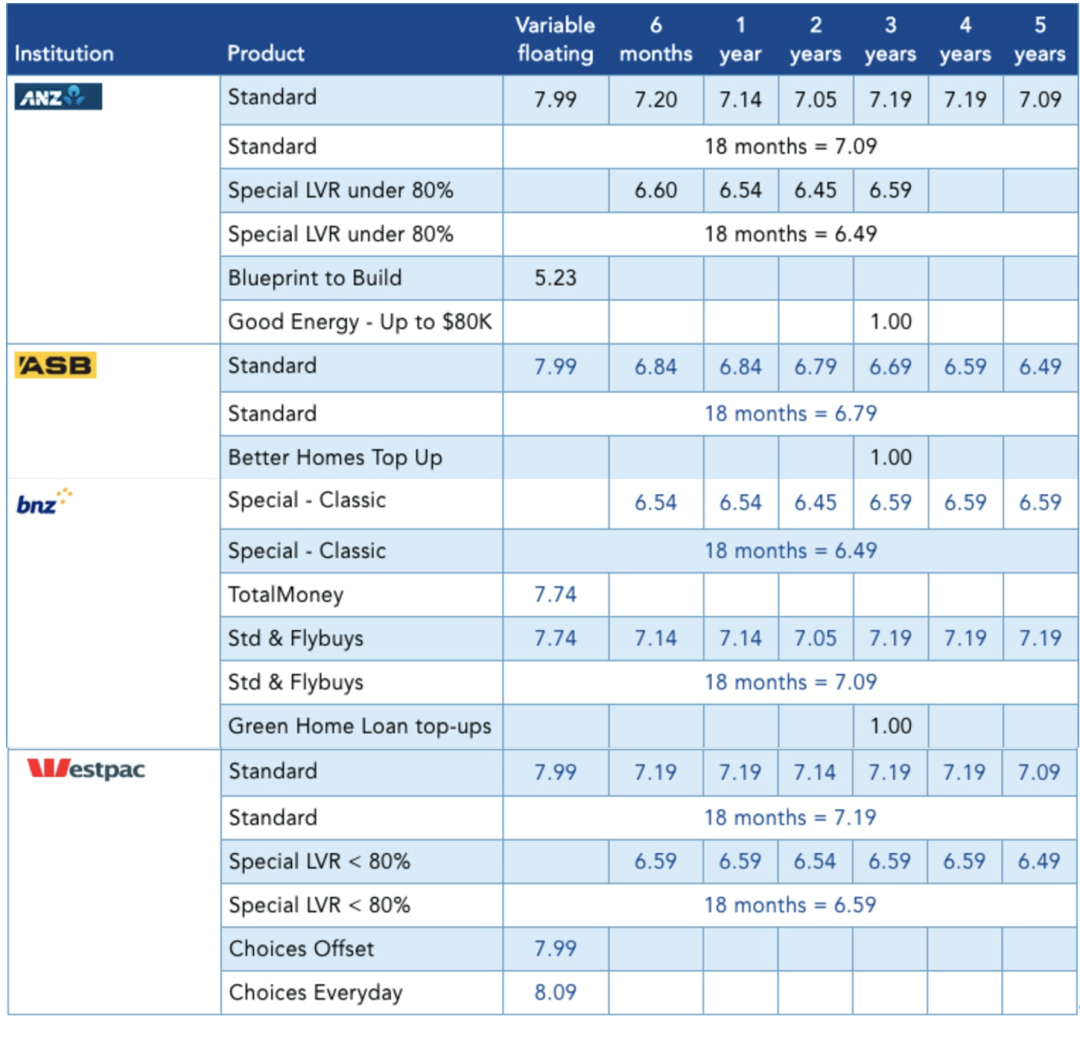
Fixed mortgage rates across different terms at the four major commercial banks as at 6 March 2023
Westpac chief economist Michael Gordon
In Westpac's latest Economic Overview report, the bank's chief economist Michael Gordon warned that borrowers' finances would face a tougher test over the coming year, with close to half of fixed-term mortgages due to be repriced within the next 12 months. Borrowers who fixed for two years at 2.5% to 3% in early 2021 will face new rates more than 3 percentage points higher.
Gordon said the sharp rise in mortgage rates would significantly reduce the disposable income of many households with mortgages. For example, a homeowner who bought at the average house price in 2021 with an 80% mortgage fixed for two years would now face an extra NZ$265 in weekly repayments. For a homeowner in Auckland, where house prices are higher, the increase in weekly interest costs would be around NZ$450.
Of course, the market is not all bad news. Many economists say fixed mortgage rates may already have peaked, and some commercial banks have quietly begun offering discounted fixed rates. With this in mind, YIJU has gathered advice from mortgage advisers to help borrowers soften the severe impact of soaring rates on their finances.

Tips from professional mortgage advisers
Lisa Meredith of Loan Market
Lisa Meredith said most of her mortgage clients were choosing fixed terms of one to two years, as people generally expected rates to fall after a year. She said the impact of higher rates varied between clients, depending largely on their financial position and ability to manage risk. If a client's household income was falling, perhaps because they were planning to have a baby, they might want to sell their property within the next 12 months. This would affect how their mortgage was structured from the outset.
She suggested that people who disliked taking substantial risks might be best choosing a longer fixed term, such as 1 to 3 years. For borrowers expecting a large sum soon, such as a year-end bonus, profit distribution or inheritance, a prudent approach would be to keep part of the loan on a floating rate or fix it for a shorter term, such as 6 months.
For borrowers with large mortgages, such as those above NZ$400,000, she suggested splitting the loan across different fixed terms. This would avoid the risk of the entire loan's rate suddenly jumping from around 3% to above 6%, while also avoiding a wait of several years to lock in a new rate when rates began falling.
{ad}
Aseem Agarwal of Global Finance
He believes mortgage rates will peak at 7% by the middle of this year and remain unchanged until the election. He also predicts that the official cash rate and mortgage rates may not fall until late this year or early next year. One-year fixed rates would fall to 6% in the first half of next year and 5.5% in the second half, before returning to around 5% in 2025.
For borrowers who need to refix soon and hope to take advantage of falling rates next year, he recommended fixing for between one year and 18 months. Current two- and three-year fixed rates are already below one-year rates, suggesting rates may remain high only in the short term.
Sue Mihakis Tierney of Sue Tierney Mortgages
Most of Tierney's clients are closely watching one- and two-year fixed rates, but she said three-year terms were not an option they were considering. Many who believe rates will fall are choosing to fix for one year, while some are considering a mix of one- and two-year terms. Tierney recommended that every household with a mortgage regularly review its spending to identify avoidable expenses. It might be time to cut services they rarely use, such as Sky TV or gym memberships.
Bruce Patten of Loan Market
Patten said he recommended fixing for 12 months for borrowers who could afford repayments at rates slightly above current levels, as he expected the Reserve Bank of New Zealand to cut the OCR soon, forcing mortgage rates down. However, for borrowers who would be seriously affected by higher rates if banks raised them further than expected, he recommended a more conservative approach, splitting their borrowing between one- and three-year terms. He believes that even if the Reserve Bank of New Zealand raises the OCR to 5.5% and holds it there, the direction of interest rates will depend largely on how the government responds to cyclone damage.
What is a reverse mortgage,
and how does it work?
Heartland Bank's general manager of retail and reverse mortgages, Keira Billot, said a reverse mortgage could be a very good option for some borrowers aged over 60, helping ease repayment pressure and make retirement more comfortable. To qualify, borrowers must be over 60 and own a mortgage-free, well-maintained property. Generally, the older the borrower, the more they may be able to borrow. At Heartland Bank, for example, a borrower aged 60 can borrow up to 20% of their home's value. This rises to 30% for those aged 70, 40% at age 80, and even 50% at age 90. Beyond the age threshold, minimum property values usually apply. At SBS Bank, the minimum property value is NZ$750,000 in Auckland and NZ$600,000 elsewhere in New Zealand.
The main difference between these loans and ordinary mortgages is that the lending bank does not require the homeowner to repay the loan promptly unless they die or sell the property. Instead, interest is added to the loan balance and compounds, causing the amount owed to grow. When the loan agreement ends, the bank also collects the accumulated interest. Because the bank may receive no return for decades, reverse mortgage rates are usually much higher than ordinary home loan rates.
More New Zealand homeowners are choosing reverse mortgages
Borrowers should consult their lawyer and mortgage adviser before applying for a reverse mortgage to avoid unexpected consequences. We have outlined the following advantages and disadvantages for reference.
Advantages:
- Homeowners can access loan funds without selling their property. This can be a good way to fund major purchases or expenses, such as a new car or roof repairs;
- Homeowners can benefit from house price growth, an advantage that buying a retirement home property cannot match;
- Homeowners retain legal ownership of their home.
Disadvantages:
- Borrowing costs are high, with interest rates generally well above ordinary mortgage rates;
- Interest compounds, meaning the interest owed keeps accumulating over time;
- Fees are high, with a range of charges attached to the loan, including application, valuation, withdrawal and contract termination fees.
- Homeowners generally cannot rent out the property and must sell it if they move out.
So, which of these approaches would be most effective for your current financial situation? Join the discussion by leaving a comment at the end of the article.