
Where are New Zealand banks' mortgage rates heading, and how should you respond if they fall?
After 6 relatively quiet weeks for mortgage rate changes, ASB broke the silence this Monday

What mortgage rates are the banks currently offering?
After 6 relatively quiet weeks for mortgage rate changes, ASB broke the silence this Monday. Yesterday, ASB officially announced changes to its main fixed mortgage rates, excluding the 5-year term. Its 6-month, 1-year and 2-year rates fell by 0.2%, its 18-month rate fell by 0.15%, and its 3-year and 4-year rates fell by 0.1%.
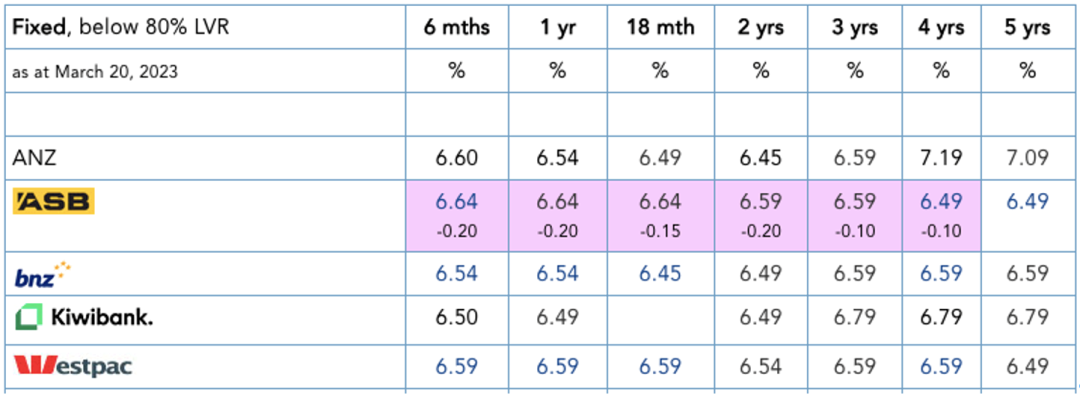
Fixed mortgage rates at New Zealand's main banks as at 20 March 2023
Following these changes, ASB's 1-year fixed rate remains 15 basis points above Kiwibank's, its 18-month fixed rate is 19 basis points above BNZ's, and its 2-year fixed rate is 14 basis points above ANZ's. Only its 4-year and 5-year fixed rates offer an advantage over those of other banks.
It appears that, after fixed mortgage rates peaked in January 2023, the major banks began quietly offering discounted rate deals. They hoped to counter an unusually quiet summer in the mortgage and property sales markets.
For homebuyers,
what do we need to know about current market conditions?
There is no denying that the battle for mortgage market share among the major banks has begun, with many using special rates to attract new borrowers. In other words, homebuyers seeking the best rate cannot limit themselves to a single bank. They need to shop around or find an independent mortgage adviser to help secure the most favourable interest rate and cashback deal.
How should you choose a fixed mortgage term? Few people may be able to predict precisely when they should choose a 1-year, 2-year or 5-year term. What we need to understand, however, is that banks are currently betting that mortgage rates will fall, leaving customers who lock in a rate making repayments above prevailing market rates. Even so, over the long term, fixed rates still involve relatively lower costs than floating rates.

YIJU New Zealand previously reported that most New Zealand property owners would face the risk of their interest rates multiplying this year when their low fixed rates expired. For each borrower, the biggest challenge is managing the impact of sharply higher repayments on personal finances and household disposable income. Mortgage specialists suggest that property investors consider splitting their mortgage into portions and fixing them for different terms. This can help prevent a financial crisis caused by all their repayments soaring at once. Borrowers can also leave part of their mortgage on a floating rate, giving them the opportunity to lock in a lower fixed rate as interest rates continue to fall.
How does the current Official Cash Rate influence future mortgage rates?
On 22 February 2023, the Reserve Bank of New Zealand raised the Official Cash Rate (OCR) by 50 basis points, from 4.25% to 4.75%. This brought the number of consecutive OCR increases since October 2021 to 10. The next interest rate announcement is due on 5 April. The OCR is a tool the Reserve Bank uses to manage the wider economy. As the rate for borrowing transactions involving commercial banks such as ANZ, ASB, BNZ and Westpac, it directly affects interest rates on mortgages, credit cards and other loans. The general theory is that, when the OCR rises, banks' operating costs increase and they pass those costs on to customers, making borrowing more expensive.
1999 to 2023: changes in the Reserve Bank of New Zealand's OCR
Why is the Reserve Bank raising the Official Cash Rate? Has it peaked?
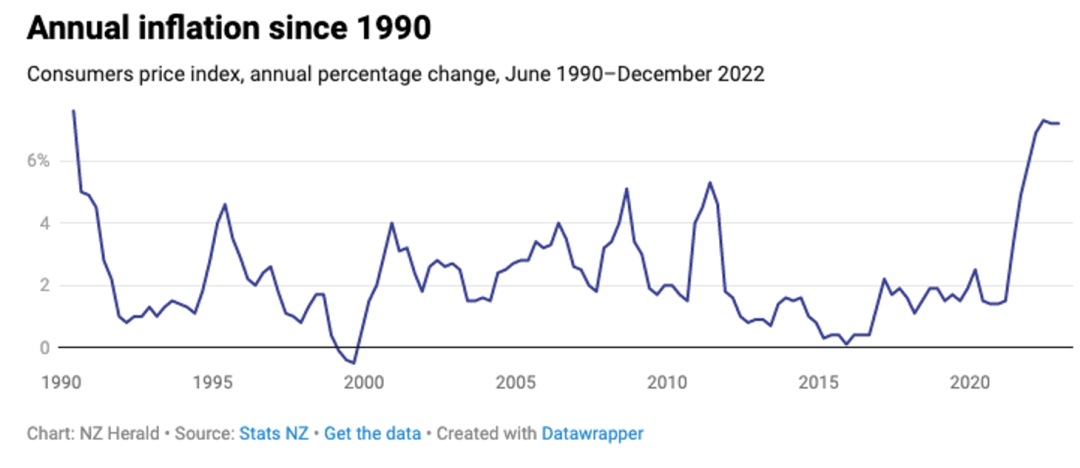
The Reserve Bank of New Zealand has been raising the cash rate to curb high inflation, with the ultimate aim of keeping inflation low, within a 1%–3% range. Achieving that goal appears far from easy. The latest Consumer Price Index figures for the final quarter of last year showed annual inflation at 7.2%, a high not seen in New Zealand for nearly 30 years.
One release to look forward to is Stats NZ's publication of inflation figures for the first quarter of this year on 20 April. The Reserve Bank has repeatedly said it would continue raising the OCR to demonstrate its determination to tackle high inflation, forecasting a peak of 5.5%. There is widespread speculation that, under current economic conditions, the Reserve Bank is very likely to pause rate rises next month and may even cut rates, particularly if clear market signals show that inflationary pressures are easing.
{ad}
If I am refixing my mortgage soon,
what should I consider?
Many people become anxious at the mention of their mortgage's fixed term expiring and the need to refix. In fact, the end of a fixed term is a good opportunity for borrowers to reassess their finances and use new market conditions to plan their investment portfolio appropriately.
Some may say a 2-year fixed rate was the best choice in the previous mortgage cycle, whereas borrowers should now choose a 1-year or 5-year term. Whatever the case, borrowers should make the choice that best suits their own financial circumstances. Those seeking long-term stability may prefer a fixed term longer than 3 years, while others may use shorter fixed terms or even the flexibility of a floating rate to wait for lower rates.
Overall, borrowers should start considering their options before their existing fixed rate expires and, wherever possible, obtain free professional advice from an independent mortgage adviser.
What is a break fee, and how can I avoid it?
A fixed mortgage rate ensures that a borrower's interest rate and repayments remain unchanged for a set period. If interest rates keep falling after a borrower signs a fixed-rate agreement with a bank, they may choose to break that agreement to secure a lower rate. To do so, they must pay a break fee to compensate the bank for the financial loss caused by ending the agreement early. In fact, the only way to avoid a break fee is to keep the fixed mortgage agreement in place. But is breaking it to obtain a lower rate worthwhile? Borrowers need to research this before deciding. Banks use very complex calculations for break fees, so borrowers should ask their bank for a specific figure in advance or seek help from a professional mortgage adviser before making a decision.