
When will mortgage rates finally fall? Should we lock in an attractive 3-year rate of 5.99%?
This year, many New Zealand mortgage holders will face the immense pressure of their fixed mortgage rates jumping from 2%–4% to 6%–8%.

YIJU New Zealand has repeatedly highlighted in previous articles that many New Zealand mortgage holders will face the immense pressure this year of their fixed mortgage rates jumping from 2%–4% to 6%–8%. For first-home buyers entering the property market and borrowers whose fixed terms are about to expire, navigating the rollercoaster of falling and rising mortgage rates is a major challenge they all face this year.

Judging by interest rate movements so far this year, fixed mortgage rates appear to have peaked in January 2023. In recent weeks, several banks have taken the initiative to lower their longer-term fixed rates. From this Tuesday, ANZ announced reductions to its two-year and three-year fixed mortgage rates. The chart below shows the latest fixed mortgage rates offered by the banks.
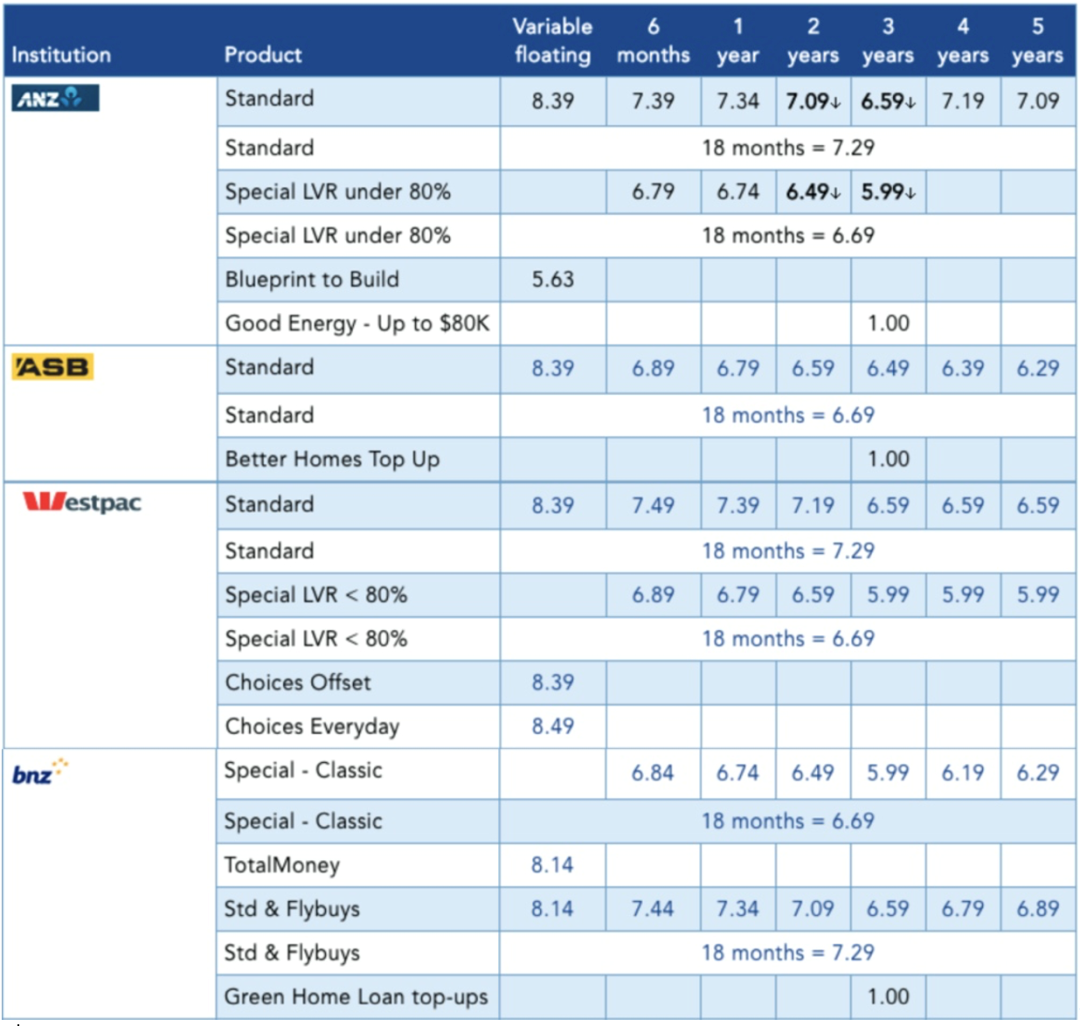
Mortgage rates at the major commercial banks as at 4 May (Source: Interest.co.nz)
What should I prepare as a first-home buyer?
In such a subdued market, commercial banks are likely to compete for market share by attracting borrowers with lower mortgage rates or larger cashback offers. Buyers wanting the best rates and offers available may need to switch from their usual bank. In other words, they should shop around or find an experienced independent mortgage adviser to do this on their behalf.
What key information should we watch in the near term
that could affect interest rate movements?
On 5 April 2023, the Reserve Bank of New Zealand raised the official cash rate (OCR) from 4.75% to 5.25%. This 50-basis-point increase was its 11th rise since October 2021. The next interest rate announcement is scheduled for 24 May. As the biggest driver of mortgage market rates, changes in the OCR directly influence the direction of commercial banks' fixed mortgage rates over the period ahead. The chart below shows interest rate movements since the OCR was introduced in 1999.

1999–2023 official cash rate chart (Source: Reserve Bank of New Zealand)
Why do interest rates keep rising, and when will they peak?
The Reserve Bank of New Zealand is raising the OCR to tackle persistently high inflation, aiming to keep it between 1% and 3%. Stats NZ's figures for the first quarter of 2023 show annual inflation at 6.7%, below expectations, with the next set of inflation figures, for the second quarter, due on 19 July 2023. The Reserve Bank previously said it expected the OCR to peak at 5.5% this year, only a step away from its current 5.25%. Once the bank sees more evidence that inflationary pressures are easing, it is likely to pause rate increases and may even begin cutting rates. The chart below shows annual inflation movements since 1990.
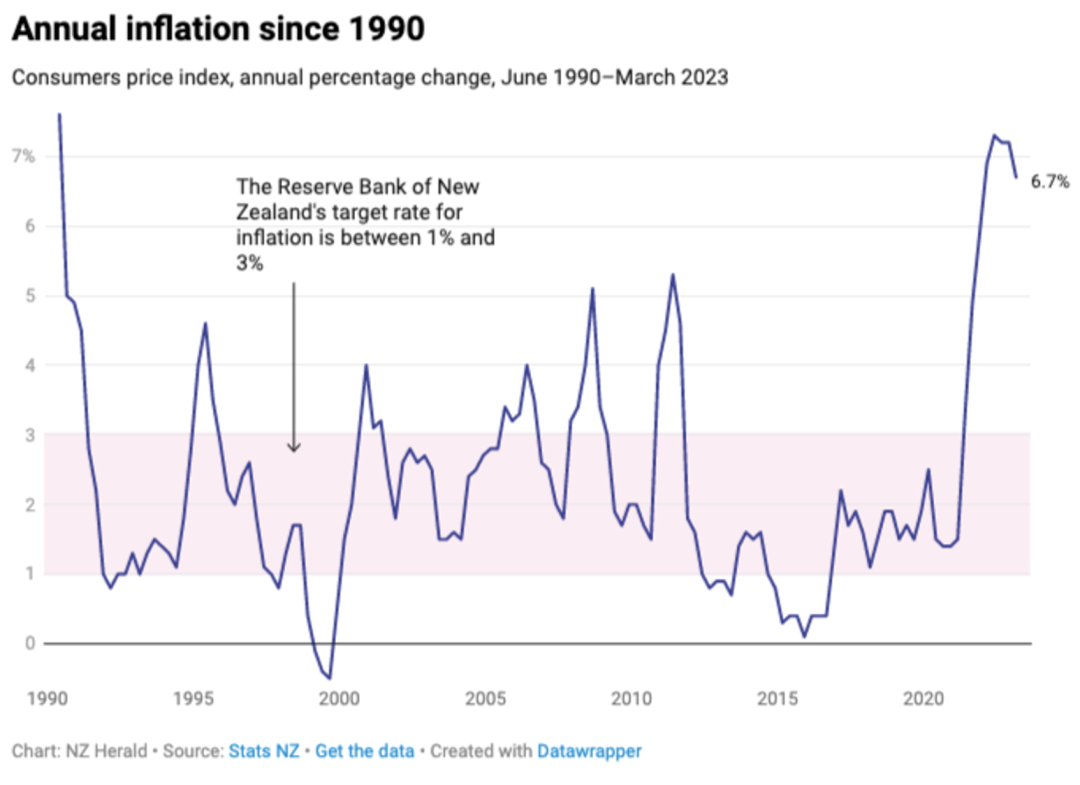
1990 to present: New Zealand annual inflation chart (Source: Stats NZ)
Should borrowers fix for a short or long term?
The latest OCR increase has again pushed short-term rates higher and longer-term rates lower. Some mortgage advisers warn that choosing a lower long-term rate could leave borrowers worse off over time. Some major commercial banks have raised their one-year fixed rates to around 6.7%, while cutting their three-year rates to an attractive 5.99%, the lowest three-year rate for some time. Gareth Veale, a financial adviser at EasyStreet Mortgages, cautions borrowers against signing up for the lowest rate currently available without considering the prospect that rates overall will fall again. He does not recommend fixing for a long term, as rates could fall to 4%–5% over the coming year. He therefore favours fixing for one year.
Tauranga mortgage adviser Dave Williams agrees with Veale and recommends that clients either fix for 12 months or spread the risk by splitting their loan, for example fixing part for 12 months and the rest for 18 months. He says various signals from the Reserve Bank of New Zealand suggest rate cuts could come by the end of this year or early 2024. Although rates certainly will not fall as quickly as they rose, he firmly believes the bank will keep cutting once inflation is under control.
{ad}
However, Infometrics chief forecaster Gareth Kiernan does not expect interest rates to fall soon. With two more OCR increases still to come, he does not expect a significant OCR decline until mid-2024. Although he currently considers fixing for 18 months the best option, he stresses that fixing for three years now is also a reasonable choice. If borrowers fix at a higher rate for 1–2 years, rates will need to have fallen sufficiently when they refix; otherwise, that approach may be no better than fixing for three years now at 5.99%.
Jordan Cameron, a mortgage adviser at Total Mortgages, agrees, saying that a rate of 5.99% is attractive to many people and that both options have advantages and disadvantages. Most of his clients split their mortgages into two portions, fixing one for 18 months and the other for two years, or one for 18 months and the other for three years. None of his clients has chosen to fix for just one year, as they worry rates could rise further and leave them stuck paying a higher rate.
Cameron also reminds borrowers to consider other incentives alongside interest rates. Most major lenders offer new borrowers or first-home buyers 1% cashback, usually capped at NZ$20,000. Banks also charge higher interest rates to borrowers with deposits below 20%, pushing a three-year rate of 5.99% up to 6.74% for borrowers such as first-home buyers.