
Be alert! Borrowers and investors face their biggest interest rate challenge ever!
Those who bought during the homebuying boom following the outbreak of the pandemic face enormous pressure on their mortgage repayments
The latest research from financial information and analysis platform Canstar shows that those who bought during the homebuying boom following the outbreak of the pandemic face enormous pressure on their mortgage repayments. Survey data shows they will have to devote around 1/3 of their household income to rapidly rising monthly interest payments.
Using New Zealand’s average property price of NZ$845,491 on 31 March 2021, a 20% deposit and a 25-year loan term, the repayment pressure on borrowers is staggering:
Canstar’s analysis found that the average total income of households with a mortgage was NZ$151,450. Homeowners who bought in April 2021 now need to spend around 31% of their income on mortgage repayments. (Mortgage stress is generally defined as spending more than 30% of household income on mortgage repayments.)
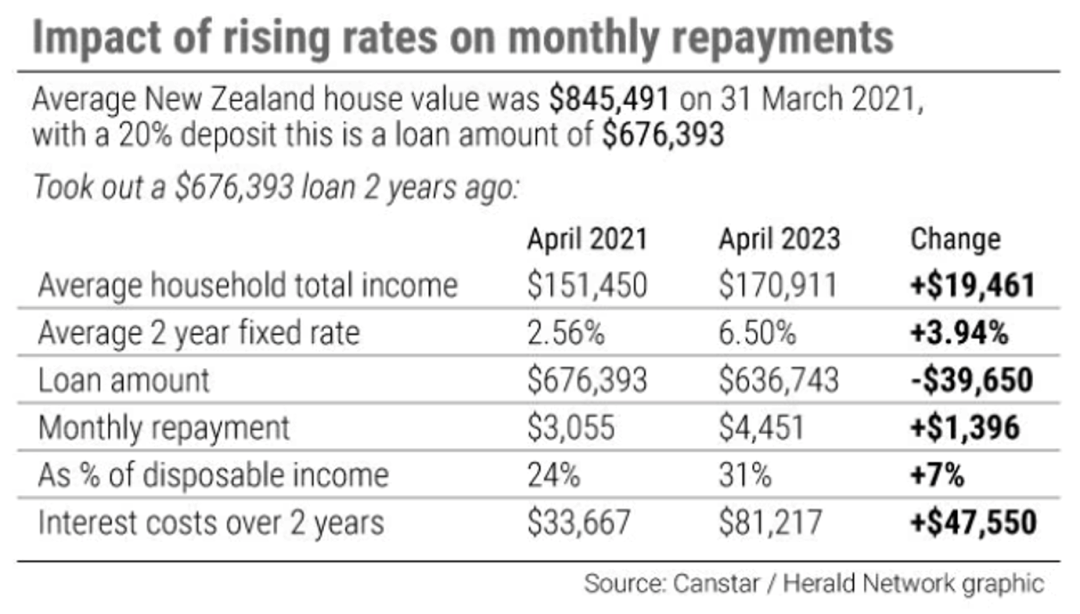
2021 Comparison with 2023 showing repayment pressure from rising interest rates over the two-year period. (Source: Canstar)
Two years ago, at the average two-year fixed rate of 2.56%, monthly borrowing costs were NZ$3055, slightly less than 1/4 of average household income. Now, the average two-year fixed rate has risen to 6.5%, pushing monthly repayments to NZ$4451, or 31% of average household income. (Of course, loan amounts differ between households, so the financial pressure on each household varies.)
{ad}
Canstar New Zealand general manager Jose George said the analysis showed that households with mortgages were struggling to absorb the pressure of rising interest rates, particularly while other living costs were also soaring.
In its Financial Stability Report released earlier this month, the Reserve Bank of New Zealand said around 1/4 of commercial banks’ mortgage contracts originated in 2021, with first-home buyers accounting for 20% of that share. Among these first-home buyers, around 5% of mortgage borrowers took out larger loans to buy their first homes at the market’s peak in 2021. Although most borrowers are still able to service their debts in a higher-interest-rate environment, those who fixed their rates at the low point in mid-2021 have undoubtedly seen much larger increases in repayment costs than other borrowers.
Over the past few weeks, commercial banks have offered differing assessments of how mortgage borrowers are coping with significant repayment pressure. ANZ chief executive Antonia Watson said their borrowers were coping “surprisingly well” with higher interest rates. Many customers had also used the lower interest rates during the pandemic as an opportunity to pay down their mortgages.
Westpac New Zealand chief executive Catherine McGrath said that, although they were not currently seeing large numbers of customers seeking help, they expected demand to increase as more borrowers faced higher interest rates. She added that many customers were working hard to adjust to increased repayments, and the bank was ready to help those who needed time to transition.
Many borrowers are finding things tough
According to New Zealand credit reporting agency Centrix, mortgage arrears rose for the eighth consecutive month in March, with around 1.31% of home loans reported as overdue, up 26% year on year. However, the mortgage arrears rate remained below its pre-pandemic level of 1.35% in December 2019. Reserve Bank of New Zealand data showed that non-performing housing loans totalled NZ$1,085,000,000 in March 2023, although this amount represented only 0.3% of banks’ overall non-performing loans.
Notably, Reserve Bank of New Zealand data showed that the average mortgage interest rate across all New Zealand borrowers, including fixed and floating loans, was 4.70% in March. This was well below commercial banks’ current average mortgage rates of 6.5%–7%. By comparison, the average rate on borrowers’ mortgages in September 2021 was even lower, at just 2.83%.
Advice from the experts
Canstar New Zealand general manager Jose George advises borrowers unable to cope with severe repayment pressure to speak to their banks early and find the most effective way through the toughest period. Options include extending the loan term or switching temporarily to interest-only repayments. Most importantly, households facing significant financial pressure should find ways to reduce discretionary spending and balance their budgets.
Mortgage adviser Bruce Patten said that, although mortgage stress was not yet a leading issue in the lending market, he expected conditions to deteriorate further in the second half of this year as more low fixed-rate loans expired over the coming months. He was seeing considerable numbers of borrowers using interest-only repayments to get by, while others were deferring payments. All borrowers were now hoping for interest rates to fall, but unfortunately he believed the OCR would not fall until early 2024, with significant cuts to commercial bank rates potentially coming between mid-April and mid-May.
Property investors are also finding things tough
Property investor Tammy Onekawa owns several investment properties in Australia and New Zealand
Property investor Tammy Onekawa recently told the media that rising interest rates and the gradual removal of mortgage interest deductibility meant investors who had bought within the past five years were effectively paying interest of around 10.5%. Onekawa said it was unrealistic for landlords to counter rising mortgage rates by increasing rents, leaving investors with very limited ability to recover their costs.
Stats NZ data showed that rents paid in New Zealand’s rental market rose by just 3.8% between April 2022 and April 2023, slightly above the long-term annual average increase of 3.13%. Measured by rents for new tenancies starting that month, the increase was even lower, at just 2.7%. Over the past year, Stats NZ recorded 5 months in which rents for new tenancies fell compared with the previous month.
Onewaka complained that higher mortgage rates and interest costs, increased insurance premiums and stricter Healthy Homes requirements were all adding to landlords’ investment costs. She estimated that some investors would have to bear costs equivalent to an interest rate of 10.5% to retain their investment properties, while also facing additional tax burdens. With property prices too high and compliance requirements too strict, she had stopped buying investment properties in New Zealand altogether and turned instead to the Australian property market.