
The market has long shrugged off rate rises, as property rapidly regains its inflation-hedging role
The OCR (Official Cash Rate) has reached 5.5% and is forecast to potentially peak at 5.75%

This Wednesday, the Reserve Bank of New Zealand announced a rate rise of 25 basis points (0.25%). The OCR (Official Cash Rate) has now reached 5.5% and is forecast to potentially peak at 5.75%.
In reality, however, the market has long been ignoring these increases.
Those familiar with the lending market will have noticed that mainstream 1–2 year mortgage rates appear to have barely risen over the past six months, remaining around 6% for 6 months. Meanwhile, the Reserve Bank of New Zealand has raised the OCR three times, by a total of 1.25%. Indeed, just the day before this latest increase, reports emerged of a 5.5% mortgage rate for first-home buyers.
The chart below shows actual mortgage rates over the past 8 months and forecasts for the next 4 months. Mainstream 1–2 year fixed mortgage rates have barely changed since November last year, and no significant change is expected ahead.
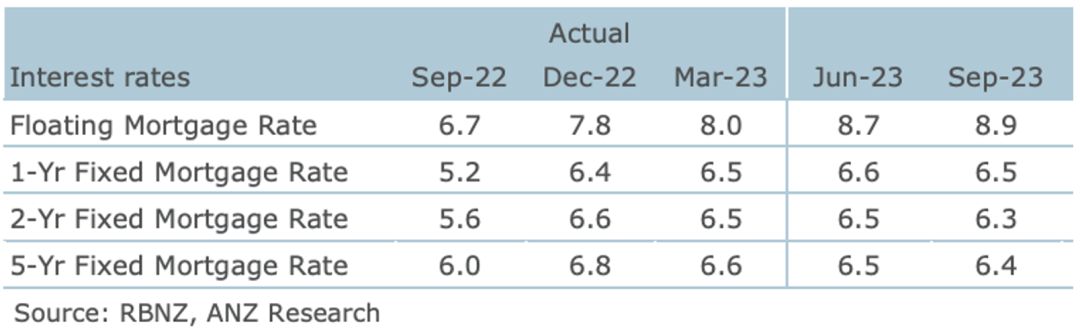
Rate rises now hardly seem to count as news. After all, mortgage rates have little room left to rise, and the end of the tightening cycle is in sight. The market believes rate cuts will come not long after the general election.
Of course, the Reserve Bank of New Zealand itself cannot possibly say that. It must insist that rates will not fall in the short term, to keep the public’s inflation expectations under control and prevent them from climbing further. If inflation expectations cannot be contained, they can become self-fulfilling, leaving the central bank ‘forced’ to raise rates again — something nobody wants.
In the actual mortgage market, however, even if 1-year fixed rates remain at current levels and prove difficult to lower, 2-year fixed rates can still shrug off the central bank’s increases. The fact is that longer terms offer lower rates, giving home buyers a choice.
2023 inflation takes on a new character — shaped by population changes
Looking back at inflation in 2021–2022, a defining feature was the sharp rise in the cost of imported items, such as oil, gas and building materials. This was essentially driven by external factors including war, shipping, inventories and exchange rates. But the situation changed significantly in 2023.
According to Stats NZ, overall inflation fell from 7.3% to 6.7%, while domestic inflation, excluding tradable goods, rose from 6.8% to 7.1%. In other words, imported items are falling in price, and inflation from 2023 onwards is mainly being driven domestically.
Wage growth is certainly an important reason, but the effect of population inflows is also becoming increasingly apparent. The chart below shows changes in migration numbers, which have far exceeded expectations at the start of the year. If migrants continue to arrive at this pace, annual net migration in 2023 could exceed 100,000.
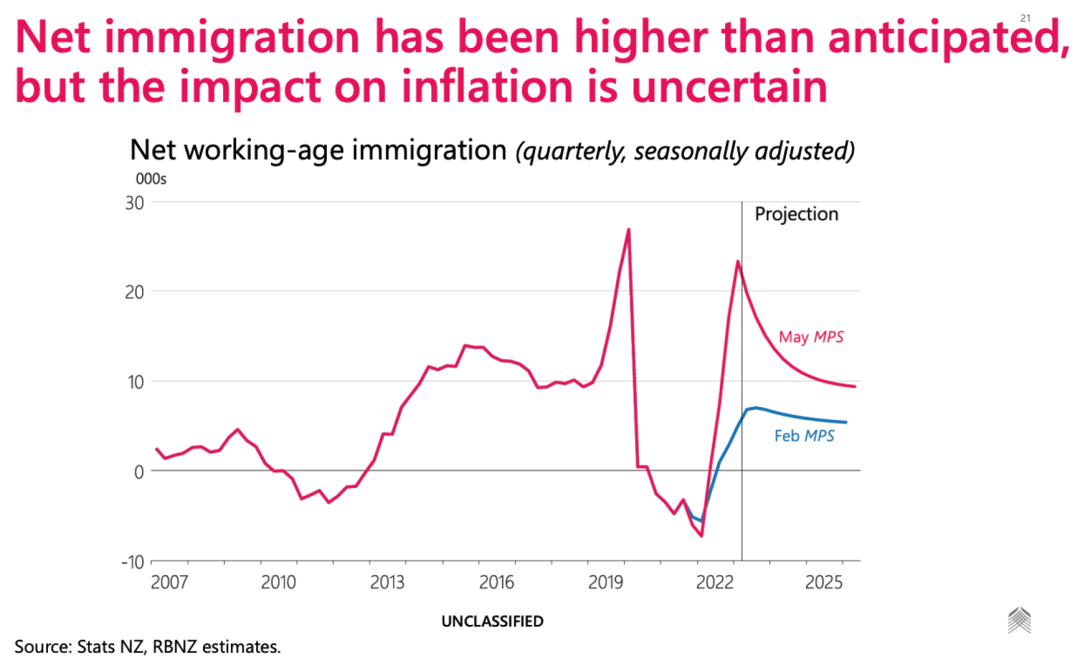
The sharp increase in net migration has substantially changed the domestic forces shaping future inflation. Immigration expands the workforce and can help moderate future wage growth. But new arrivals first increase demand for housing, food and transport, with the dampening effect on wages coming later.
This means inflation from 2023 onwards will be closely linked to migrant arrivals. It also means residential property, after 2 years of decline, will once again join the ranks of assets that hedge against inflation.
Auckland rents rise markedly, restoring property’s role as an inflation hedge
The latest rental report from Auckland’s largest real estate agency, Barfoot & Thompson, shows a marked rise in rents in Auckland, the city where migrants first arrive. Rent growth in some areas reached 7.2%, while 2 other areas recorded increases of 4.7% and 4.3%, respectively.
Current economic data shows that growth in the number of newly completed homes continues to slow. Falling house prices have kept new housing starts stalled, while applications for new homes have dropped sharply. Housing demand, meanwhile, continues to increase as wages rise and migrants arrive rapidly. This means rising rents will be a major trend over the next few years.
Rent growth in 2023 may still struggle to outpace CPI, but that could change significantly by 2024. The Reserve Bank of New Zealand forecasts overall CPI inflation will fall to 4% in 2024. With the balance of supply and demand reversing, Auckland rent growth in 2024 is expected to be higher than in 2023, overtaking overall CPI inflation and restoring property’s place among inflation-hedging assets.
{ad}
Official forecasts confirm a smaller expected fall in house prices
Supported by rents, property prices will also bottom out and recover. The market has already changed noticeably. Auckland’s auction clearance rate, a leading indicator of property prices, continues to rise, potentially signalling that prices will bottom out and begin increasing over the coming months.
Even the Reserve Bank of New Zealand slightly raised its projected floor for property prices in this week’s report, officially confirming a smaller expected decline.
Bear in mind that the central bank’s forecast covers nationwide house prices, while Auckland will move ahead of other cities. The changes now taking place in Auckland’s market therefore already indicate that house prices are at the bottom.
Insights from the frontline of Auckland’s market
To get a closer view of the market, we interviewed 2 well-known agents from Auckland’s largest real estate agency, Barfoot & Thompson, to hear their first-hand observations.
The first is Rocky Liu of Barfoot & Thompson’s Northcote Branch on Auckland’s North Shore.
The second is Mandy Huang of Barfoot & Thompson in Highland Park / Pakuranga, East Auckland. Pakuranga recorded the city’s 2nd-highest rent growth last year.
Rocky Liu
Residential Sales
Northcote Branch
Mandy Huang
Residential Sales
Highland Park Branch
Q1: We hear the market has been doing well recently. Could you tell us more? What has changed most noticeably compared with the previous period?
Rocky Liu:As property professionals on the frontline, the most obvious change we have seen is more people attending open homes each weekend. Even with poor weather over the previous two weekends, buyers still came to view properties, some even twice. Our conversations with visitors show these are buyers with a definite need for a home. If the property suits them and the price is within reach, they are ready to act. We have also noticed a clear increase in phone enquiries. Some concern our listings; others are from people wanting help finding homes that match their budgets and needs. Market activity is gradually increasing.
Mandy Huang: The pickup in activity is clear to see. Last week, B&T’s auction clearance rate reached 60%, with bids on 80% of properties. At this Tuesday’s Highbrook auction in East Auckland on 23 May, 9 properties were offered, 5 received bids and 4 ultimately sold unconditionally. Of those, 3 sold above the owners’ reserves.
On the supply side, fewer properties have come onto the market recently as the rainy season approaches and sale prices remain relatively subdued. Yet the number of buyers following the market and attending open homes has clearly increased. A typical family home at 45 Glannworth Pl — a regular-shaped, single-level brick-and-tile house — attracted nearly 30 groups of buyers over two weekends, excluding visitors brought by colleagues. Although many visitors are still watching and waiting, a considerable number say their finances are ready and they will consider buying when the right property appears.
Q2: Which homes are most in demand at present? Where are the biggest gaps in supply?
Rocky Liu:Homes for owner-occupiers with a genuine need to buy remain the main source of demand. Across different areas and price brackets, most people viewing homes or making phone enquiries are buying somewhere to live. Some are first-home buyers seeking their first home of their own in Auckland. Others are moving because their families are growing, their children have schooling needs or their workplace has changed, requiring them to move from their current home or upgrade to another.
Mandy Huang: Most properties selling successfully in East Auckland at present are priced below $1,000,000. Affordable homes in good condition that are easy to maintain appeal to first-home buyers. Smaller homes around $1,200,000 in the Macleans school zone are also in short supply. The school’s recent tightening of eligibility checks for out-of-zone students has made homes in its zone even more sought after. For example, 6/3 Picton St, a 2-bedroom townhouse in the zone listed at $670,0009, initially attracted little interest but has recently received quite a few enquiries.
Q3: Have you noticed changes in rents? What recent trends and particularly significant changes have you seen in your area?
Rocky Liu:Very much so. Several first-home buyers we have spoken to said that with rents rising recently, they had done the sums and decided they would be better off buying a home. That reflects the situation of some buyers and also provides indirect evidence that rents are indeed rising. Some owners of city-centre apartments have also told us that apartments are now very difficult to find and rents have risen substantially. This is partly because large numbers of international students returned in the first half of this year and office work has returned to normal.
Mandy Huang: In the year to March, rents in the Pakuranga/Howick area rose 4.93%, the second-highest increase across Auckland. The main reasons include: 1. East Auckland suffered less damage during the earlier severe weather. 2. Since the pandemic, many people have chosen to work from home rather than commute to the city centre. 3. The Macleans school zone is highly sought after. Another development worth watching is that some homeowners taking jobs in Australia are choosing to rent out their homes first rather than sell, perhaps because they are uncertain about the future. These owner-occupied homes are in very good condition, most have gardens, and they are popular with tenants.
Q4: What advice do you have for home buyers?
Rocky Liu: This is a time of both opportunity and risk. On the one hand, house prices have almost reached the bottom; on the other, we are experiencing the highest mortgage rates in 15 years. Meanwhile, different opinions and forecasts fill the media and news.
We need to exercise our own judgement and seek professional guidance. Whether arranging finance, planning a project, choosing a property or analysing the market, qualified, experienced professionals should help us assess each stage. That way, we can avoid unnecessary detours and achieve more with less effort.
Mandy Huang: Preparation comes first. Whether you are a first-home buyer, an owner-occupier looking to move or an investor optimising your assets, secure bank pre-approval or sell your existing property first. Getting your finances in order strengthens your negotiating position. An offer with no finance condition is very attractive to many owners.
I have a few suggestions for first-home buyers:
- A home to live in is an essential need, so do not hesitate. Although mortgage rates remain high, this market still gives buyers the chance to choose a suitable property with relatively little pressure. Compared with a low-interest-rate market where buyers have to compete fiercely for homes, now is a better time to get onto the property ladder.
- Adjust your expectations to your circumstances. Having a home of your own is a wonderful beginning. Do not miss a suitable property by pursuing perfection too relentlessly. A home, like life, does not have to come together all at once.
- Finally, buying a home may be the biggest investment of your life so far, so seek professional help. A good agent understands the market and the sales process, can advise you according to your needs, shortlist suitable properties, organise efficient viewings and guide you through negotiations and auctions. This saves time and helps you avoid unnecessary detours.