
New Zealand enters recession! Looking back and ahead: which recent market developments deserve your attention?
Last week, Stats NZ released New Zealand’s first-quarter gross domestic product (GDP) figures, showing that the economy was already on a recessionary path at the start of the year. This came as little surprise to many
Stats NZ confirms New Zealand’s economy entered recession in the first quarter of 2023: what does it mean for us?
Last week, Stats NZ released New Zealand’s first-quarter gross domestic product (GDP) figures, showing that the economy was already on a recessionary path at the start of the year. This came as little surprise to many.

Latest figures show New Zealand’s economy entered recession in the first quarter of 2023
Stats NZ figures show that New Zealand’s GDP fell by 0.1% in the March quarter of 2023. Reassuringly, the contraction was small. Statistically, 0.1% represents a flat result, and the current contraction is small enough for GDP growth to return to positive territory in the following quarter.
So what does New Zealand’s entry into recession mean for us?
Westpac senior economist Michael Gordon says it clearly means the economy is losing momentum. Given the sharp rise in interest rates over the past two years, a recession was an inevitable outcome. But is the slowdown sufficient to bring inflation back towards the central bank’s desired low range of 2–3%? In the author’s view, that remains to be seen. Economists and markets have now lowered their expectations of another increase in the Official Cash Rate, and believe the Reserve Bank of New Zealand considers interest rates to have peaked.
Kiwibank economist Jarrod Kerr says they expect economic activity to contract further in 2023, potentially continuing into 2024, while government tax revenue, consumption taxes and business taxes will all fall well short of expectations. “Demand is being suppressed by rising interest rates, household consumption is declining, and business confidence remains very low.” Kerr predicts the slowdown will push unemployment higher, to an expected 5–5.5% in 2024, while inflation will also ease.
ASB economist Nathaniel Keall also believes the cash rate has risen sufficiently. Business survey results, inflation and labour market data over the coming quarters will therefore be key factors shaping the economy’s direction.
02
ASB Bank forecast: New Zealand house prices to rise 7.5% in 2024 and 16% in 2025?
{ad}
ASB’s property market forecast, released last week, predicts house prices will rise 7.5% next year and jump 16% in 2025. ASB chief economist Nick Tuffley says he shares the view of economists at other commercial banks that the property market downturn is over. Increased net migration, reduced residential construction and an eventual fall in mortgage rates will drive the next rise in house prices.
He says that when large numbers of net migrants arrive in the country, it is unlikely that the surge will have little impact on house prices. If net migration remains relatively high over the long term, it will “put greater pressure on infrastructure and the balance between housing supply and demand”. Annual net migration of 110,000 would require nearly 40,000 additional homes to accommodate those arrivals, yet only 21700 new homes were granted building consent across New Zealand in the year to April. Construction is also generally highly sensitive to rising interest rates, and over the past year many developers have found it relatively difficult to secure sufficient presales and finance.
03
ANZ Bank announces mortgage rate rises, but the overall outlook points downwards
Last Tuesday, ANZ, New Zealand’s largest home lender, announced increases to its 6-month, 12-month, 18-month and 3-year rates. Its 1-year special rate rose from 6.65% by 34 basis points to 6.99%, while its 3-year special rate increased from 5.99% to 6.29%. The 3-year standard rate rose to 6.89%, while the 6-month and 1-year standard rates both increased to 7.59%.
Last month, the Reserve Bank of New Zealand raised the Official Cash Rate by a further 25 basis points to 5.50%, saying this was the highest level needed in the current cycle. Recently, shorter-term fixed rates have been well above longer-term fixed rates, reflecting market expectations that interest rates will fall over the longer term. In other words, despite commercial banks raising their rates, the overall future trend points downwards.
Alongside its mortgage rate increases, ANZ also raised deposit rates on some savings and transaction accounts by 10 or 20 basis points, bringing its standard online rate to 2.75%. See the table below for the latest mortgage rates at New Zealand’s commercial banks.
See the table below for the latest mortgage rates at New Zealand’s commercial banks.
(Data source: https://www.interest.co.nz/borrowing)
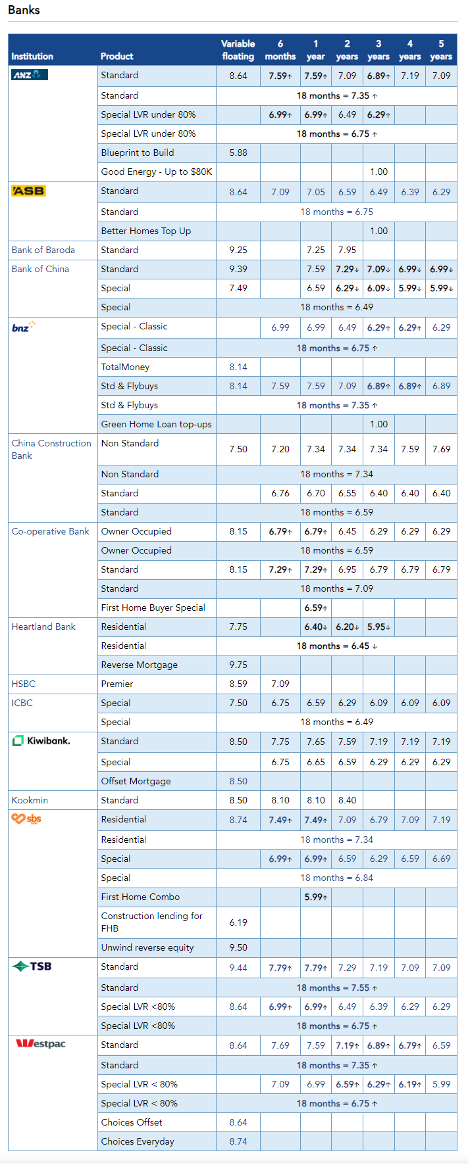
Latest mortgage rates at New Zealand’s commercial banks. Data source: the interest website