
Warning! Are more New Zealand property investors making losses? The latest market developments to watch
The latest research released by Valocity shows a sharp increase in the proportion of buyers purchasing investment properties in New Zealand who are making losses.
Are more New Zealand property investors making losses?
The latest research released by Valocity shows a sharp increase in the proportion of buyers purchasing investment properties in New Zealand who are making losses. Of particular concern, the proportion with negative cash flow has jumped from 10% in 2021 to more than 90% now.

Valocity's calculations, based on investment property purchase prices, market rents and interest rates at the time of purchase, show that rising mortgage rates have sharply increased the annual sums investors with negative equity must put into their properties. Average annual mortgage interest payments per property have jumped from NZ$5000 in 2021 to as much as NZ$30,000 now.
{ad}
Valocity senior property research analyst Wayne Shum said some owners wanted annual house price growth of 2.7% to 3% to justify continuing to hold their properties. In reality, however, it is too early to conclude that house prices will recover soon. Even if they do, any near-term increase would fall well short of the short-term capital returns investors hope to achieve. Shum stressed that the question for property owners was no longer how high their returns would be, but how long their cash flow could hold out.
Notably, the research shows that the proportion of investors finding their newly purchased properties had negative cash flow began rising as interest rates increased from late 2021. At the beginning of last year, only around 10% of investment buyers were making losses, but by the fourth quarter that proportion had rapidly risen to 60%. A year later, around 90% of investors have purchased properties with negative cash flow. Shum said investors' thinking in 2021 was that they could comfortably manage an additional NZ$5000 to NZ$10000 in annual mortgage repayments. Now, higher mortgage rates could push them to breaking point at any time.
The data also shows that some small investors owning one or two properties are leaving the market. The analysis was based on all borrowers purchasing investment properties with a 0 deposit. Although most investment properties on the market have a loan-to-value ratio of 60%, Shum said buyers borrowing at 100% faced more pronounced difficulties. Most investment buyers use their own homes as security to purchase additional properties, meaning their actual debt burden is higher.
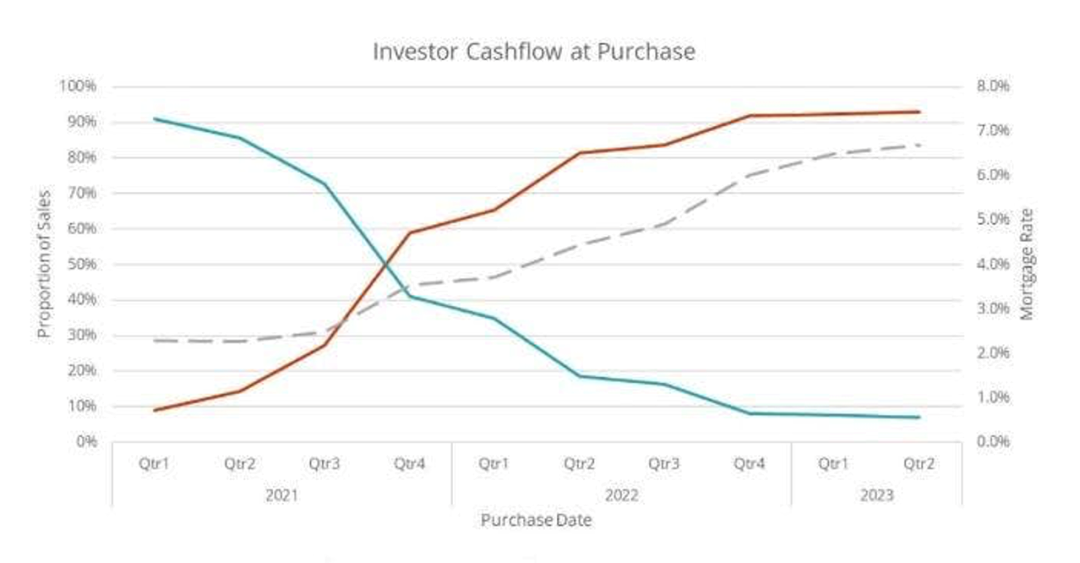
2021 to the present: changes in investor cash flow. Data source: Valocity
How difficult is it for investment buyers now? Shum ran through the figures:
In Auckland, even buying a property priced at NZ$700,000 with a 40% deposit means finding NZ$280,000 upfront. But how many ordinary households can easily produce that much cash? Their option, therefore, is to use their existing property as security to borrow a higher proportion of the purchase price.
So what should these investors do if they find they are making losses? Shum was frank: if investors put all their debt against their rental property, with their own home as security, selling the investment property now would mean taking a loss and could very well cost them their own home too.
Shum warned that times had changed. Although New Zealand property investors had enjoyed substantial annual capital gains since 2011, that trend reversed in September 2022. Returns have fallen year by year, while the mortgage repayments needed to cover rental shortfalls have increased annually. The data shows investors now need annual house price growth of at least 2.7% to break even. In Auckland, the figure is higher, at more than 3%. Shum stressed that this year's October general election could see some investor-friendly policies return. However, even restoring mortgage interest deductibility for property investors would be unlikely to have an immediate effect on the property market. In the market he currently sees, more investors want to reduce their debt repayment burden rather than take on additional debt.
2
Has New Zealand's recession ended?
Figures released by Stats NZ last week show the New Zealand Activity Index (NZAC) for May was 0.7% higher than a year earlier and up 0.8% on the previous month. Although these figures are hardly spectacular, they still point to second-quarter GDP growth of +0.5%, giving us reason to believe the brief recession has ended.
CoreLogic chief economist Kelvin Davidson said the end of New Zealand's recession would help employment rise further. He also said the property market might have emerged from its downturn.
3
Inflation expectations fall as employment rises
ANZ's June business and consumer confidence surveys, released last week, were very encouraging. Businesses and households expressed greater optimism about New Zealand's economic outlook, while businesses' expectations of cost pressures, goods prices and inflation all eased to varying degrees. A Stats NZ report released last week also showed that job vacancies expanded again in May. This should help raise household incomes, easing the heavy repayment pressure caused by higher mortgage rates.
4
Are looser LVR restrictions starting to work?
The data shows that NZ$5,900,000,000 in mortgages was issued nationwide in May. Although this remained below the level a year earlier, the monthly decline of -14% was the smallest in nearly 18 months. There are signs that the easing of LVR restrictions has already had some effect, recently lifting the share of high-LVR lending to owner-occupiers from around 4% a few months ago to more than 6% now.
5
Are mortgage borrowers favouring shorter fixed terms?
The Reserve Bank of New Zealand will release figures on new mortgage lending for June this week. The April figures showed that 74% of owner-occupiers and 78% of investors fixed their mortgages for terms of up to two years. The May figures showed new borrowers increasingly favoured shorter fixed terms, even though some banks offered three-year fixed rates well below their shorter-term rates.