
A foregone conclusion? The Reserve Bank of New Zealand announces its OCR decision this Wednesday! What other major developments deserve attention?
Many mortgage holders were visibly unsettled last week after the four major commercial banks successively announced increases in their fixed mortgage rates to their highest levels in almost a decade

The Reserve Bank will release its latest monetary policy statement this Wednesday
Many mortgage holders were visibly unsettled last week after the four major commercial banks successively announced increases in their fixed mortgage rates to their highest levels in almost a decade. The latest Reserve Bank of New Zealand figures show that around 50.4% of mortgages will reach the end of their terms over the next 12 months, facing the prospect of refixing at higher interest rates. Many people are concerned that the Bank will announce another increase in the Official Cash Rate (OCR) this Wednesday.
These concerns are not unfounded, even though the Reserve Bank of New Zealand previously gave a strong, clear signal that its 0.25 percentage point OCR increase in May would be the last in this tightening cycle, with the OCR expected to remain at 5.5% until the middle of next year. The biggest unknown in the OCR decision, however, is the current inflation rate. Until Stats NZ releases this year’s second-quarter inflation figures on the 19 of this month, we cannot judge whether the Bank’s interest rate rises have been highly successful in reducing inflation.

New Zealand’s GDP already showed signs of recession in the first quarter of this year, but the latest economic indicators suggest the economy is emerging from its trough and the recession may already be over. ANZ’s latest business and consumer confidence surveys show that people are optimistic about the economy’s future direction, while inflation expectations are also falling.
Good news from Australia has further reinforced this optimism. The latest figures released by the Reserve Bank of Australia show that high inflation there has been brought under control, falling to 5.6%. Although further interest rate rises remain possible, its most recent monetary policy statement made clear that Australia would hold its OCR unchanged at 4.1%.
In New Zealand, one key indicator in deciding whether the OCR should remain at 5.5% is the Quarterly Survey of Business Opinion (QSBO), published by the New Zealand Institute of Economic Research (NZIER). BNZ head of research Stephen Toplis believes the Reserve Bank of New Zealand should be pleased with the latest survey results. In his latest market report for BNZ, he said:
“The Reserve Bank of Australia’s decision last week to leave its OCR unchanged is an extremely important signal for the New Zealand market. If central banks in other trading partner countries raise interest rates aggressively, this will directly weaken the New Zealand dollar, generating some inflation. But strong evidence currently shows that inflationary pressures are easing and sustainable jobs are increasing. All signs suggest that another interest rate rise is now very unlikely.”
He predicted that the ideal outcome this Wednesday would be for the Monetary Policy Committee to leave the OCR unchanged at 5.5%.
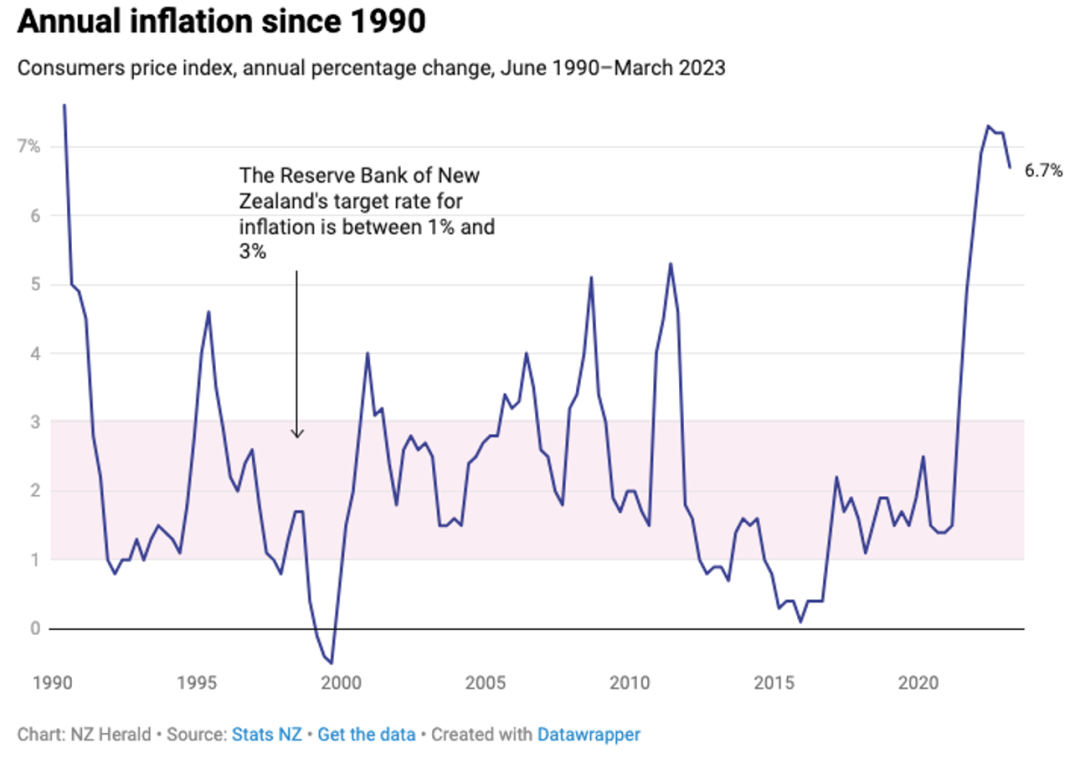
1990 to the present: changes in New Zealand’s inflation rate (source: Stats NZ)
Kiwibank chief economist Jarrod Kerr believes that Australia began raising interest rates later than New Zealand and has been more conservative with its increases, but still needs further rises to curb inflation. Kerr expects New Zealand’s OCR will not fall before February next year. His team forecasts that the Reserve Bank of New Zealand’s first rate cut will come in February, 9 months from now.
ASB chief economist Nick Tuffley also believes Wednesday’s monetary policy announcement will contain no surprises. In his latest business report, he said that given current economic conditions, the Reserve Bank of New Zealand could remain on hold for now. This was consistent with the Bank’s expectation that it had done enough to bring inflation back into its target range of 1–3% next year.
2
What other data releases deserve attention this week?
This Wednesday will also bring the latest New Zealand net migration figures for May and national rental price data for June. Figures for the preceding months show that growth in net migration has remained very strong. Although it may ease in future, it will still generate substantial housing demand, which will show up in rents first. Many property investors will undoubtedly be watching both releases closely.
3
Fewer borrowers choose shorter mortgage fixing terms
The latest Reserve Bank of New Zealand figures show that in May, 65% of owner-occupier buyers chose fixed terms of two years or less, compared with 70% of investor buyers. The average across the two groups was 67%, a substantial decline from 74% in March and 75% in April. This is because commercial banks have lowered fixed mortgage rates for terms longer than two years, making these more attractive to borrowers than one-year terms.
{ad}
4
Building consent applications fall again
Rising mortgage rates, falling house prices and continuing increases in construction costs have dampened sentiment among developers and prospective buyers to some extent. Figures show that building consent applications in May fell 18% compared with the same month last year. This was the eighth consecutive monthly decline, taking annual applications from a peak of 51,000 dwellings a year earlier to 45,000. There is reason to believe this downturn will continue for some time, although the large volume of previously approved building consent applications means many builders will remain very busy for a while yet.