
Official: OCR unchanged as expected, but these latest survey findings may deserve more attention from property investors
As expected, and as outlined in YIJU’s article on Monday (click to read), the Reserve Bank of New Zealand announced today that the Official Cash Rate (OCR) would remain unchanged at 5.5%
As expected, and as outlined in YIJU’s article on Monday(click to read), the Reserve Bank of New Zealand announced today that the Official Cash Rate (OCR) would remain unchanged at 5.5%. The Bank also said the OCR might need to stay at this level for some time. Its Monetary Policy Committee said the OCR needed to ‘remain manageable for the foreseeable future’. The decision to hold the OCR was in line with market expectations.
ASB economists said this demonstrated the Reserve Bank of New Zealand’s determination to keep interest rates at their current level to combat high inflation. Chief economist Nick Tuffley expects the OCR is unlikely to fall before May next year. Tackling high inflation is a difficult challenge shared by many central banks around the world. Countries worldwide are experiencing interest rate rises, particularly those under the European Central Bank and the Bank of England. (The chart below shows current OCR and inflation levels across major economies.)
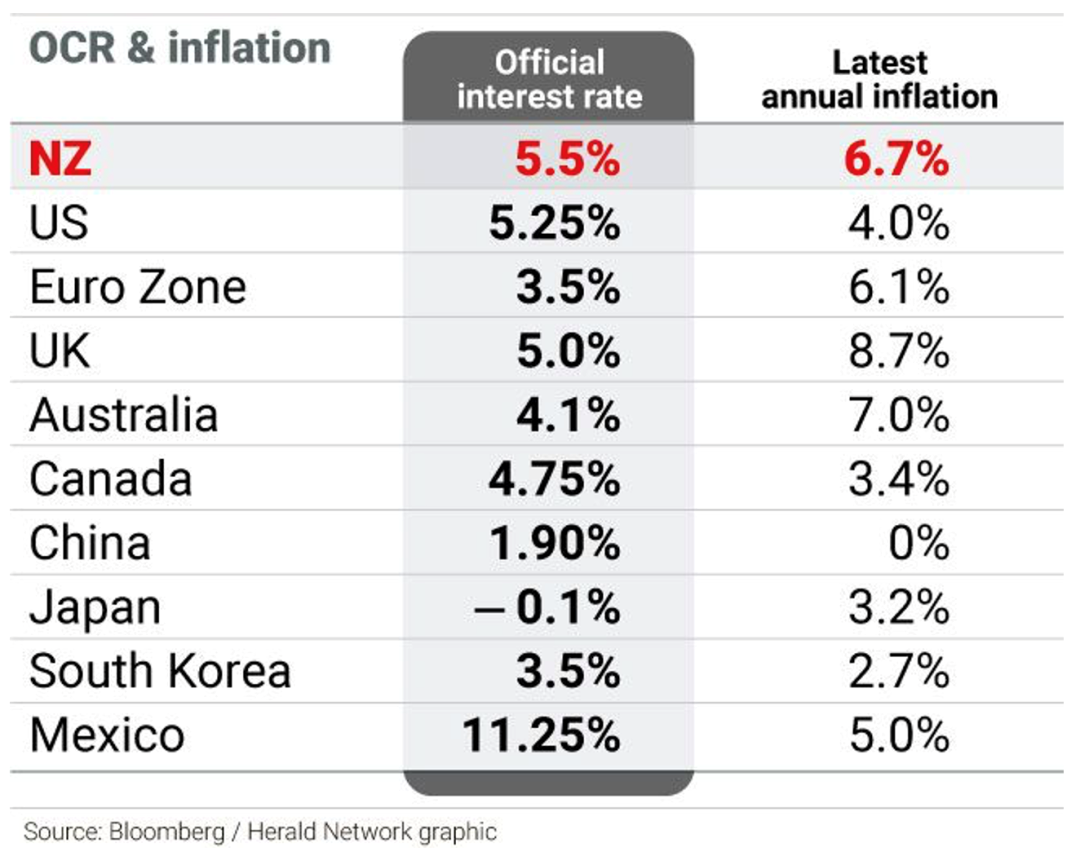
Current OCR and inflation figures for major economies (source: Bloomberg)
Market volatility continues as house prices keep falling
Property valuation company Quotable Value (QV) recently said that house price declines were beginning to slow, but there would be no ‘perfect’ soft landing, with further market fluctuations expected over the coming months. Its latest survey data shows that house prices continued falling in the three months to June, with the national average down 1.8% to NZ$891,585. This was smaller than the average decline of 3.4% in the three months to May.
QV operations manager James Wilson said that although house price declines were slowing in many parts of the country, there would be fluctuations over the coming months. Low sales volumes meant prices would continue falling in uneven steps, potentially with short-lived spikes in the rate of decline.
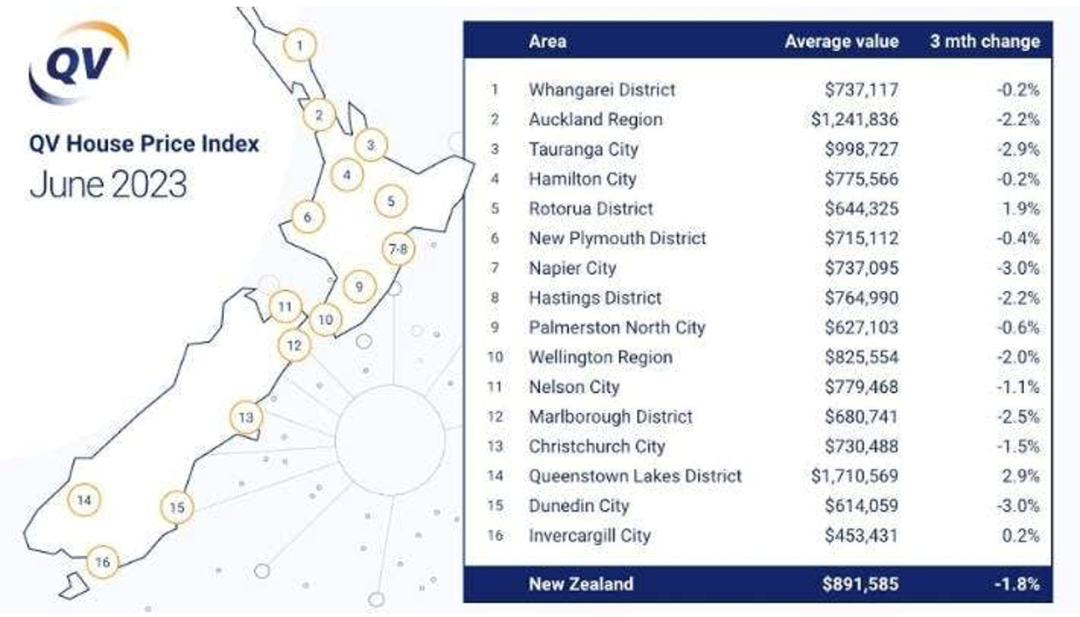
QV Published house price indices for New Zealand’s main cities in June (source: QV)
The detailed figures show that in June, average quarterly declines eased across the country’s 16 largest cities, except in Hastings and Dunedin, where they increased slightly. Quarterly house price declines in Auckland, Wellington and Christchurch slowed from 2.3%, 2.6% and 2.5% respectively in May to 2.2%, 2% and 1.5% in June. Average house prices currently stand at NZ$1,240,000 in Auckland, NZ$825,440 in Wellington and NZ$730,488 in Christchurch. Queenstown, Rotorua and Invercargill recorded quarterly increases of 2.9%, 1.9% and 0.2%, taking their average property prices to NZ$1,710,000, NZ$641,633 and NZ$454,159 respectively.
Wilson said that with economic uncertainty continuing, it remained to be seen how many investors had returned to the property market. We are now entering the next wave of refinancing, with many households having to refinance at substantially higher mortgage rates. The property market downturn may be nearing its end, but there is no sign of a rapid rebound in house prices or sales volumes. Meanwhile, demand for entry-level properties is increasing as overall housing demand grows. Encouragingly, with today’s official announcement that the OCR will remain unchanged, and interest rates having peaked, we may see some positive market developments later this year.

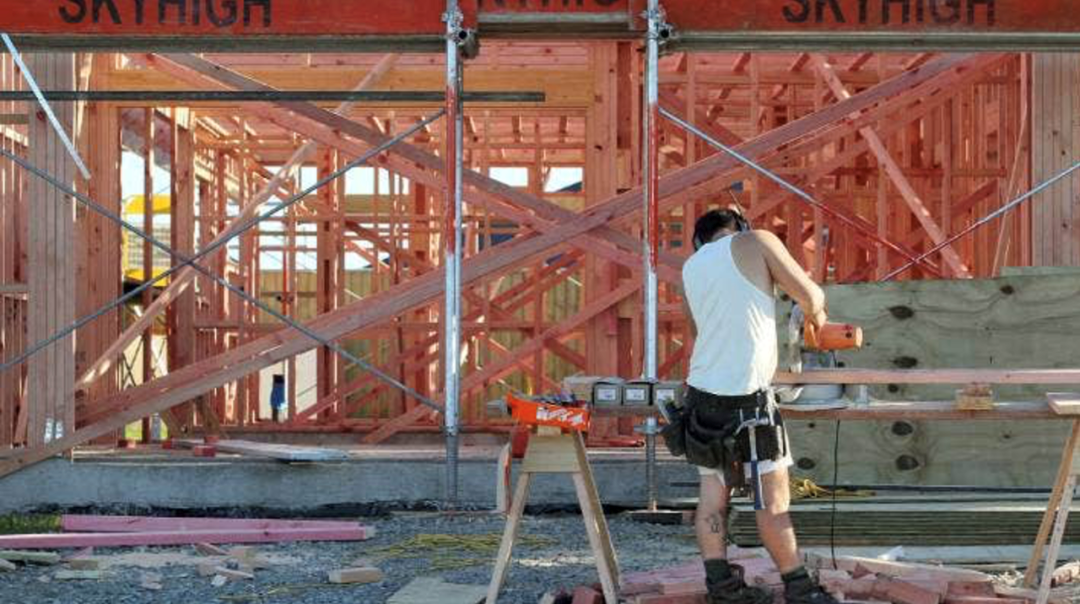
Fewer building consents for new homes,
and construction cost growth is also slowing
CoreLogic’s latest Cordell Construction Cost Index shows that construction costs rose in the three months to June, but the rate of increase had stabilised compared with the first quarter. (The index measures construction costs using the cost of a standard single-storey brick-and-tile home with three bedrooms, two living areas and two bathrooms.)
National house-building costs rose 0.6% in June, well below last year’s average quarterly increase of 2.5%. Annual growth in house-building costs nationwide has slowed to 6.5%, although this remains above the average increase of 4.5% over the past 10 years.
{ad}
CoreLogic chief property economist Kelvin Davidson said the current rate of construction cost growth had improved considerably from its peak of 10.4% late last year. The latest Stats NZ figures show that building applications for new homes fell 10% to fewer than 46,000 dwellings, which has, to some extent, eased pressure on building material supplies.
Easing demand for new homes and increased capacity among building material suppliers will restrain construction cost growth, but the impact of the new wave of immigration on labour supply needs close attention. Meanwhile, timber prices have stabilised in 2023, with some structural timber costs falling. Metal prices have also been very stable, and structural steel prices have declined recently.
Davidson expects building material prices to continue rising by around 0.5% per quarter in the second half of this year, with annual growth falling below 3% by the end of 2023. He also said this did not mean building a home would cost less, but buyers could be reassured that construction costs would no longer rise at the pace seen over the past two years.