
New Zealand's housing market has bottomed out and is recovering. Can the trend last? A look at the facts
It is no longer news that New Zealand house prices have bottomed out and started rising. Numerous media reports have confirmed this, so rather than repeat them, we will look at how far the market has recovered

New Zealand's housing market has bottomed out and is recovering, but has yet to return to normal
It is no longer news that New Zealand house prices have bottomed out and started rising. Numerous media reports have confirmed this, so rather than repeat them, we will look at how far the market has recovered.
Days to sell has never been a leading indicator, but it is a useful measure for confirming the market's current position. Data released by Trade Me last week shows that the national median time to sell a property fell from 76 days in July to 68 days.
We are currently at the point indicated by the arrow. This shows that, nationally, the market remains in the early stages of recovery. New Zealand's housing market has begun to thaw after being deeply frozen, but it has yet to return to its normal range.
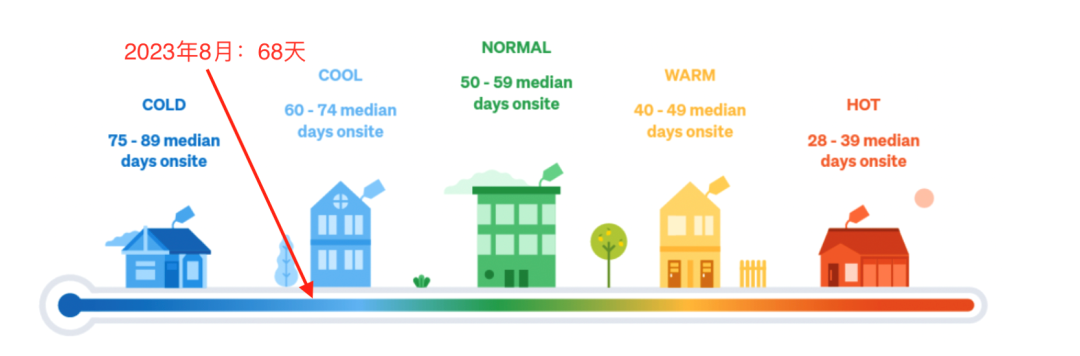
Measured by the time taken to sell, the market is now roughly back to 2019 levels.

The market debate centres on two questions: will the policy of high interest rates continue? And if the current recovery is a response to National's aggressive property policies, could the trend be interrupted if National fails to take power after the election?
Why commercial banks have recently raised interest rates: greed
Concerns about high interest rates stem from commercial banks' recent increases to short-term mortgage rates. Despite the Reserve Bank of New Zealand holding rates steady, ASB raised its most widely used 1-year fixed mortgage rate 2 times in succession, while other banks made 1 additional increase. The commercial banks have spooked the market.
The banks' explanation is that wholesale interest rates have risen. Internationally, the US Federal Reserve also appears unfriendly towards the market, driving continued increases in US Treasury yields and prompting debate about whether this will affect future rate rises in New Zealand. Others, however, believe the additional increases beyond the central bank's moves are driven simply by bank “greed”, rather than rising wholesale rates.
The chart below shows that, since the Reserve Bank of New Zealand stopped raising rates, the 1-year wholesale rate, shown on the bottom line, did not rise between May and September. Yet ASB raised rates 2 times in succession, and other banks made 1 increase.
This has pushed New Zealand banks' interest margins to levels near their highest in 10 years, allowing the banks to make huge profits. Some industry figures believe the main reason banks dare to do this is that high interest rates make refinancing with another bank very difficult. When their fixed terms expire, borrowers can only refix with their existing bank, handing it substantial profits. Such rate increases may therefore lack support from the fundamentals and may not continue.
Further rate rises are unlikely; the focus is on cuts
Business survey data provides a forward-looking view of inflation. The ANZ business survey data below makes this clear: cost structures, inflation expectations and pricing all indicate that inflation's downward trend will continue.
The only remaining expectation of an increase is for wages. In the chart below, expectations of non-wage cost increases, shown in blue, had disappeared entirely by August and turned negative, suggesting that everything other than wages is trending downwards. Even expectations of future wage growth, the sole remaining increase, have fallen from 6% at the start of the year to 4%.
Looking at domestic conditions, inflation in New Zealand has been brought under control.
Whichever party takes power, the housing market may receive support
The reality is that whichever political party takes power, its approach to property will only become more favourable.
With the election approaching, National's proposed property policies seem almost unbelievable. From reducing supply by withdrawing from medium-density housing rules, to boosting landlords' income by restoring interest deductibility and shortening the bright-line tax period from 10 years to 2, to allowing overseas buyers back into New Zealand, it is going all out. Few people truly believe National could implement all these policies in full if it takes power. What matters is the attitude they signal.
Labour, as the governing party, cannot make a 180-degree turn on its existing policies, but its actions behind the scenes are all aimed at supporting the housing market. The government's housing agency, Kāinga Ora, has repeatedly issued new debt this year and used the funds to keep buying homes on the market, becoming a major buyer.
{ad}
Labour's future policies include increased energy-efficiency rebates, a broad offering of “sweeteners” ranging from several thousand dollars to $18,000, as well as a proposed “amnesty” for tens of thousands of migrants. Such policies could increase actual demand for home purchases, whether by individuals or through Kāinga Ora.
Therefore, if either of the two mainstream parties remains in government, property policy will continue to support the housing market until it becomes hot again.
The choice with better odds
Returning to the opening point, the market has bottomed out and is recovering. This is only the beginning: it remains far from normal, and major price increases have yet to emerge. Many people have been frightened by high interest rates over the past 2 years, while many others are waiting for the final election result.
Looking ahead, the reality is that the risk from high interest rates has receded, and the different parties' policies point in the same direction. This is precisely a time when actual risk is very low, the chance of continued price rises is high, and the chance of new lows is almost non-existent. The market's rise is spreading. Comparing the odds, taking active steps to prepare to enter the market clearly offers the better chance of success. Why wait until prices have risen before buying?
At this stage, it is necessary to choose the market leader.
Looking at policy, both National and Labour offer the greatest benefits to major cities, so Auckland remains the clear first choice. Auckland's price rises are now beginning to spread gradually from central areas to surrounding suburbs.
We now invite an experienced professional from Auckland's largest real estate agency, Barfoot & Thompson, to discuss recent sales and future trends in representative areas.
Frances Li
Associate Salesperson Epsom Branch
YIJU: How has Auckland's housing market performed over the past year?
To be honest, in more than thirty years in real estate, we have never encountered a housing market as quiet as it has been this year. Interest rates are high and homes are slow to sell, while owners are reluctant to lower prices or even list their properties unless they have to sell. Buyers cannot find the homes they want, and sellers cannot get good prices, so both sides are struggling. In recent months, properties in central Auckland have generally become easier to sell. Some owners are willing to list now because there is little competition, while others want to wait until after the election in the hope of getting a higher price. Overall, the broader market is heading in a better direction.
YIJU: How do you see Auckland's housing market developing?
Although conditions have been poor overall this year, the market has generally warmed up recently. The development we have been selling at 13A Clarke Rd, Royal Oak, is a good example. It is a row of 8 high-quality, 3-bedroom, two-storey brick homes, each about 180 square metres. They were listed in the middle of last year and attracted no interest, with only 1 home sold after considerable difficulty. Recently, however, we sold 5 in quick succession, with competing offers. The buyers included investors, owner-occupiers and downsizers. We also feel that the market has truly bottomed out and is showing signs of a slight recovery. We really hope the election brings renewed hope to the property industry and a return to its former strength.