
First-home buyers' share of purchases hits a record! How can they make the most of today's lower house prices?
Recently released authoritative data shows that, despite interest rates reaching highs not seen in more than a decade, first-home buyers' share of purchases has reached a record 26.4%

A golden opportunity for first-home buyers
Data released by the Real Estate Institute of New Zealand (REINZ) shows that, among properties sold nationwide in July, the average sale price in the lowest-priced 25% of the market fell by NZ$3000 to NZ$587,000. Although the change was small, it is very positive for first-home buyers, helping them gain confidence during their long search for a home.
Recently released authoritative data shows that, despite interest rates reaching highs not seen in more than a decade, first-home buyers' share of purchases has reached a record 26.4%.
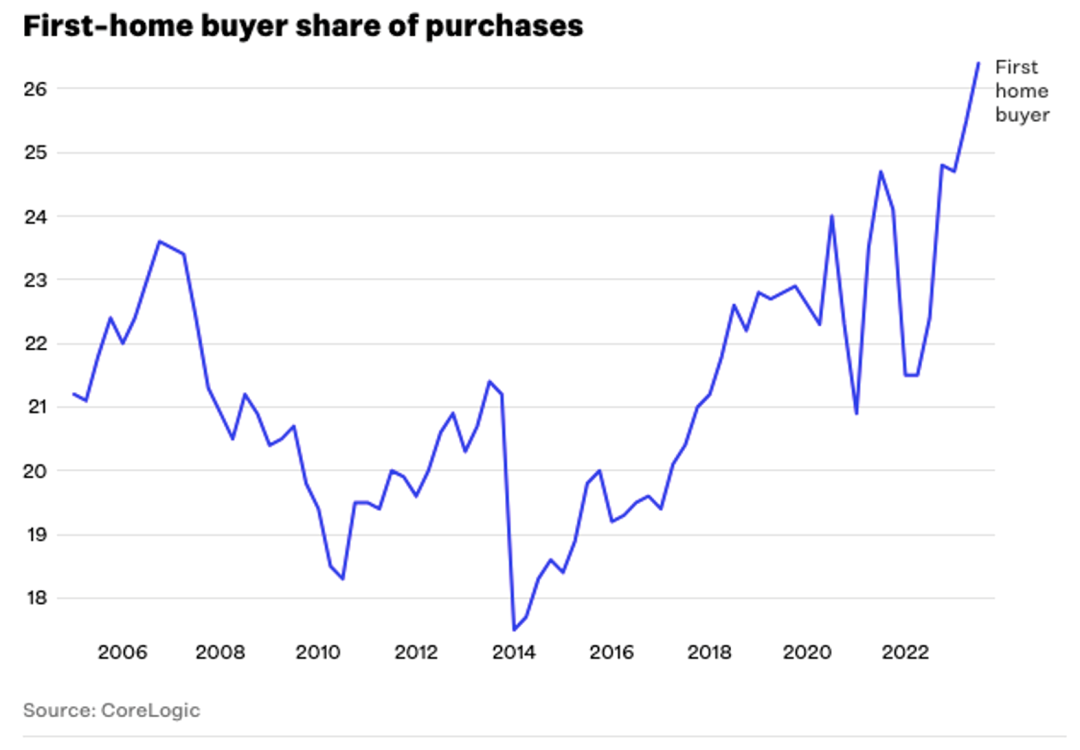
CoreLogic chief property economist Kelvin Davidson said this could reflect a combination of reduced competition as other buyer groups become less willing to buy, house prices remaining relatively low compared with their peak two years ago, and the implementation of grants and lending measures that help first-home buyers. Commercial banks offering higher-LVR loans to borrowers with loan ratios below 20% have also provided some impetus.
2006 First-home buyers' share of purchases through to the present (Source: CoreLogic)
Mortgage broker Susan Templeton believes first-home buyers are confident about the housing market because they have seen house prices rise and fall over the past few years. Meanwhile, an increase in net migration will bring greater activity to land development and the labour and building materials markets, ultimately leading to renewed house price rises. They now feel a sense of urgency to enter the market.
ANZ senior economist Miles Workman said the biggest question for first-home buyers is whether they have a sufficient deposit and the income needed to qualify for a loan.
He noted that soaring house prices in 2020/21 made it difficult for some prospective first-home buyers to save a 20% deposit. Even if their incomes continued to rise during that period, buying a home remained difficult. As house prices began falling from the end of 2021, deposit and LVR constraints eased considerably. The housing market has gradually shifted from an era of high house prices and low interest rates to one of high interest rates and falling prices. Although first-home buyers have faced different market conditions at different times, their overall market share has continued to rise steadily.
How first-home buyers can take advantage of today's lower house prices
01
Applying for a loan
Obtaining a bank loan is currently no easy task. Before considering a loan, banks generally require borrowers to provide a 20% deposit, or 10% for a new build. Based on New Zealand's national average house price of NZ$893,639 in August, this means a deposit of NZ$178,727 for an existing home or NZ$89,363 for a new build. Buyers without a sufficient deposit can still obtain one through other means.
02
Shared ownership scheme
The First Home Partner Scheme offered by New Zealand's housing agency, Kāinga Ora, is well suited to first-home buyers who cannot provide a sufficient deposit. Under this shared ownership scheme, Kāinga Ora contributes up to NZ$200,000 or 25% of the purchase price and jointly owns the home with the first-home buyer.
03
First Home Grant
First-home buyers who have contributed to KiwiSaver for at least three years can build up their deposit through Kāinga Ora's First Home Grant scheme, which offers up to NZ$10,000. The amount available depends on the applicant's income and the type of home they wish to buy.
04
Loan guarantee
Another way to buy a first home is for Kāinga Ora to guarantee the buyer's bank mortgage. The borrower still needs a 5% deposit, but Kāinga Ora does not contribute cash and therefore does not own a share of the home. It charges only a small mortgage insurance fee. The scheme allows banks to offer buyers low-LVR mortgages that they would otherwise be unable to approve.
{ad}
05
Non-bank lenders
There are many non-bank mortgage lenders, and they typically offer packages that help borrowers obtain the home loan they need without the large deposits required by major banks. Although interest rates may be higher, the benefit is that borrowers can buy their first home sooner.
Finally, YIJU recommends consulting a professional mortgage adviser, choosing the loan package best suited to your financial circumstances, and shopping around to secure the best deal.