
Take note! Two recent industry developments will directly affect the future of New Zealand's housing market
ANZ recently said New Zealand house prices were “recovering rapidly”. The bank had previously forecast a 3% rise in house prices in the second half of 2023

Development one: house prices are rising faster than expected
ANZ recently said New Zealand house prices were “recovering rapidly”. The bank had previously forecast a 3% rise in house prices in the second half of 2023. However, with prices rising faster than expected, its latest forecast is for an overall increase of 4% across New Zealand this year, with prices continuing to rise until next autumn.
ANZ's economists said the housing market's downward trend had clearly reversed, with house prices remaining on an “upward” trajectory over recent months. They expect the national median house price to jump from its current NZ$780,000 to NZ$812,000 by the end of this year. Although this measure indicates the housing market is still far from “hot”, there is no denying that activity continues to pick up.
REINZ's August property data shows that, over the past three months, the house price index rose 0.7% month on month, with an annual increase of 8%. New Zealand recorded net migration of nearly 100,000 over the past year, while housing supply has not matched demand. Nevertheless, with unemployment rising and mortgage interest rates remaining high, house price growth is expected to stabilise in the second half of 2024. ANZ now expects house prices to rise 5% in 2023, with growth slowing to around 3% in 2025. If upward pressure on house prices increases CPI inflationary pressure, the Reserve Bank of New Zealand could continue raising interest rates to prevent further house price rises.
They also noted that borrowers can still lock in relatively low mortgage rates over longer fixed terms, but those hoping for lower rates in the short term may be disappointed. This means borrowers should consider fixing for longer rather than shorter terms. Long-term fixed rates are currently relatively low and offer an immediate benefit once locked in, while short-term fixed rates only become advantageous when mortgage rates begin to fall. For example, the one-year fixed rate would need to fall from its current 7.29% to 6.61% within a year, then to 6.3% within two years, for choosing a one-year fixed rate now to be better value than fixing for two years at 6.95% or three years at 6.73%.
Mortgage rates at New Zealand's major mainstream commercial banks as at 28 September 2023 (Source: interest.co.nz)
Development two: a 50% chance of another Reserve Bank of New Zealand rate rise
Meanwhile, several economists have recently said they believe the Reserve Bank of New Zealand could raise the OCR once more. Although such a move carries some risk, domestic inflation has not fallen as quickly as the central bank expected.
Westpac chief economist Kelly Eckhold said that, although the OCR was highly unlikely to change at the central bank's next monetary policy review on 4 October, concerns were growing that it would rise by at least another 25 basis points over the next 6 months, reaching a new high of 5.75%. This is because the latest economic data shows that the economy performed better than expected in the second quarter of this year. That has temporarily lifted New Zealand out of recession, while also putting pressure on the Reserve Bank of New Zealand to raise the OCR.
{ad}
Eckhold put the chance of a rate rise in November at 50%. The reality is that, if the Reserve Bank of New Zealand raises rates again, wholesale rates will continue to rise, pushing up commercial banks' lending rates. Whether rates rise will depend on the consumer price index report due in mid-October and other key economic data to be released over the next six weeks.
CoreLogic chief economist Kelvin Davidson agreed, saying that the next CPI and labour market statistics would have a greater influence on the direction of inflation and the OCR than the result of New Zealand's general election.
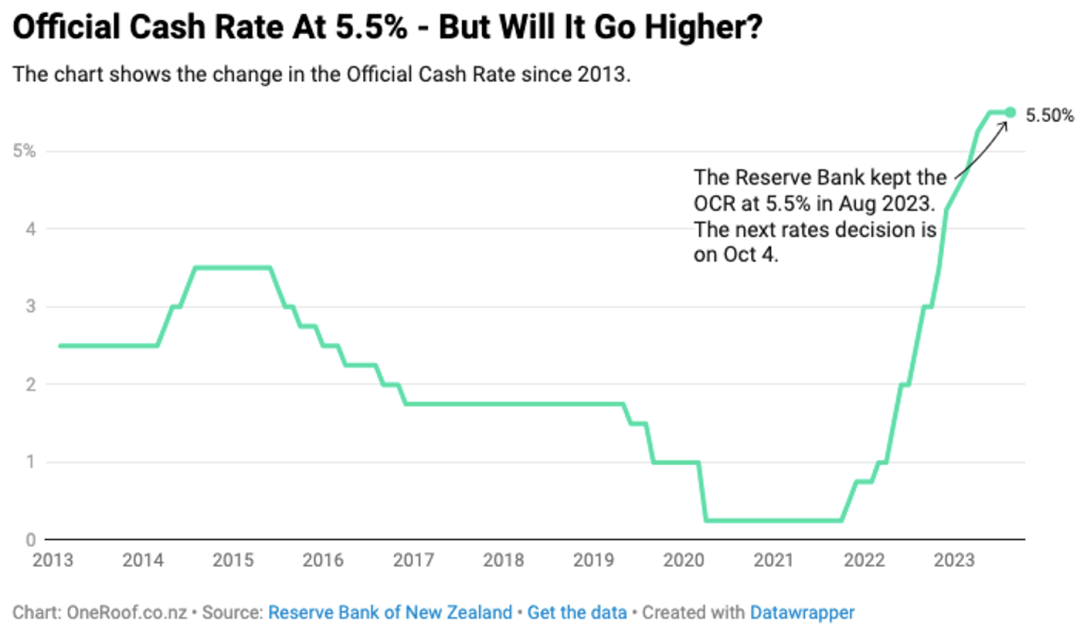
Although most mainstream banks say the central bank could raise the Official Cash Rate again, views across the market are not unanimous. Kiwibank chief economist Jarrod Kerr believes the next rate change will come in May next year rather than November, and firmly maintains that the OCR's next move will be a cut of 25 basis points rather than a rise. He forecasts several OCR cuts next year, beginning in May 2024. He and his team believe the OCR will remain unchanged in November, with some time still to wait before the first cut. His reasoning is that the conditions for rate cuts have already been met, with inflation on a downward path towards the central bank's target range.