
House price growth is gathering pace and buyers are getting restless? Hold on — even bigger positive news for the market is on its way!
Several property industry experts predict that, with the National-led coalition government taking office, the party's proposed restoration of interest deductibility will bring more investors into the market. Property valuation agency QV also says house price growth is gathering pace.

QV's latest House Price Index report shows that New Zealand's average house price rose 2.1% in the three months to the end of October. This was considerably higher than the 0.9% increase in the three months to the end of September. Notably, just three main centres recorded price falls over the quarter: Whangarei, down 0.4%; Hamilton, down 0.2%; and New Plymouth, down 2.8%.
 QV operations manager James Wilson
 said the market was showing clear signs of recovery despite persistently low property sales volumes and difficult economic conditions. In his view, the recovery has largely been driven by first-home buyers in more affordable areas. It is spreading across many main centres and regions and gradually extending into higher-priced markets. Although many people remain cautious about entering the housing market given current economic conditions, he said he had seen some positive shifts in prospective buyers' attitudes. He had noticed a clear rise in interest in buying property following the election, as the peak selling season approached. A shortage of new listings has brought back a fear of missing out, or FOMO, among some buyers, which will put some upward pressure on future house prices.
 QV's report also emphasises that property buying and selling activity is recovering slowly but steadily. Interest rates undoubtedly remain a focus, but the difference now is that people have a rough idea of where rates will peak, understand how the OCR might change and have largely established the repayment burden they will face over a given period ahead. Wilson said the market now felt very much like the early stages of the last economic boom eight or nine years ago. He was seeing very active first-home buyers, alongside increasingly active owner-occupiers and investors. He believed this relatively buoyant market would continue, with house prices maintaining their recovery over the next three to six months.
Wilson also predicted that some property investors would become more active over the coming months, particularly after the new National-led coalition government was formed. Record growth in net migration would rapidly lift expectations of house price increases in some main centres. However, he also said a large-scale return of investors was unlikely in the short term while high interest rates and credit restrictions remained.
 Wholesale swap rates have recently fallen sharply after wholesale interest rates peaked in early October, particularly the one-year and two-year swap rates. As we know, changes in swap rates and term deposit rates both affect mortgage rates. Term deposits are the main funding source for home loans, while wholesale markets also have a substantial influence, particularly when banks hedge the risks associated with borrowing short and lending long. Inflationary pressures also appear to have passed, and the US Federal Reserve is no longer under pressure to raise rates, prompting a sharp fall in wholesale rates. Once term deposit rates fall in line with recent interest rate changes in the world's major economies, mortgage rates will follow.
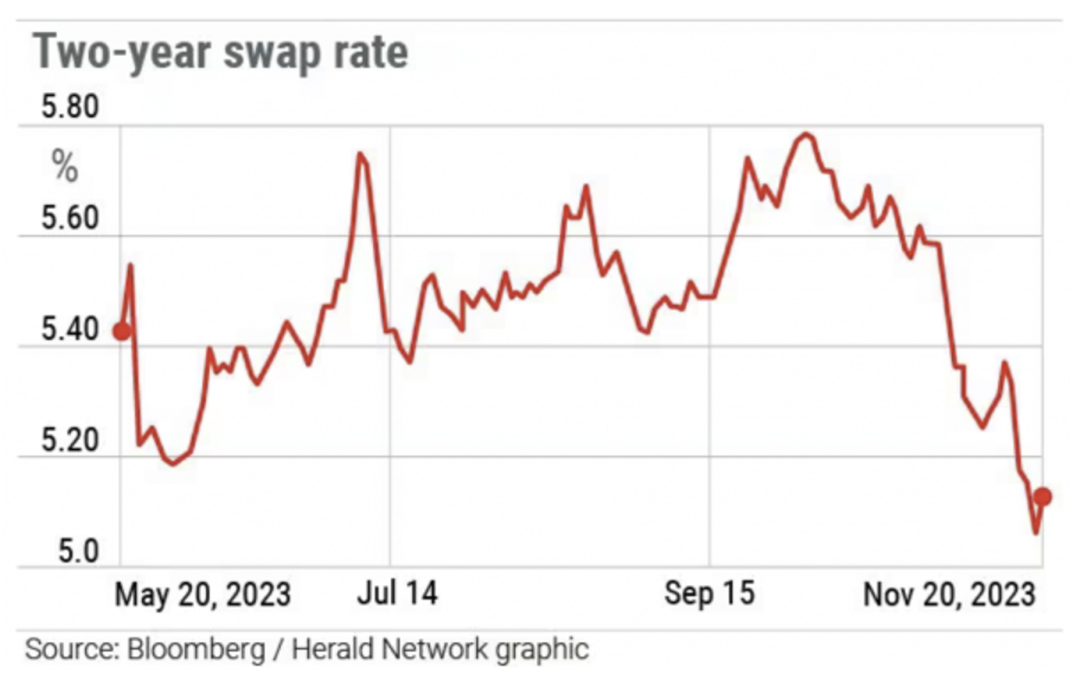 Chart showing recent changes in two-year swap rates (Source: NZ Herald)
Kiwibank chief economist Jarrod Kerr said we were at a critical juncture. He expected mortgage rates by this time next year could be at least 50–100, or even 150, basis points lower than now. This is welcome good news for mortgage holders, suggesting lending rates could continue falling over the coming year. Based on the current official cash rate (OCR) of 5.5%, he predicted that rate cuts could begin as early as the middle of 2024.

Harbour Asset Management fixed income and currency strategist Hamish Pepper
Harbour Asset Management fixed income and currency strategist Hamish Pepper shared this view. He said lower wholesale rates should soon feed through into mortgage rate cuts. Recent weak economic data indicated that the Reserve Bank of New Zealand's rate increases had achieved their intended effect in slowing inflation. Given current conditions, he believed the market was increasingly pricing in the possibility of rate cuts beginning before April or May, with that likelihood growing as 2024 approached. The market's position was that interest rates had peaked, both wholesale and retail. There was also good news from overseas markets, where central banks appeared to have safely passed the inflation peak.
Notably, in its latest Monetary Policy Statement, the Reserve Bank of New Zealand indicated that the OCR was expected to begin falling later next year. That raises the question: will the OCR be cut earlier, or remain unchanged? Let us await the Reserve Bank's final Monetary Policy Statement of the year, due next Wednesday.