
Latest house price report released: where are New Zealand’s hottest property investment markets?
The latest house price data from OneRoof shows that although a sharp slowdown in property sales late last year gave New Zealand’s housing market a poor start to 2024, house prices still recorded quarterly increases in 90% of suburbs nationwide.


The latest house price data from OneRoof shows that although a sharp slowdown in property sales late last year gave New Zealand’s housing market a poor start to 2024, house prices still recorded quarterly increases in 90% of suburbs nationwide. Arrowtown (8.3%), Mataura (8.2%) and Whitford (8%) posted the largest percentage gains. Queenstown-Lakes recorded the largest increase in dollar terms, while lower-priced areas such as Southland, the West Coast and Canterbury also saw substantial gains, buoyed by strong interest from first-home buyers towards the end of the year.
 House prices in Arrowtown, in Queenstown-Lakes, rose by more than 8% over the three months to the end of January.
The study found that, among the 793 suburbs nationwide where more than 20 properties sold over the past 12 months, more than 40% recorded annual house price growth, indicating a clear improvement in the market.
Over the three months to the end of November, New Zealand’s average house price rose just 0.9% (NZ$9000) to NZ$973,000. Many buyers temporarily stepped away from the market after a busy October and November.
The data shows that the West Coast recorded the largest quarterly increase, rising 4.7% to an average of NZ$424,000. Southland and Otago also performed strongly, with quarterly gains of 3.7% and 3.2% respectively. In fact, house prices in all three regions have returned to pre-pandemic levels.
Canterbury house prices have also almost returned to pre-pandemic levels. The region’s average house price rose 3.3% year on year and was just 2.2% (NZ$17,000) below its peak of NZ$798,000, reached in June 2022. However, price growth slowed slightly over the last quarter. Waikato and Gisborne both recorded modest declines over the past three months, with prices falling 0.3% in each region.
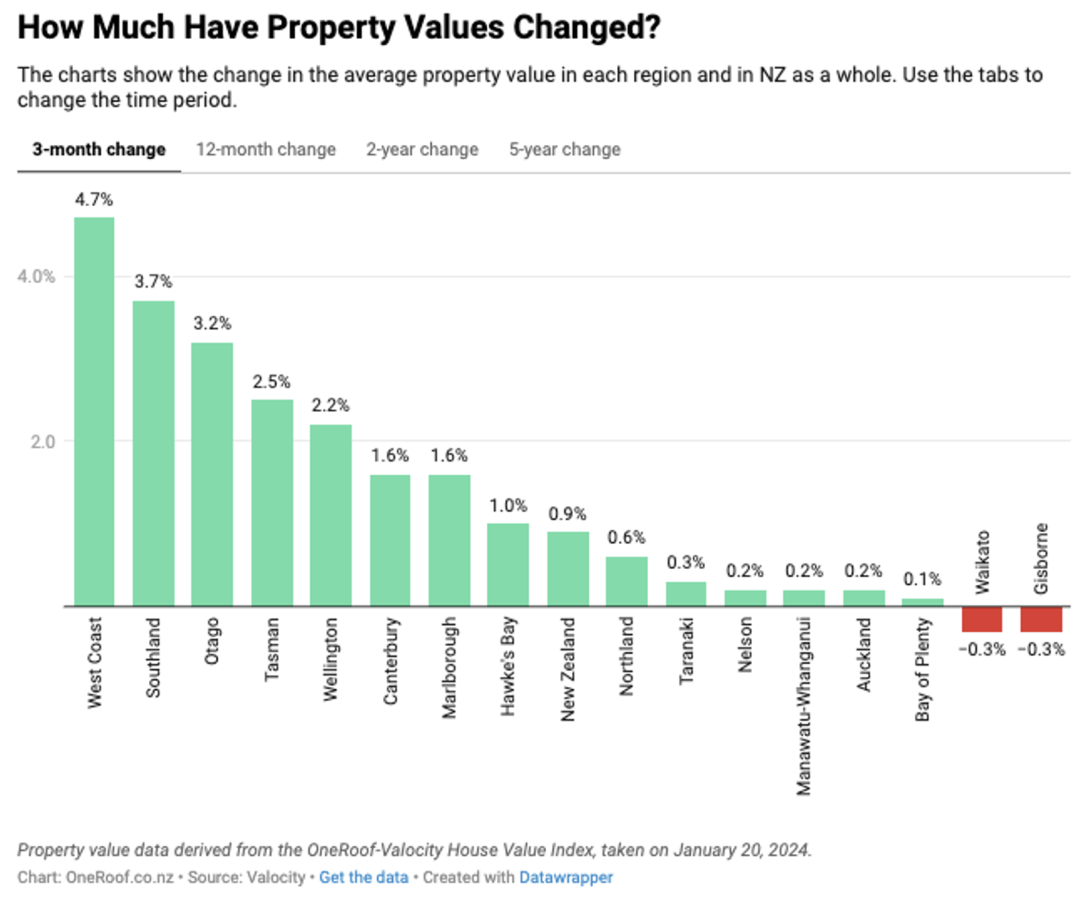
Bar chart showing current quarterly changes in average house prices across New Zealand’s main regions (Source: Valocity)
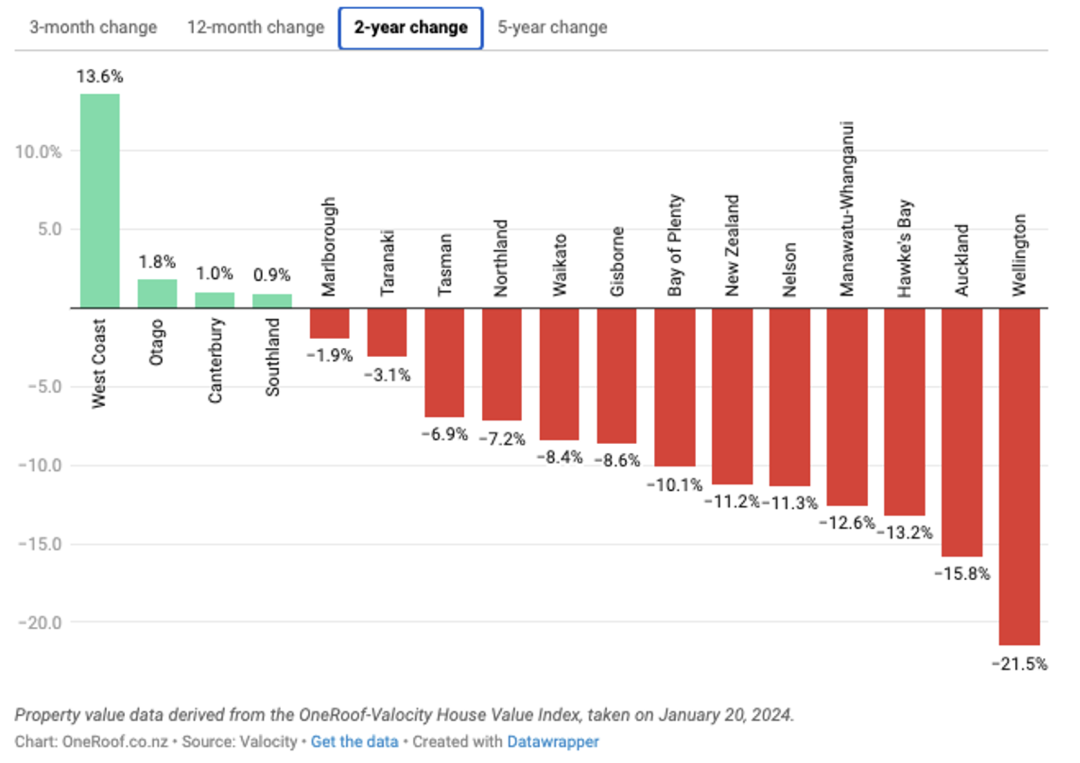 Bar chart comparing current average house prices across New Zealand’s main regions with those two years earlier (Source: Valocity)

The housing market’s weakness at the end of 2023 also cast a shadow over the recovery in several well-known luxury suburbs. Over the past three months, house prices fell 4.1% in Remuera and 2.6% in Omaha. With the Christmas and New Year holidays marking the quietest period for the property market, house price growth nationwide slowed markedly in January.
The figures also highlight the abrupt standstill in Auckland’s housing market over the holidays. Over the past three months, Auckland’s average house price rose just 0.1% to NZ$1,324,000, a stark contrast to its growth over the three months to November. Queenstown-Lakes, by comparison, led the country’s main urban markets, with house prices rising 4% quarter on quarter and 6.3% year on year. Although Christchurch’s market was less buoyant than before the October election, prices still rose 4.8% annually to an average of NZ$783,000. Over the same period, Tauranga’s average house price rose 1.5% to NZ$1,093,000, Wellington’s increased 1.4% to NZ$1,014,000, and Hamilton’s edged up 0.2% to NZ$818,000, all showing signs of the seasonal slowdown.
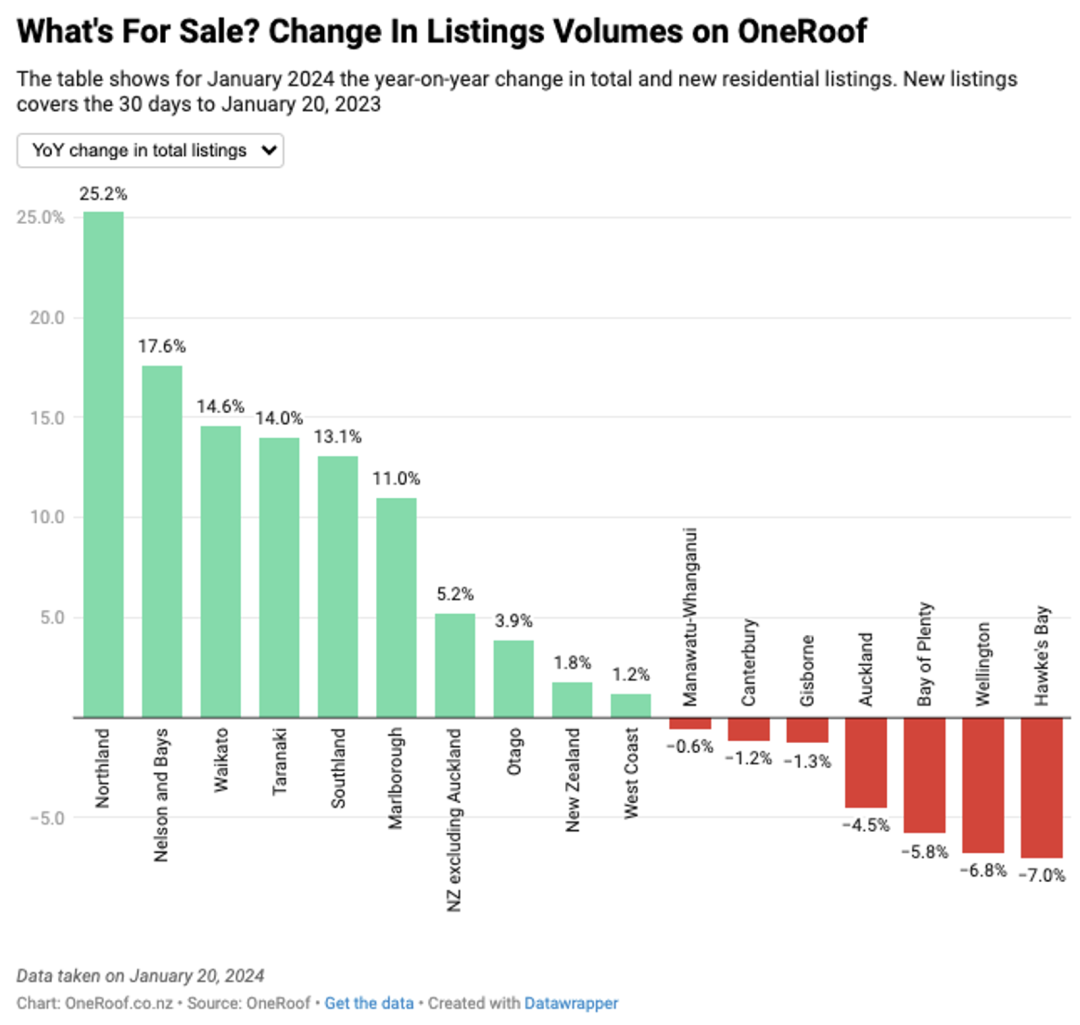 Bar chart showing annual changes in property listing numbers across New Zealand’s main regions (Source: OneRoof)
Nationwide, the stock of properties for sale remains at historically low levels. However, new listings in Auckland have risen again, and many agents expect a surge in listings in February and March.
 Helen O’Sullivan, Valocity’s global chief executive of real estate
, said that given the strong market performance in October and November, sales volumes in December fell short of expectations despite increasing year on year. The data shows that first-home buyers’ share of mortgage registrations fell in the final quarter of last year from the previous quarter’s five-year high of 45% to 44%. Over the same period, property investors’ share edged up from 22.4% to 23.6%.
O’Sullivan also said that, in the current high-interest-rate environment, the Reserve Bank of New Zealand’s announcement on debt-to-income ratios (DTIs) was unlikely to affect the market immediately. However, implementing DTI and loan-to-value ratio (LVR) restrictions together would effectively constrain house price growth during the next upswing. When interest rates are low, borrowers may be able to service their debt and meet LVR requirements, but debt-to-income ratios will limit how much debt they can take on. The aim is to curb the rapid house price growth that could follow a fall in interest rates.