
Breaking: major banks begin cutting rates sharply. Could one-year fixed mortgage rates fall below 6% this year? Or even below 5%?
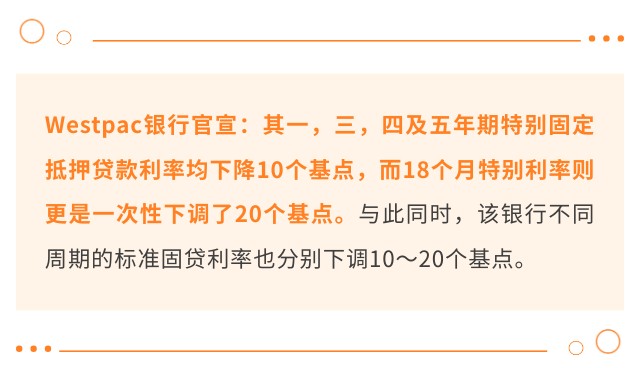
Westpac has announced cuts of 10 basis points to its special one-, three-, four- and five-year fixed mortgage rates, while its 18-month special rate has been cut by 20 basis points in one move.
There are two major developments today:
Following strong employment figures, ANZ economists have changed their forecast for the Reserve Bank’s rate-hiking path, saying it could raise rates by 25 basis points in each of February and April, taking the OCR from its current 5.5% to 6%. The expected start of rate cuts has been pushed back from August to February 2025. For borrowers, this outlook undoubtedly adds to their difficulties. ANZ economists said strong employment could be interpreted by the Reserve Bank as evidence that the economy is performing better than expected, making it more likely to keep interest rates at their current level for longer.
Following ASB’s cuts to a range of mortgage rates two weeks ago, Westpac reignited the banks’ “interest rate war” this morning.
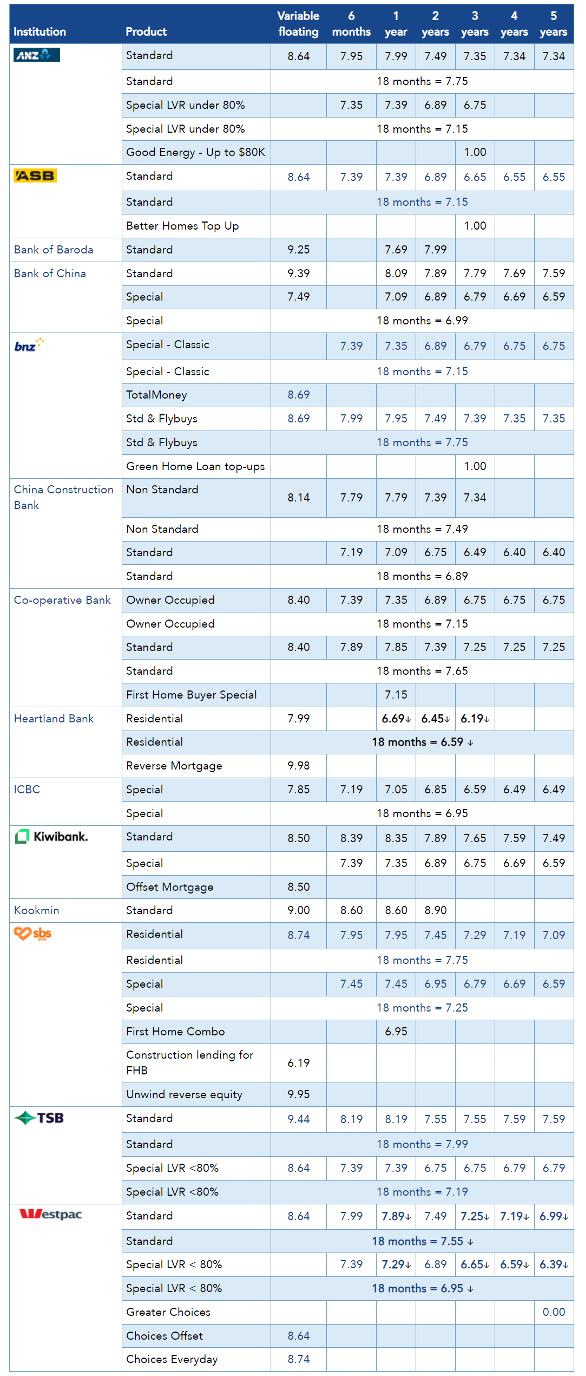 Latest mortgage rates at New Zealand commercial banks, as at 9 February. Source: interest.co.nz
Westpac general manager of product, sustainability and marketing Sarah Hearn said the cuts were good news for customers looking to refix their mortgages soon, although many remained concerned that refixing would increase their living costs. Its data show that the vast majority of customers are managing higher living costs well. Nevertheless, Westpac will contact borrowers who may be facing financial difficulties to ensure they receive support and fully understand their financial position.
So why are commercial banks making such substantial rate cuts? In fact, the latest inflation figures recently released by Stats NZ quietly marked a significant turning point. Data for December last year showed that quarterly Consumers Price Index (CPI) inflation was below 1%. This was the first time in nearly two and a half years, following 10 consecutive quarters, that CPI inflation had fallen below 1%. Many economists said this was a very clear market signal that the global surge in inflation triggered by the COVID pandemic was finally coming to an end。Inflation is falling steadily and substantially across most Western economies.
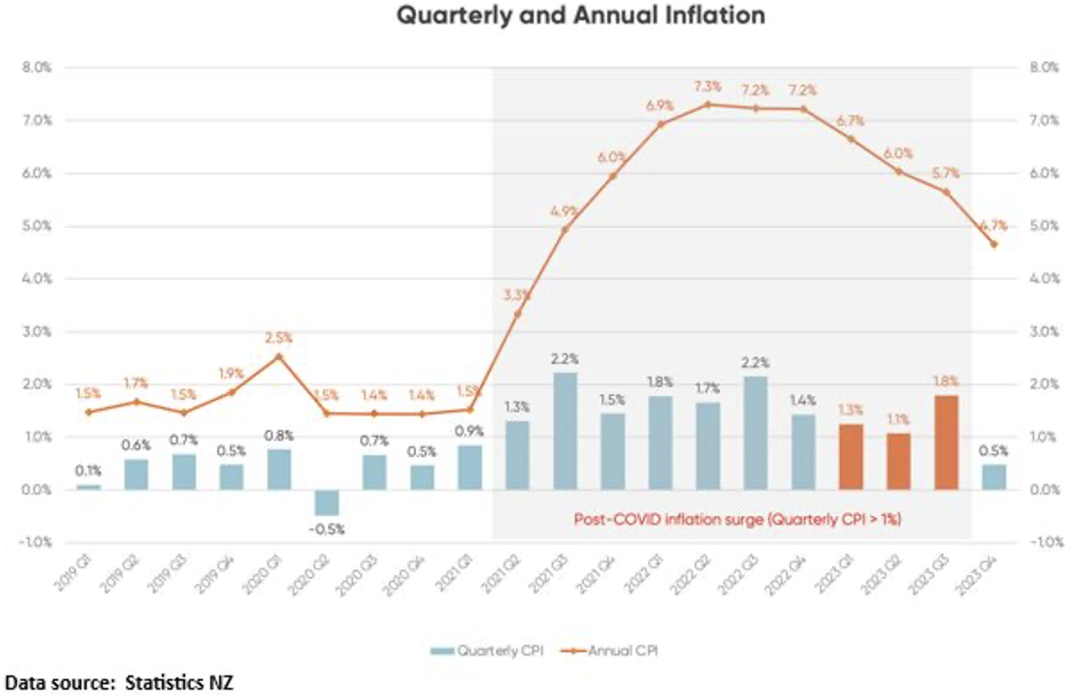 Chart showing changes in New Zealand’s quarterly and annual inflation rates from 2019 to 2023. Source: Stats NZ
The chart above shows changes in New Zealand’s quarterly and annual inflation rates over recent years. We can see that inflation remained well behaved until the end of 2020, with quarterly inflation averaging around 0.5% and annual inflation at 2%. In fact, extending the chart back to around 2000 would show a broadly similar picture. This indicates that, before the latest CPI surge, quarterly inflation averaged 0.5% for roughly 20 years.
The Reserve Bank of New Zealand’s role is to keep annual inflation between 1% and 3%. Stats NZ’s reported annual inflation rate of 4.7% for the fourth quarter of last year was therefore not a bad result for the Reserve Bank, seemingly leaving it only a step away from bringing inflation below 3%.

The best way to understand the direction of annual CPI inflation is to review the quarterly figures. Quarterly inflation rose sharply in 2023, reaching 1.3% in March, 1.1% in June and 1.8% in September, when the government ended the fuel excise duty discount. By the fourth quarter of 2023, quarterly inflation had fallen back to its long-run average of 0.5%.
If actual quarterly inflation stays low over the coming quarters, annual inflation could fall rapidly.
Projections suggest that if quarterly CPI inflation averages 0.5%, annual CPI inflation could return to 2% by September this year. However, these figures are only the outcome of a hypothetical scenario.


A rapid fall in inflation could lead to substantial cuts in short-term interest rates next year, which is precisely what wholesale interest rate markets are predicting. This is despite the Reserve Bank of New Zealand’s repeated hawkish statements that meaningful cuts to the Official Cash Rate (OCR) may not begin until 2025.
Long-term fixed rates may continue to fall as the expected timing of OCR cuts draws closer. Some economists currently forecast that the OCR will fall to 3% in a few years, leaving greater room for long-term fixed rates to decline.


First, we need to recognise that the gap between banks’ current fixed mortgage rates and wholesale interest rates is already very large. For one-year fixed mortgages, the usual bank margin is between 1.0% and 1.5%, but it is currently as high as 2.0%. Meanwhile, 6-month and 1-year term deposit rates are particularly attractive. In fact, the current gap between deposit rates and wholesale rates represents a negative margin of around 0.75%, or a loss.
Until term deposit rates fall, the scope for mortgage rate cuts is extremely limited. However, once deposit rates decline, they will undoubtedly become a catalyst for another rapid fall in mortgage rates.
Taking all these factors together, Squirrel chief executive David Cunningham concludes that one-year fixed mortgage rates are expected to fall below 6% by the end of 2024, and below 5% by the end of 2025. Do you agree with this view? Share your thoughts in the comments below.