Could the OCR reach 7%, or even 8.25%?! Bank warns borrowers to prepare
Reserve Bank of New Zealand Governor Adrian Orr recently spoke at an economic forum hosted by the University of Waikato
Reserve Bank of New Zealand Governor Adrian Orr recently spoke at an economic forum hosted by the University of Waikato. He said the Reserve Bank would focus on core inflation measures and data, and that more work was needed to bring inflation back within the 1–3% target range, particularly given domestic pressures.

Reserve Bank of New Zealand Governor Adrian Orr
BNZ Head of Research Stephen Toplis and others have been discussing whether the Reserve Bank of New Zealand should adopt a higher target to address structural inflationary pressures. Orr’s speech appeared to counter that argument. He said it was unrealistic to ensure inflation fell to 2% on a particular day, and any attempt to do so could cause undesirable economic volatility. He therefore allowed for the Reserve Bank to meet its inflation objective ‘over the medium term’, giving its Monetary Policy Committee sufficient room to adjust policy.
In their latest Property Focus report, ANZ economists said mortgage holders should consider whether they could afford mortgage interest payments at rates two to three percentage points above current levels.

ANZ previously forecast that the OCR would begin falling in August, but now sees the possibility of two further hikes this year, with rates falling from next year. The economists said OCR increases would put some households under financial strain, particularly those that took out large mortgages at low rates during the 2021 property boom. However, interest payments as a share of income for the average household remained relatively low compared with the global financial crisis period in 2007, when the OCR reached an unprecedented peak of 8.25% to curb inflation.
The bank’s Quarterly Economic Outlook highlighted a strong possibility that the OCR could rise to 7% even without any geopolitical or oil price shocks. ANZ Senior Economist Miles Workman said this scenario reflected monetary policy having less impact than expected. In such circumstances, rapid wage growth and strong employment meant household income growth was offsetting more of the rising debt repayment burden. With an OCR of 6%, the slowdown in aggregate demand would be insufficient to curb domestic inflation, forcing the Reserve Bank of New Zealand to consider further rate hikes.

He also noted that the OCR might not fall to the 2% target range until the middle of next year. In this scenario, monetary tightening would need to be stronger than the Reserve Bank had calibrated. If it wanted to avoid an unnecessary economic hard landing and bring inflation back to target within a reasonable timeframe, the OCR would need to rise above its current level.
ANZ economists said a higher OCR forecast meant house prices could continue falling. For now, this was only a potential risk. Given the continued strength of the house price index, they still expected prices to rise during the first half of this year, without a sharp decline.

The economists believed the Reserve Bank should enter the final stage of its fight against inflation in around 12 to 18 months.
For borrowers, longer fixed terms such as two or three years offer lower rates and may suit those wanting to stagger their fixed terms. However, this may prove less sensible once rates begin falling again. Overall, they believed a one-year fixed rate still looked like a good option. The current higher OCR would force inflation back into the target range more quickly and avert the risk of further inflation increases.
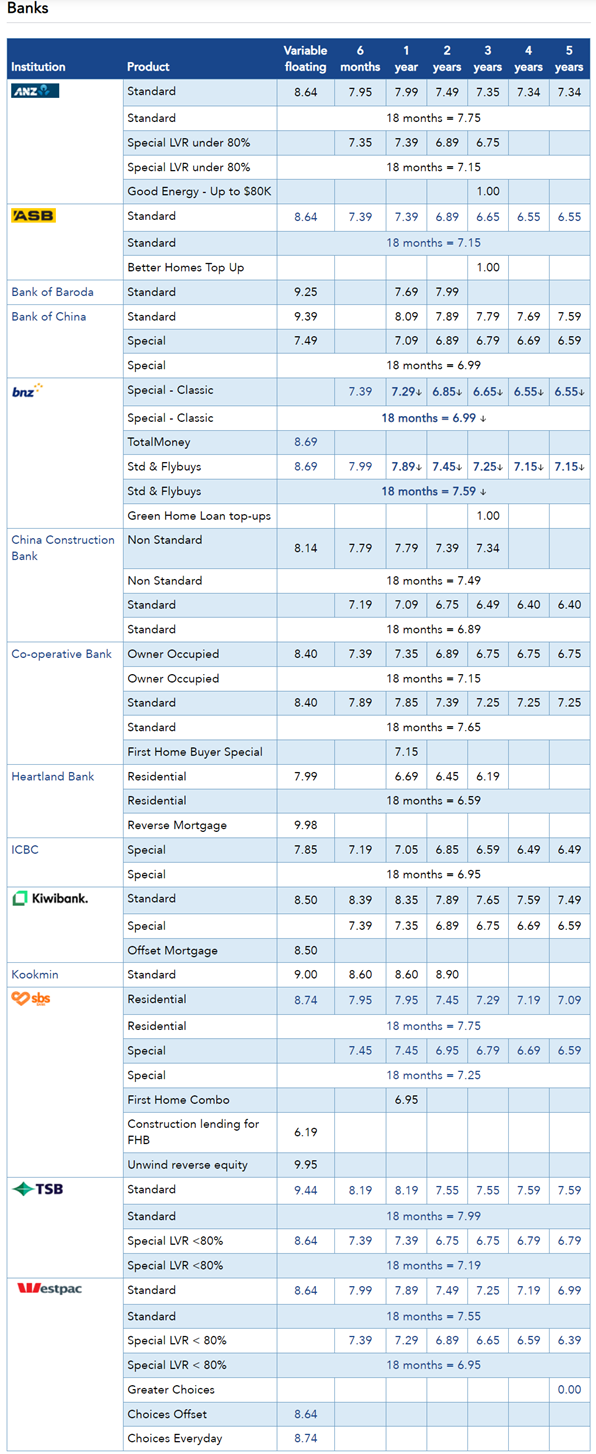
The latest mortgage interest rates offered by banks are listed below: