
More good news for the housing market! Will you be among the biggest beneficiaries of these new rules and policies?
In this article, we take stock of the new rules and policies worth looking forward to.

Recent developments in New Zealand’s housing market have attracted widespread attention. Although some unfavourable trends have emerged, the newly formed coalition government is also set to introduce a range of policies aimed at addressing the unprecedented challenges facing the property market. In this article, we take stock of the new rules and policies worth looking forward to.

The Reserve Bank of New Zealand is considering replacing loan-to-value ratio (LVR) rules, which assess mortgage lending against property values, with debt-to-income (DTI) rules based on buyers’ incomes. The proposed changes are reportedly due to take effect around the middle of this year. They would cap approved debt at six times income for home buyers and seven times income for investors.
CoreLogic chief property economist Kelvin Davidson said the new restrictions could have a greater impact on the housing market once interest rates fall.
However, even if mortgage rules change as outlined above, first-home buyers on low incomes need not worry,because banks can allocate up to 20% of their mortgage lending to borrowers who exceed the limits, such as first-home buyers. There are also exemptions, including for new builds, which will not be subject to DTI restrictions. In theory, this could allow first-home buyers to purchase new homes under slightly more relaxed rules.
Davidson believes first-home buyers still have ways to achieve their home ownership goals, such as increasing their income by taking on part-time work or bringing in boarders. Investors may find it more difficult, however. As they have historically carried higher debt levels, the new DTI rules could have a greater impact on their loan applications.

Under the bright-line test, sellers must pay income tax on profits from selling residential property that is not their own home. National originally introduced the test in October 2015 to curb property speculation. Initially, it applied to properties sold within two years. In March 2018, the Labour government extended the bright-line period to 5 years, then extended it further to 10 years in March 2021, aiming to cool speculation in the housing market and create a level playing field for first-home buyers. After coming to power last year, National pledged to restore the bright-line period to two years to deliver “meaningful income tax relief”.
In numerical terms, close to 60,000 properties could benefit from average tax savings of NZ$55,000 to NZ$65,000 under the policy.
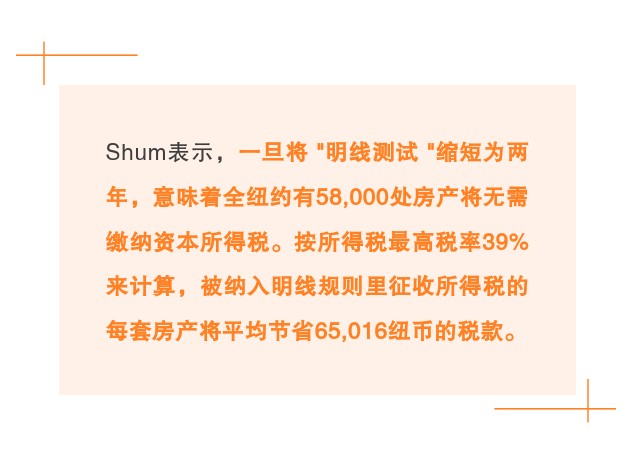
Property data company Valocity conducted a study into how many properties could benefit from shortening the bright-line test period from 10 years to 2 years. Its figures showed that 130,726 existing homes were sold between the beginning of 2019 and the end of 2023. If sold now, they would be subject to the 10-year test. Of these, around 58,000 would benefit from the rule change taking effect on 1 July this year.
 New Finance Minister Nicola Willis
When announcing a mini-Budget in December last year, new Finance Minister Nicola Willis said removing this effective capital gains tax would mean that properties sold after 1 July 2024 would only be taxable if held for less than two years. She also confirmed the Government’s commitment to fully restoring interest deductibility for rental properties.
The study found that more than 98% of properties bought by investors between 2019 and 2020 had increased in value and would be taxable under the current bright-line rules. However, the rapid fall in house prices following the boom had squeezed capital gains on investment properties bought after 2022. Only 31,000 properties had gained in value and would attract income tax if sold now.
Valocity senior research analyst Wayne Shum said the average gain on investment properties purchased nationwide since 2019 was NZ$166,707. Otago had the highest average gain, at NZ$210,695, driven by strong house price growth in Queenstown-Lakes. Nelson had the lowest average gain, at just NZ$102,294. Auckland, a major market for existing home sales, recorded an average gain of NZ$175,170.
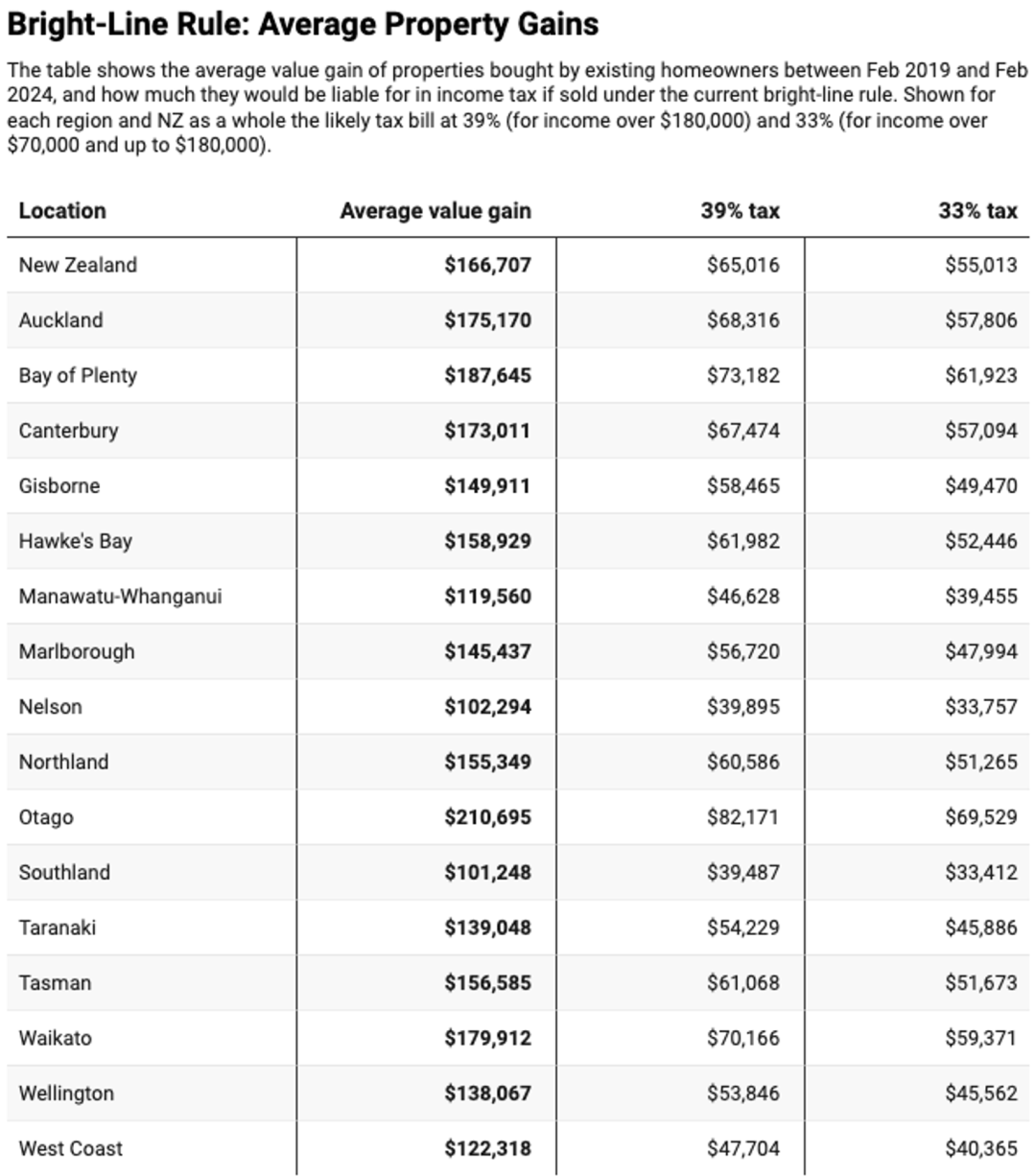 Comparison of average gains and capital gains tax on investment property sales across New Zealand regions (Source: NZ Herald)
Anthony Appleton-Tattersall, director of AAT Accounting Services, said extending the bright-line period to 10 years had “penalised” owners who would otherwise not have had to pay capital gains tax. A tax bill called the Taxation Remedial Matters Bill 2024 is due to be introduced in the coming months。The bill will make a series of small tax changes. He expected the main-home exemption to remain and continue to apply proportionately to homes used both as a main home and as a rental during the bright-line period. This means that if owners rent their home to tenants or leave it vacant for a period, bright-line tax will be apportioned according to the time they lived there.
It remains uncertain whether other exemptions will continue, including for land inherited from family, relationship property settlements and, in some circumstances, property transferred to family trusts. Appleton-Tattersall said investors who bought at the market peak in 2021 were unlikely to be affected by the bright-line rules because only capital gains could be taxed. Most properties bought at the peak had fallen in value and would therefore not attract bright-line tax. The clients most affected were those wanting to restructure their property holdings and transfer ownership to a company or trust.
Consequently, this had little to do with properties actually being sold on the open market, as most property investors wanted to hold their properties for the long term. He noted that fewer than 5% of his clients were considering selling, and those who were still intended to retain some properties and sell only one or two. He said restoring interest deductibility could prompt some to immediately reconsider selling.
Sources: official media and online news