
Official: OCR stays at 5.5%, but the property market is already heating up!
The Reserve Bank believes global economic growth remains below trend and is expected to stay subdued, despite differences between regions.


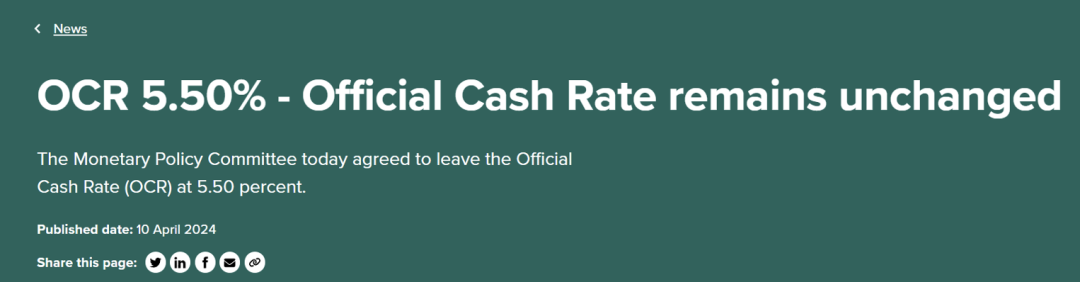
Today (10 April), the Reserve Bank announced it would leave the OCR unchanged at 5.5%.
In its announcement, the Reserve Bank said New Zealand’s economy continued to evolve as the Monetary Policy Committee expected. Inflation remained above the Committee’s target range of 1% to 3%. A restrictive monetary policy stance remained necessary to further reduce capacity pressures and inflation.
It believed global economic growth remained below trend and was expected to stay subdued, despite regional differences. However, with persistent inflation risks, most major central banks remained cautious about easing monetary policy. Economic growth in New Zealand remained weak. Although some short-term price pressures persisted, the Committee was confident that keeping the OCR at a restrictive level for a sustained period would return inflation to the 1% to 3% target range this year.
These comments were consistent with most economists’ earlier forecasts, while reinforcing the Bank’s determination to curb inflation and perhaps signalling that the OCR would remain elevated for some time. But the OCR is never the only factor determining market direction, and this will not dampen property investors’ enthusiasm for entering the market. Recent months’ market performance offers some clues.

According to Barfoot & Thompson’s latest property market report, Auckland recorded strong property sales in March, substantially reducing the stock left unsold during the first two months of the year. Both the median and average sale prices exceeded NZ$1,000,000 in March. The median was NZ$1,050,000, up 8.2% on the previous month and 4.2% above the average for the preceding 3 months. The average sale price was NZ$1,227,000, up 10% on the previous month and 8.9% above the average for the preceding 3 months. Both the median and average sale prices were also above their levels a year earlier.

Barfoot & Thompson Managing Director Peter Thompson said:
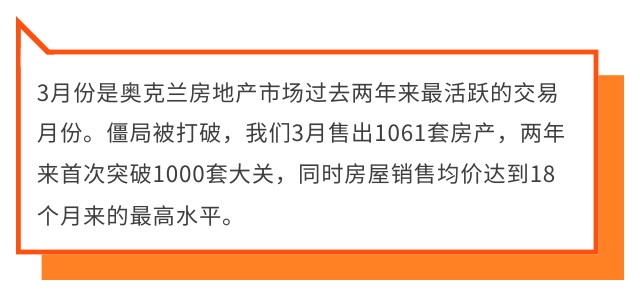
It is worth highlighting that buyers who committed in March considered property good value at current prices and were willing to accept prevailing mortgage interest rates. This suggests market confidence has returned, with the recovery expected to continue throughout autumn.
Meanwhile, new properties continued to enter the market, with 1952 new listings in March. At the end of March, Barfoot & Thompson had 5741 properties on its books. Although an average of 34 homes are currently selling each day, new listings have exceeded sales, meaning Auckland’s selection of homes for sale remains at its largest in more than a decade.
Another feature of March sales was the return of buyers at the upper end of the market. There were 89 homes sold for more than NZ$2,000,000, including 27 above NZ$3,000,000. Sales in the rural and lifestyle property market were consistent with those 12 months earlier. Although this market was less active than metropolitan Auckland, sellers and buyers generally felt more confident.
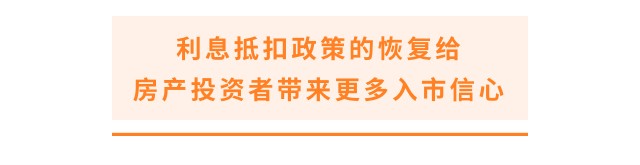

Interest deductibility was reinstated this month, undoubtedly providing a lifeline for the property investment market. This tax year, 80% of interest can be deducted from income, increasing to 100% next year.
Many frontline real estate agents believe the policy will encourage more investment property purchases and sales. In addition, because investors can deduct interest from income, persistently high borrowing costs will have less impact on their cash flow. This could increase sales volumes and prices for some types of homes. Investors will be better able to afford investment properties, and many will be encouraged to retain those they already own, providing some support for housing prices.

ASB economists previously said there was little indication of when the Reserve Bank of New Zealand would begin cutting the OCR. However, they expected cuts to start in November, earlier than the Reserve Bank forecast. Their reasoning was that recent economic data had been mixed and had done little to change the inflation outlook. Near-term inflation in the first quarter appeared likely to be slightly higher than the Bank expected, while economic conditions were likely to remain weak. By November, however, the Reserve Bank would have third-quarter inflation and labour market data, which would be crucial in determining whether inflation was sufficiently under control.
ANZ said it would continue to monitor the Reserve Bank’s discussion of near-term inflation risks and any changes to the monetary policy outlook. Its expectations were very close to the position stated in February: interest rates needed to remain restrictive for some time.

Sydney-based UBS economists said rising loan arrears showed more people were experiencing financial difficulty meeting repayments, which would force the Reserve Bank to cut interest rates in August. They believed the Bank had passed the peak of the OCR tightening cycle. However, it now faced the task of balancing persistently high domestic inflation against clear signs of spreading financial stress. If mortgage arrears continued to worsen, the Bank would shift towards more dovish action by its May Financial Stability Review.
Infometrics Chief Forecaster Gareth Kiernan said that since the last monetary policy review, swap rates had fallen back towards levels seen between mid-December and early February, meaning financial markets were again pricing in faster interest rate cuts than the Reserve Bank of New Zealand. Meanwhile, Stats NZ’s selected price indexes for February suggested there might be more residual inflation in the system than previously thought. He therefore expected the Bank to be more concerned about domestic inflation risks now than it had been in February.
The Reserve Bank’s decisions are only part of the broader picture. In the coming months, we will see further changes affecting property and construction, including the introduction of DTI policy, changes to policies on overseas building materials, and further effects from tighter immigration settings. Each policy will influence market activity and direction to some degree.
In today’s complex market, we recommend consulting a professional Barfoot & Thompson real estate agent before buying or selling property.
Barfoot & Thompson is the real estate agency that knows Auckland best
Barfoot & Thompson accounts for 1/3 of Auckland’s home sales,
far ahead of every other real estate agency.
