
Latest: lending reforms announced! Commerce Minister promises to protect borrowers from loan sharks and crack down on “bad actors”
Last Sunday, Commerce and Consumer Affairs Minister Andrew Bayly and Housing Minister Chris Bishop jointly announced the latest details of lending reforms.

Commerce and Consumer Affairs Minister Andrew Bayly and Housing Minister Chris Bishop jointly announce details of lending reforms
Last Sunday, Commerce and Consumer Affairs Minister Andrew Bayly and Housing Minister Chris Bishop jointly announced the latest details of lending reforms. The Government hopes the changes will make it easier for applicants to access home loans and other credit while strengthening borrower protections.
Bayly and Bishop said the affordability regulations introduced by the previous government in December 2021 under the Credit Contracts and Consumer Finance Act 2003 (CCCFA) had created unnecessary compliance costs and excessively high barriers to borrowing. Overly cumbersome checks had significantly increased the time needed to process home loans, making things harder for people trying to enter the property market. People were even struggling to borrow NZ$500 to repair their cars, leaving them forced to turn to loan sharks. The new Government will repeal the previous government’s 11 pages of overly prescriptive affordability regulations so New Zealanders can access finance with confidence.
The Government said these affordability assessment requirements are expected to be removed in the coming months. Redundant COVID exemptions in the CCCFA will also be removed. Once this work is complete, the Responsible Lending Code will be updated for lenders.

For borrowers, the most immediate impact concerns exemptions. From 25 April, local authorities will receive an exemption from the CCCFA so they can administer voluntary targeted rates schemes, such as loans for insulation or heat pump installation, without unnecessary compliance costs. Meanwhile, entities whose main business involves non-financial goods and services, such as certain car dealers, will be fully exempt from the CCCFA’s duplicate reporting requirements. Earlier this year, Bayly announced that oversight of the CCCFA would move from the Commerce Commission to the Financial Markets Authority, better aligning with the existing roles and responsibilities of financial services regulators.

The second phase of the reforms includes:
-
Streamlining three pieces of legislation: the CCCFA, the Financial Markets (Conduct of Institutions) Amendment Act 2022, and the Financial Service Providers (Registration and Dispute Resolution) Act 2008. Public consultation on these reforms will begin in the coming weeks.
-
Reviewing the CCCFA, including liability settings, disclosure obligations and high-cost credit provisions.
-
Improving the effectiveness of the financial dispute resolution system
-
Making amendments to support the transfer of responsibility for the CCCFA from the Commerce Commission to the FMA.
-
Clarifying the requirements of the financial institutions conduct regime and reviewing the conduct licensing framework in the Financial Markets Conduct Act to ensure it is balanced and flexible.

Removing affordability checks could have some interesting ripple effects across the banking sector. According to the Commerce Commission’s retail banking market study report released last month, affordability assessments may be one reason for the lack of competition in banking。The Commission said consumers who might otherwise consider switching banks at the end of their home loan terms could be deterred by a new affordability assessment. Those involved have been advising the Government to consider amending the CCCFA to ensure competitive neutrality between existing home loan providers and potential alternative providers when consumers refinance.

Financial adviser Kylie Connor welcomes the lending reforms
Speaking on AM yesterday, financial adviser Kylie Connor described the changes as “significant”, saying they would open the door for people on the margins who had previously been ineligible for loans. Loan applications would become more workable, making a huge difference to many New Zealanders hoping to get onto or move up the property ladder, or even change their existing loans.

Following Sunday’s announcement, Labour’s commerce and consumer affairs spokesperson Arena Williams warned that the policy change would reduce protection against high-interest lending. One reason the CCCFA was introduced was to stamp out loan shark lending.

Commerce and Consumer Affairs Minister Andrew Bayly
On this morning’s interview programme, Commerce and Consumer Affairs Minister Andrew Bayly addressed the issue directly. He had been concerned that people seeking small loans could not pass the current series of very strict tests. “The very people we want to protect are having to turn to loan sharks.” There is growing concern that tighter lending regulations could put vulnerable people at risk. He said lenders would need to meet minimum requirements to ensure they did not put anyone into financial hardship. “We will strengthen dispute resolution mechanisms, seek to drive bad actors out of the market and give financial institutions more discretion so that more longstanding customers can benefit.”
Are the lending reforms ultimately good or bad for ordinary borrowers? We have invited York Zhang, General Manager of Huarong Credit and a senior mortgage adviser, to explain.

York Zhang
General Manager of Huarong Credit and senior mortgage adviser

York Zhang:The Government’s recently proposed lending reforms aim to simplify the process of obtaining home loans and reduce unnecessary compliance costs. They will have a significant impact on both first-home buyers and investors, although the specific effects will differ slightly between these groups:
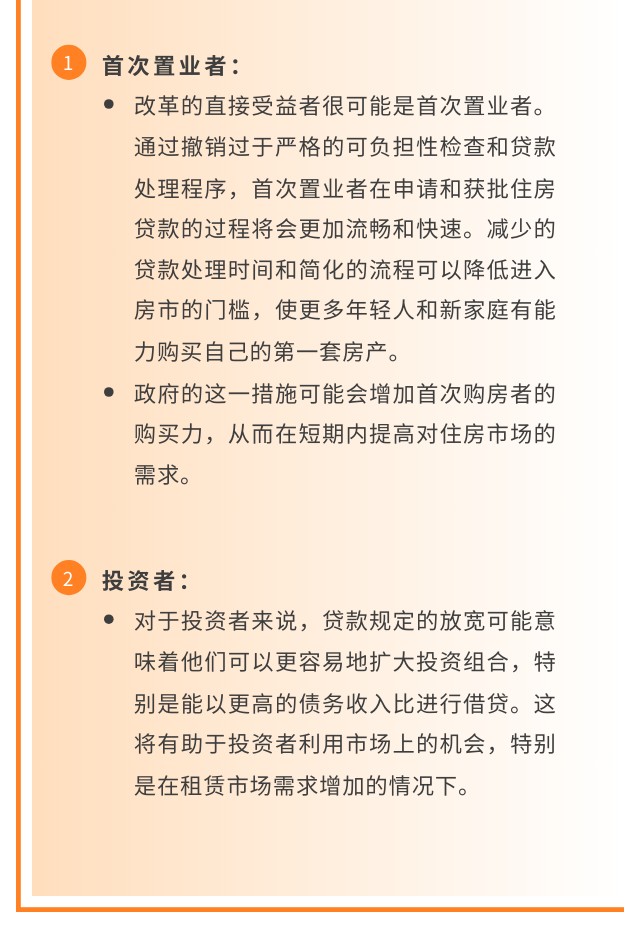
The reforms will also have some ripple effects, such as encouraging home sales, as investors and first-home buyers may become more active.
In the short term, easing lending rules could stimulate housing market activity, particularly among first-home buyers and investors. This could lead to a short-term rise in house prices. However, the long-term impact will depend on whether new supply enters the market to meet growing demand, and whether the Government intervenes further to regulate the market, for example by increasing the supply of affordable housing.